Description
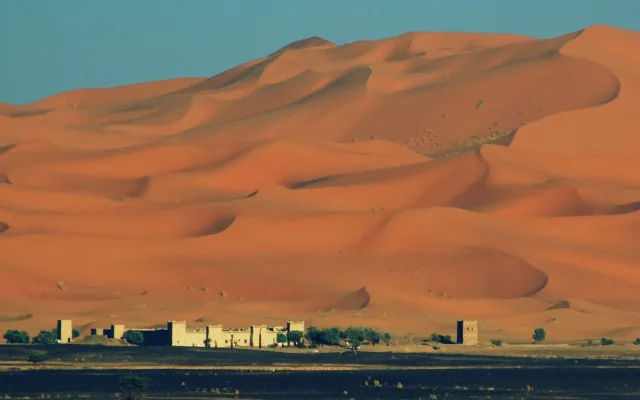
The gateway to the Sahara — the great dunes of Erg Chebbi, a night in a desert camp and sunrise from a crest.
Wiki
Merzouga is a tiny village on the very edge of the Erg Chebbi dunes, and people cross half the country to reach it. This is where the tarmac ends and the real Sahara begins, and the whole point of the trip comes down to one night in the sand and one sunrise from the top of a dune.
Is it worth it, and for how long
Two days with an overnight is enough to take in the desert without rushing: arrive during the day, head into the dunes towards evening, spend the night at a camp, catch the sunrise, and drive back in the morning. Staying longer only makes sense for deeper trips by jeep, or if you simply want to sit in the silence.
Honestly, about the main thing: the camel tour and the camp are a conveyor belt, with dozens of caravans heading into the dunes at once. But Erg Chebbi itself overrides any amount of touristiness. Dunes up to 150 metres, clean orange sand, complete silence at night and a sky with no light pollution — that is not "atmosphere" but a specific experience nothing else in Morocco offers.
Getting there
Merzouga is at the edge of the country, and there is no fast way here.
- On a tour. The commonest option is the standard three-day route from Marrakesh or Fez. Merzouga is the final point, with Ait Benhaddou and the Todra gorge shown along the way. Convenient, but the pace is imposed on you.
- Independently. Minibuses and coaches (Supratours and CTM, for instance) run via Erfoud and Rissani, the transport hubs of the region. Rissani to Merzouga is the last short leg, often on local transport or a hotel transfer.
- By hire car. The best option for freedom: the road to the edge of the dunes is paved and there is parking at the hotels. You do not drive on the sand itself, of course — beyond that it is a camel or a four-wheel drive with a driver.
An important detail: almost all guesthouses and camps arrange a free or cheap transfer from Rissani or Erfoud if you book a night. Write ahead — it takes the headache out of the last leg.
A night in the desert: choosing a camp
The key decision of the trip. The options:
- A basic Bedouin camp (haima). A tent of camel wool, mattresses, a shared tagine dinner, minimal facilities. Authentic and cheap.
- A comfortable camp. Separate tents with proper beds, a toilet and a shower — reckon on 860-1,610 dirhams ($90-175) a night. The difference is not about showing off but about whether you sleep before the sunrise.
What to look at when choosing: how far into the dunes the camp stands (the deeper, the quieter and the darker the sky) and whether the camel ride is included. The ride itself takes one to two hours each way, and people normally set out at sunset to catch the colour on the sand.
A practical point: bring warm clothes. Even in the warm season the desert cools sharply at night, and you meet the sunrise on a windy crest. A headscarf saves you from the sun and the sand, and locals will happily show you how to tie one.
Around the dunes
Besides the overnight, Merzouga has a daytime programme, useful if you came under your own steam and have hours to spare.
- The village of Khamlia — descendants of migrants from the Sahel, and live Gnawa music. Short concerts happen almost daily, usually for a modest donation.
- Lake Dayet Srji — seasonal, filling after rain, when flamingos arrive. In a dry year it is simply a salt flat, so do not expect much.
- Buggies and quad bikes — the starting point is by the village of Mifis. A fast way into the sand without a camel.
- Fossils. The region is known for trilobites and ammonites, and the shops are full of them. Be careful: fakes and "improved" stones are everywhere and real value cannot be judged by eye — buy as a souvenir, not as an investment.
Money, food and bargaining
The cooking is simple Berber: tagine (chicken with lemon, vegetables, kefta), couscous on Fridays, harira, and a great deal of mint tea. At the camps dinner and breakfast are normally included in the price, so there is no point eating separately.
Merzouga feels dearer than the Moroccan average: the place is touristy and remote, and supplies are brought from far off. Bargaining works everywhere, though — on camel tours, souvenirs and excursions. Halve the first price you are quoted.
Where to save:
- book the camp directly with the guesthouse rather than through an intermediary in Marrakesh;
- getting to Rissani independently is noticeably cheaper than buying the whole trip as a package;
- eat in the village itself and not only at your hotel.
Common mistakes
- Chasing "wild" solitude in high season — there are hundreds of people in the dunes at once. Solitude comes not from an absence of crowds but from how deep into the sand you go at night.
- Coming for a day without staying over. The whole point is the stars and the sunrise; the daytime Sahara in the heat is exhausting and disappointing.
- Underestimating the drive. It is a full day to Merzouga from Marrakesh or Fez. Do not plan anything important for that evening.
- Paying serious money for "ancient" fossils — it is almost always an overpayment.