Города и дороги
Description
The spiritual capital of Armenia, 20 kilometres west of Yerevan: the mother cathedral of Etchmiadzin, the seventh-century churches of St Hripsime and St Gayane, and the ruins of Zvartnots under Ararat.
Wiki
Vagharshapat stands on the Ararat plain 20 kilometres west of Yerevan and has a population of about forty-six thousand. King Vagharsh I gave it its name in the second century, but the world knows it by another one — Etchmiadzin, after the mother cathedral of the Armenian Apostolic Church. In the third and fourth centuries this was the capital of Greater Armenia, and according to tradition it was here that Gregory the Illuminator moved the centre of the church after the country's conversion. Etchmiadzin has been the seat of the Catholicos of All Armenians ever since, which makes it the spiritual capital and the single reason people come: the town itself is small and largely built of Soviet apartment blocks, with everything of importance packed into a few blocks and one site on the approach road.
Why come and what to actually see
Church tradition dates the founding of the cathedral to 301–303, immediately after Christianity became the state religion, and it is described as the oldest cathedral in the world. The present building is the product of many rebuildings: the cross-domed core is assigned to the fifth century, the bell tower was added in the seventeenth, the rotundas over the side chapels in the eighteenth. The cathedral spent six years closed for major restoration and reopened in the autumn of 2024; the work covered both the structure and the eighteenth-century paintings made by Armenian masters from Persia.
Next to it stands the treasury, which holds the relics: the lance said to have pierced Christ, a fragment of Noah's Ark, relics of the apostles. It is a separate museum with a separate ticket, and it matters more than the description suggests — vestments, crosses and manuscripts are gathered here too.
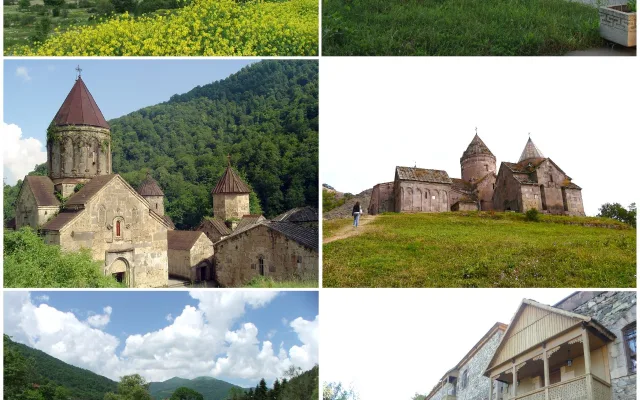
The church of St Hripsime, built in 618, is the most accomplished of the seventh-century Armenian domed churches and the model that was copied for centuries afterwards. Outside it is austere to the point of severity; the whole effect is inside, in the play of volumes. St Gayane of 630 stands to the south and is arranged differently, with a three-aisled hall. Both, together with Shoghakat from the late seventeenth century and the cathedral, are on the UNESCO list.
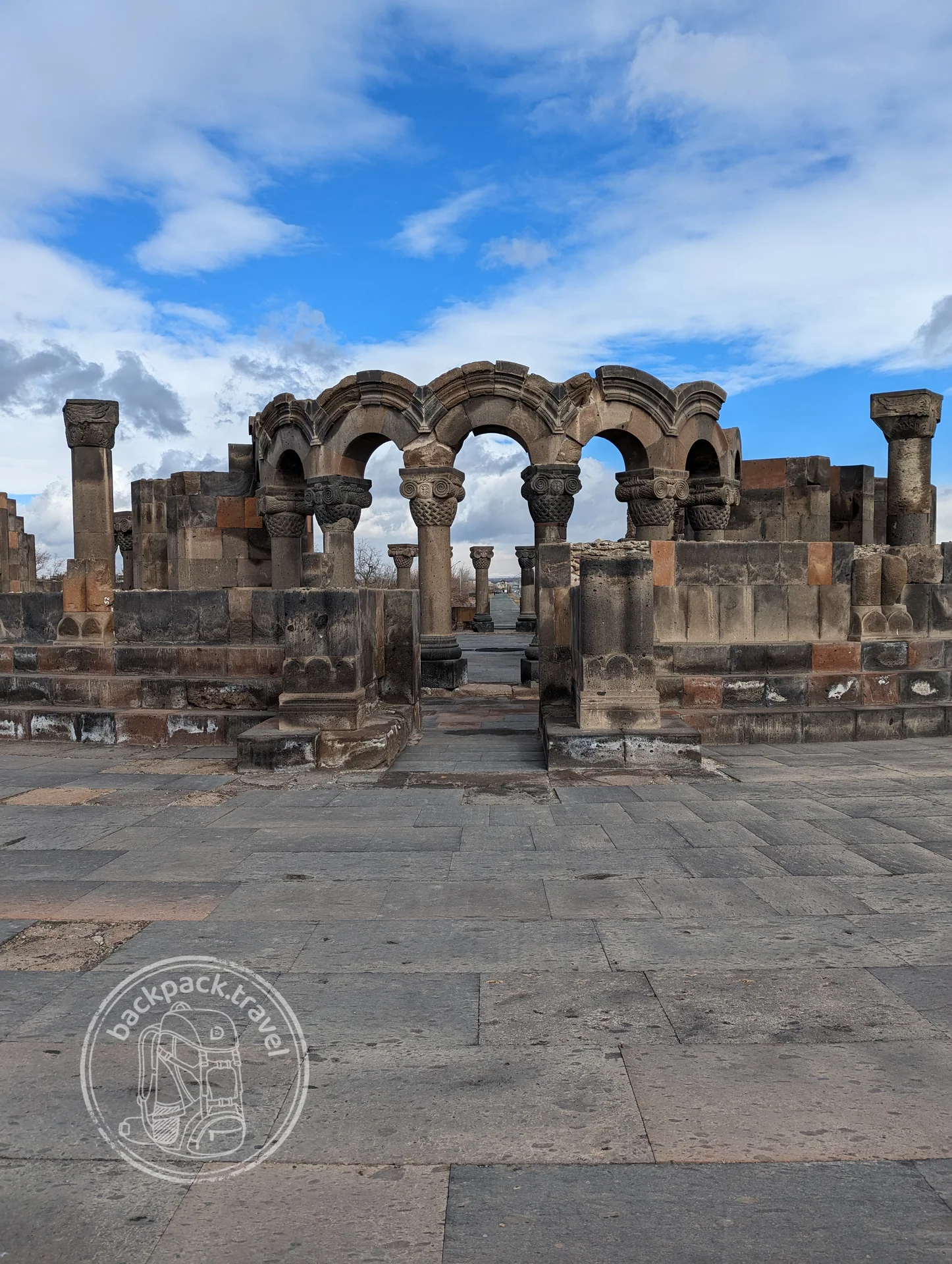
Zvartnots lies five kilometres away in the direction of Yerevan. The round, three-tiered church was built between 641 and 653 under Catholicos Nerses III and most likely came down in an earthquake in the tenth century. The ruins were excavated in the early twentieth century, and what stands now is a field of capitals carved with eagles, columns and foundations, with one section reassembled. Against Mount Ararat on a clear day it is a strong sight.
Getting there and getting around
The easiest approach is from Yerevan: marshrutkas leave from the Barekamutyun metro station and from the bus station, and the trip takes between thirty and forty minutes. A taxi is cheap and makes sense if you want to stop at Zvartnots on the way.
Zvartnots airport sits exactly between Yerevan and Vagharshapat, 10 kilometres from town, so arriving here straight from the airport is no trouble either.
Inside town everything is walkable: about a kilometre from the cathedral to Hripsime, slightly less to Gayane. The one exception is the ruins of Zvartnots, which need a car or a marshrutka heading towards Yerevan.
Where to stay
There are few hotels in Vagharshapat, and most visitors sleep in Yerevan: the capital is half an hour away and the choice there is incomparably wider. Staying the night makes sense on major feast days, when pilgrims fill the town and the road is jammed.
A handful of small guesthouses operate near the cathedral, simple and family-run. There are also pilgrim houses attached to the church centre, but they are set up for organised groups.
Day trips
Vagharshapat fits into half a day and is almost always combined with something else. Zvartnots is on the same road, and beyond it Yerevan with all its museums.
South, towards Ararat, is Khor Virap monastery with the pit where Gregory the Illuminator was held for thirteen years by tradition; it also offers the best view of the mountain. It is about 50 kilometres away.
The road west leads to Metsamor fortress and the Bronze Age settlement of the same name, with its observatory. To the north lies Ashtarak, with churches of the fifth to seventh centuries and the Kasagh gorge.
When to come
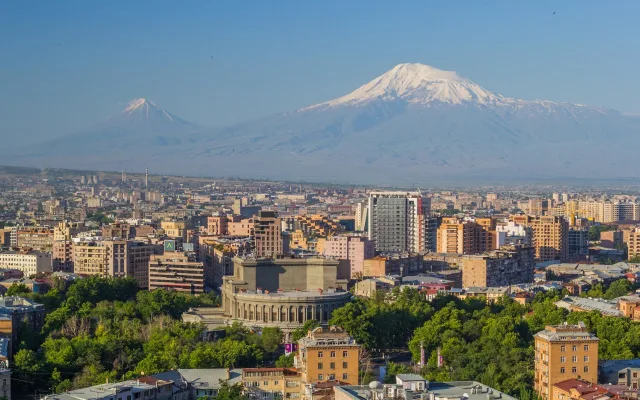
April, May, September and October are the most comfortable months: the plain is warm without being punishing, and on clear days Ararat is visible, which is a large part of why people come. In summer the Ararat plain holds above thirty-five degrees, and it is sensible to start early.
Winter is cold, around freezing and below, but the churches are open and there are almost no tourists. Church feasts are a separate matter: at Easter and at the blessing of the holy myrrh, held once every seven years, the town fills up and getting inside the cathedral becomes difficult.
Food and money
There is no distinct local cuisine here, only Armenian cooking in general: khorovats, tolma, lavash from the tonir, local cheeses and herbs. Simple cafes around the cathedral cater to pilgrims, and the market sells dried fruit and gata.
Armenian prices are noticeably below tourist-level Yerevan. Cards are accepted in hotels and larger cafes, but cash drams are needed at the market, on the marshrutkas and in small shops; there are exchange offices in the centre.
What to know
The cathedral is a working church and remains the residence of the Catholicos, so access is limited during services and flash photography is not allowed inside. Cover up; a headscarf is preferred for women, though it is not strictly required.
The town itself is not built for strolling: ordinary residential blocks with nothing to look at fill the space between the churches, and there is no historic centre to look for. Everything worth the trip stands inside the church precinct and at Zvartnots.
Distances are short, but the summer sun on the plain is harsh and there is no shade at all at Zvartnots — take water and a hat.
Updated