Description
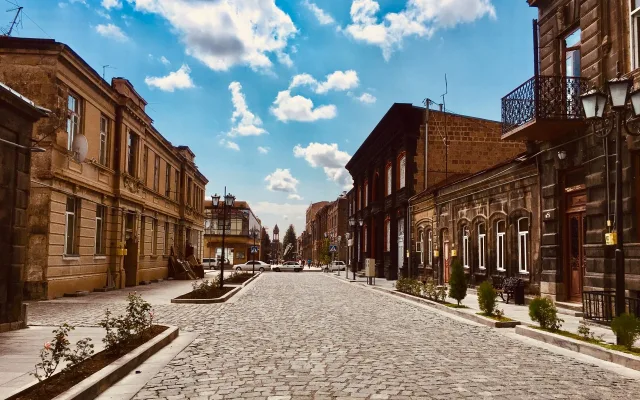
Gyumri is Armenia's second city, known for its rich history, 19th-century architecture and craft workshops.
Wiki
Gyumri is the second-largest city in Armenia and the unofficial capital of the country's humour, its crafts and its working-class life. People come here for the genuine provincial spirit of old Alexandropol: quarters of 19th-century black tuff, home-run eating houses and an unhurried rhythm that the capital has lost.
Is it worth going, and for how long
One day is enough to walk the historic core and see a couple of museums — the old centre is compact and entirely walkable. The easiest approach is a day trip from Yerevan: leave in the morning, return in the evening. But if you want to catch the atmosphere without the tourist rush, stay the night — the old town in the evening, without the tour groups, makes a far stronger impression.
Keep the context in mind: the city lived through the devastating Spitak earthquake of 1988, which officially killed around 25,000 people in the region, with some estimates running twice as high, and the traces of that are still legible here, in the memorials and in the character of the people.
What is actually worth seeing
- The Kumayri old town — the main reason to come. Around a thousand 19th-century monuments in black and red tuff, concentrated along Rustaveli and Abovyan streets. This is not a museum but a living quarter: walk without a plan and look at the carved window frames, the courtyards, the wrought-iron balconies.
- Vardanants Square — the formal centre, with two churches: Surb Astvatsatsin (the Seven Wounds of the Mother of God) and Surb Amenaprkich (the Holy Saviour). A good place to start a walk.
- The Dzitoghtsyan House Museum — the best way to understand how the well-off citizens of old Alexandropol lived. Ethnography and city history in an authentic mansion.
- The Black Fortress (Sev Berd) — a Russian fortification of the 1830s, now holding a restored concert hall. It stands on high ground, with views over the city.
- The earthquake memorial — a chapel and a memorial walk commemorating 7 December 1988. A place that explains a great deal about Gyumri.
- The Avetik Isahakyan House Museum — for anyone interested in Armenian poetry and literary life.
A tip: allow plenty of time for aimless wandering through Kumayri, and pick one or two museums at most — otherwise the day turns into a checklist.
Getting there and getting around
From Yerevan (about 120 km) there are two options. The minibus is faster and more frequent, roughly two hours, leaving from the Yerevan bus stations. The train is slower, three to four hours, but cheaper and more scenic — a good choice if you would rather take the journey slowly than be packed into a minibus. There is also Shirak International Airport (LWN), with a modest number of regional flights.
Inside the city you do not need a car — everything of note is within walking distance. For outlying points or the station, use Yandex Go: rides across town cost next to nothing. Minibuses run, but working out the routes for a single day is not worth the effort.
Where to stay
Stay in the old town or near Vardanants Square — then the whole route is at your feet and the centre is a short walk away in the evening. Guest houses in historic tuff mansions are popular in Gyumri: cheaper than hotels and with far more atmosphere.
Food and prices
Gyumri is noticeably cheaper than Yerevan. The cooking is Armenian with a Shirak accent: khash (traditionally eaten on winter weekend mornings, heavy and not for the faint-hearted), harissa, tolma, basturma and local apricot jam. Lunch in a café is 2,000-3,500 dram (about $5-10), a full restaurant dinner 5,000-9,000 dram ($14-25), and a taxi across town 600-1,000 dram ($1.50-3). Prices are as of 2026. Look past the tourist places on the square and find the family-run eating houses in the side streets — the food there is more honest and better.
Armenian brandy is a local subject in its own right: a glass costs very little, but it is meant to be drunk thoughtfully rather than knocked back.
Practicalities and common mistakes
- Do not come in the shoulder seasons without warm clothes. Gyumri sits high, and winter here is noticeably colder and windier than in Yerevan, with a shorter summer. Late spring to early autumn is the most comfortable.
- Do not try to combine Gyumri with the monasteries of Shirak in a single day without your own car — public transport will not get you round in time, so concentrate on the city itself.
- Carry cash: small cafés and craftspeople may not take cards.
- Do not expect polish. Parts of the city still look poor and battered — this is not neglect staged for visitors but real life, and half of Gyumri's charm is in it.
Safety is not a concern: the city is calm, travellers are treated warmly, and local hospitality here is not a figure of speech.