Description
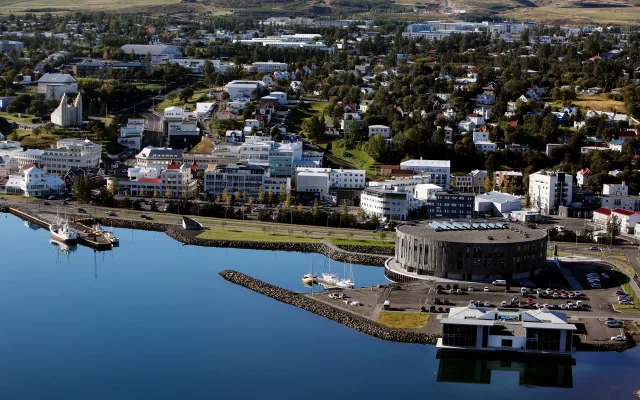
Akureyri — Iceland's "Capital of the North," a base for exploring Eyjafjörður fjord, the Goðafoss waterfall, and the Hlíðarfjall ski resort.
Wiki
Akureyri is a compact northern city on the shore of Eyjafjörður, which locals call the "Capital of the North." For independent travellers it's an ideal base: the city itself can be covered in a couple of hours, while everything interesting — waterfalls, whales, geothermal lagoons — is scattered around the region and conveniently reached from here.
Is it worth the trip?
Akureyri is not worth visiting for the city alone — it has 19,000 residents, a waterfront, a couple of streets with cafés, and a church on a hill. Its real value lies elsewhere: it's the only major hub in northern Iceland, with an airport, shops, petrol stations, and accommodation. All day trips along the northern route start from here, and getting around the north without stopping here is difficult. Allow 2 days: half a day for the city itself, a day and a half for the surroundings.
What to see in the city
- Akureyrarkirkja — a Lutheran church on a hill, designed by the same architect, Guðjón Samúelsson, as Hallgrímskirkja in Reykjavík. Going inside is optional, but the church offers a view over the fjord.
- Lystigarðurinn Botanical Garden — one of the world's northernmost botanical gardens. Free entry and pleasant in summer when everything blooms under the midnight sun.
- The waterfront and city centre — compact and walkable in an hour or so. Pop into the local coffee shops: the coffee culture here is surprisingly well developed.
One local detail worth knowing: traffic lights in the city show a heart-shaped red light — a small local quirk introduced after the 2008 financial crisis as a symbol of solidarity.
The surroundings — the real reason to come
- Goðafoss ("Waterfall of the Gods") — roughly 40 km along the Ring Road toward Mývatn. One of the most photogenic waterfalls in Iceland, horseshoe-shaped, with paths down to the water on both banks. Allow 30–40 minutes as a stop en route.
- Mývatn — a lake in volcanic landscapes about 90 km away, with geothermal bathing at the Mývatn Nature Baths. A quieter and cheaper alternative to the Blue Lagoon in the south. Nearby are the Hverfjall crater and the boiling mud pots of Hverir.
- Húsavík — a small town about 90 minutes' drive away, considered Iceland's best spot for whale watching. Tours run in summer; chances of seeing humpbacks are high.
- Hlíðarfjall — a ski resort right above the city, open in winter. Worth noting for backpackers travelling in the cold season.
Getting there and around
- From Reykjavík: a domestic flight (Icelandair, ~45 minutes) into Akureyri Airport (AEY) is fast but pricier. Driving the Ring Road (Route 1) is cheaper and more flexible — about 5 hours and 380 km. Intercity buses exist but tie you to a schedule.
- Airport to the centre: the airport is almost within the city limits; the journey takes a few minutes and taxis are inexpensive.
- Around the city: on foot. Free city buses also run.
- Around the region: realistically only by car. There is essentially no public transport to Goðafoss, Mývatn, or Húsavík. In summer a regular car is fine on the ring route; unpaved roads and mountain tracks (F-roads) require four-wheel drive. Fill up in advance — there are few petrol stations between attractions.
Money and how to save
Iceland is expensive, and the north is no exception. A café lunch easily runs 3,500–5,000 ISK (about $29–40), dinner at a restaurant 7,000–11,500 ISK ($58–92), and a coffee around 700 ISK ($6). Prices are as of 2026. Ways to cut costs:
- Shop at Bónus and Krónan supermarkets — self-cater if your accommodation has a kitchen.
- Tap water is excellent; there's no need to buy bottled water.
- Alcohol is sold only at state-run Vínbúðin stores and is very expensive; bars charge even more.
- Book accommodation early: options in Akureyri are limited and fill up fast in summer.
Local food to try: fish soup, skyr (a thick fermented dairy product), and fresh trout or salmon from the fjord.
When to go
- Summer (June–August): midnight sun, whale watching, hiking, all roads open, 10–17 °C. Peak season and peak prices.
- Winter (November–March): northern lights, skiing at Hlíðarfjall, 0 to −10 °C. Some roads to outlying areas may be closed or dangerous.
- September and March — a compromise: the northern lights are already (or still) visible, and roads are generally passable.
Common mistakes
- Arriving without a car and expecting to see the surroundings — it won't work.
- Underestimating the weather: it changes rapidly even in summer, so bring wind- and waterproof layers.
- Planning winter excursions without checking road conditions on road.is — sections are closed during blizzards.
- Expecting a "city experience" — Akureyri is valuable as a convenient base, not as a destination in itself.