Description
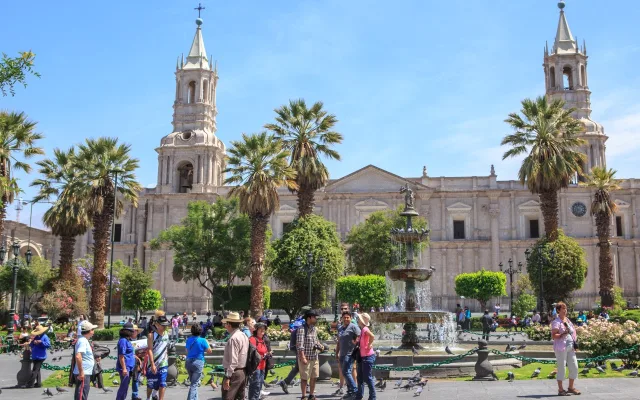
White city of volcanic sillar at the foot of El Misti — gateway to Colca Canyon with condors, and home to the Juanita mummy at the local museum.
Wiki
Arequipa is Peru's second-largest city and the administrative capital of the department of the same name in the south of the country, sitting at roughly 2,350 metres in the Andean foothills. It is known as the "White City" (La Ciudad Blanca) for the pale volcanic stone from which its historic quarters are built, and for the particular luminosity of its architecture under the bright southern sun.
History and general character
The Spanish founded Arequipa in 1540, though the valley had been settled long before the conquest — home to communities linked to the Inca Empire and earlier Andean cultures. The colonial centre grew up around the main square and its monasteries, built from sillar, a compressed volcanic tuff of white and pinkish hue that cuts easily and holds carved detail well. As a result, cathedral and mansion façades are richly ornamented in the mestizo baroque style, which fuses European motifs with Andean imagery — suns, pumas, local plants. The historic centre is a UNESCO World Heritage Site. The city has suffered repeated earthquakes, so many buildings have been rebuilt over the centuries, yet they retain their characteristic thick walls and low proportions.
Arequipans have long prized a distinct local identity and independent spirit — the joke about the "Republic of Arequipa" and its own passport still circulates. The city is a major university, commercial and industrial hub for southern Peru.
What to see
- Plaza de Armas — the grand central square with a fountain, framed by two-tiered arcaded walkways and the Cathedral, which occupies the entire length of one side — an arrangement rare in Latin America.
- Santa Catalina Monastery — a vast 16th-century convent arranged as a self-contained neighbourhood of narrow lanes, courtyards, cells and chapels painted in deep ochre and blue.
- Museum of Andean Sanctuaries (Santuario) at the Catholic University — home to "Juanita," the mummy of an Inca girl sacrificed on the summit of Ampato volcano and preserved in ice for around five centuries.
- Church and cloister of La Compañía — a Jesuit complex with an exceptionally ornate carved sillar portal.
- Yanahuara and Carmen Alto viewpoints — neighbourhoods of white stone arches with views across to El Misti volcano. The perfect cone of Misti, at 5,822 m, dominates the skyline; nearby rise Chachani and Pichu Pichu.
- San Camilo Market — a covered market hall with fruit, cheeses, fresh juices and local food stalls.
Surroundings and Colca Canyon
The main excursion from the city is Colca Canyon, roughly four to five hours to the north. It is one of the deepest gorges on the planet; from the Cruz del Cóndor viewpoint, visitors watch Andean condors soaring on thermal updrafts in the morning hours. Along the route lie terraced fields still farmed since pre-Columbian times, the villages of Chivay and Yanque with their thermal springs, a high-altitude plateau with vicuñas, and a pass above 4,800 metres. Multi-day hikes down to the canyon floor are also popular.
Food and drink
Arequipa's cuisine is considered one of the most distinctive in Peru, centred on the picanterías — traditional local eateries. Dishes to try include rocoto relleno (a large hot pepper stuffed with minced meat and cheese), adobo (pork slow-cooked in chicha, a fermented maize drink — a hearty Sunday breakfast), ocopa with its fragrant yellow sauce, chupe de camarones (a thick river-prawn soup), and the sweet queso helado. To drink: pisco sour made from local grape brandy, and herbal infusions.
Practical information
Alfredo Rodríguez Ballón Airport (AQP) connects Arequipa with Lima (about one and a half hours by air) and other Peruvian cities. Long-distance buses run to Cusco, Puno and the coast; the journey from Cusco takes around ten hours. Within the city, taxis and ride-hailing apps are the most convenient option.
The dry season runs roughly from April to November: days are warm, around 18–22 °C, with cool nights at altitude. May to September is the best window for trekking in Colca. In the rainy season (December–March) mountain roads can be difficult. Because of the altitude, plan to spend the first day or two acclimatising — drink plenty of water and avoid overexertion, especially before heading up to the canyon.
Allow a couple of days to explore the city itself, plus one or two more for a trip to Colca.