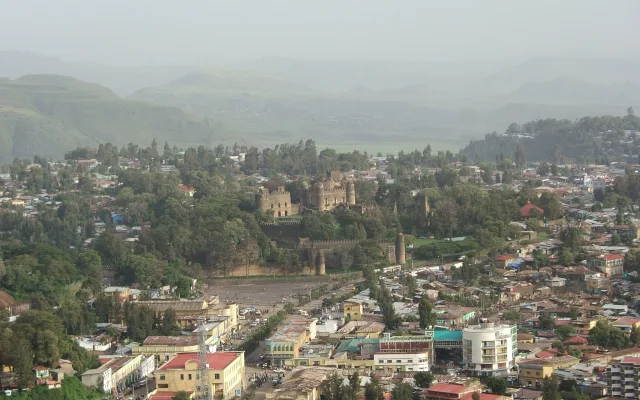
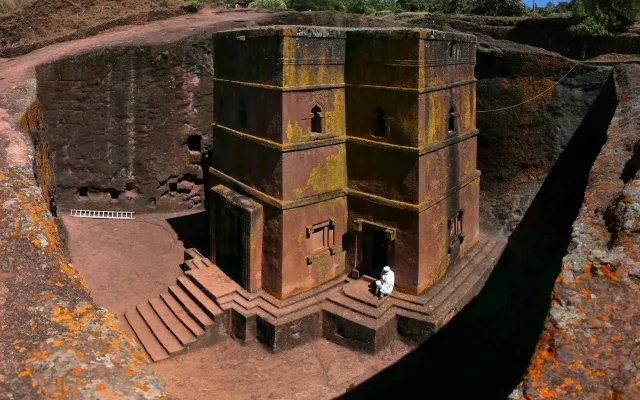
Description
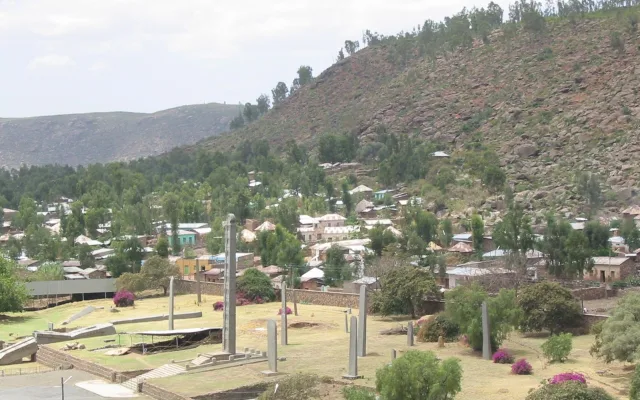
The ancient capital of the Aksumite kingdom — the UNESCO-listed stelae, the church of Mary of Zion and the supposed resting place of the Ark.
Wiki
Axum is a small town in northern Ethiopia where the depth of African antiquity is genuinely palpable: one of the great empires of the ancient world stood here, trading with Rome and India. For the independent traveller it is a concentrated dose of history and living Christianity — compact, coverable in a couple of days, but with an important caveat about the security of the region.
Is it worth coming, and for how long
Two days is enough to see everything without hurrying. The sites are scattered across the town and its edges, but the distances are short and Axum itself is small — the centre is walkable, and a bajaj takes you to the outlying points.
A realistic plan:
- Day 1 — the Stelae Field, the museum on the site, the church of Mary of Zion and the chapel of the supposed Ark, and the neighbouring royal tombs.
- Day 2 — the outskirts: the tombs of Kaleb and Gebre Meskel, the Dungur palace (the "Queen of Sheba's palace"), the Queen of Sheba's bath, and the inscribed stones.
You need more than two days only if you are continuing along the northern historical circuit (Gondar, Lalibela) and using Axum as a stop.
What is actually worth seeing
The Stelae Field is the great impression. Granite obelisks up to 24 metres high were cut from single blocks and carved to imitate multi-storey houses with windows and doors. One of the largest lies broken — which shows the scale of the fourth-century engineering problem better than any information board. Allow at least a couple of hours here.
The church of Mary of Zion is the spiritual centre of the entire Ethiopian church. Beside it stands the chapel where, by tradition, the Ark of the Covenant is kept; nobody is admitted except its single monastic guardian, so the excitement around the Ark is a matter of faith rather than of exhibits. Note that women are traditionally not admitted to the old church; there is a newer one, open to all.
The tombs of Kaleb and Gebre Meskel, the Dungur palace and the Queen of Sheba's bath are ruins and underground chambers, interesting for their context and legends rather than for spectacle. Without a guide much of it passes you by: stones look like stones until you know what stood here.
The practical move is to take a local guide for half a day. They open up sites that otherwise look empty and tie the scattered points into a single story of the kingdom.
Tickets and money
Entry to the UNESCO sites is covered by a single combined ticket, roughly 1,600 birr ($10), which covers the main points, so there is no paying separately at each. Carry cash in local currency: cards barely work outside the larger hotels, ATMs are temperamental, and it is easier to change money in advance in Addis Ababa. Prices are as of 2026.
Prices feel cheap for food and transport. Lunch at a local café costs a few dollars, dinner at a hotel restaurant more. A bajaj across town is a token sum; agree the fare before getting in.
Food
The cooking is classic Ethiopian and essential to try:
- injera — the slightly sour flatbread of teff, the foundation of the table, and the utensil as well;
- wats — stewed sauces, hot with berbere or mild;
- tibs — fried pieces of beef;
- shiro — chickpea purée, cheap and filling, and a salvation on fasting days.
Bear in mind the Orthodox fasts: during fasting periods and on Wednesdays and Fridays many places serve only vegetarian food — for a traveller that is rather an advantage, as the food becomes cheaper still. The coffee ceremony is not a tourist attraction but daily life; if you are offered one, accept.
Getting there and getting around
The reliable way into Axum is by air. Ethiopian Airlines flies from Addis Ababa in about an hour and a half; tickets are markedly cheaper if bought together with an international flight on the same airline. The airport is close to town.
An important note on safety. The Tigray region has been through armed conflict and the situation remains unstable. Overland travel by road can be long and risky, with checkpoints and restrictions. Before travelling, check the latest advice from your own foreign ministry and confirm the status of the region — conditions change, and this is a case where checking cannot be skipped.
Within the town, everything is walkable or a bajaj ride away.
When to go
The dry season, October to March, is best: a comfortable 15-25°C by day and passable roads. The rainy months (June to September) complicate travel and the outlying ruins.
If you want the great religious event, come for Timkat (Epiphany, January): processions, relics and crowds of pilgrims in white. It is a spectacle, but book accommodation in advance — there is almost nothing free at that time.
Common mistakes
- Travelling without a reserve of local cash and relying on cards — it will not work.
- Seeing the ruins without a guide and leaving disappointed: without context, half the meaning is lost.
- Skipping the security check on Tigray before the trip.
- Planning an overland entry "to save money" — the time and the risk are not worth it.
- Forgetting the dress code at the shrines: shoulders and knees covered, and restrained behaviour at the churches.