Description
Bath is a UNESCO-listed city known for its Roman baths, the Georgian sweep of the Royal Crescent and its associations with Jane Austen.
Wiki
Bath is a compact Georgian city in the south-west of England, visited for its Roman baths, its honey-coloured facades and the traces of Jane Austen. It is easy to spend a couple of full days here on foot without using any transport at all.
Why come, and what is actually worth seeing
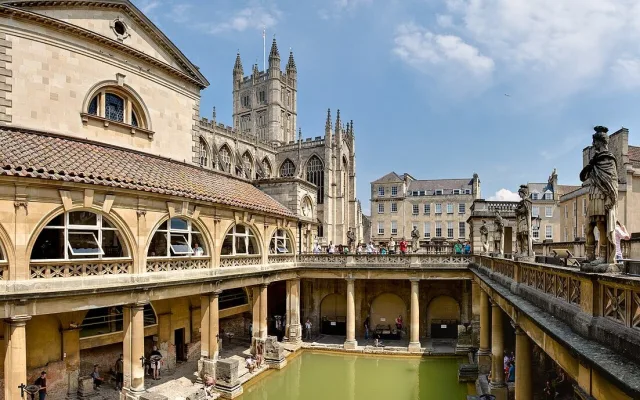
- The Roman Baths — the main reason to come. A genuine Roman thermal complex with a hot spring that still flows. Inside is a museum of the finds, with an audio guide. The ticket is not cheap and the queue at the entrance can be long: arrive at opening time or book a timed slot online in advance and save yourself an hour of standing.
- The Royal Crescent — a semicircle of thirty joined Georgian houses, the emblem of the city. It costs nothing to look at from outside, and the lawn in front is a popular place to sit. Number 1 houses a period museum showing 18th-century life.
- The Circus — a circular space of the same facades, a couple of minutes from the Royal Crescent. You see it on the way.
- Bath Abbey — the Gothic abbey in the centre, right by the baths. The tower climb is worth it for the view (on the tour schedule).
- Pulteney Bridge — a bridge lined with shops on both sides, with a weir cascading below. A fine photograph, especially from the riverside.
- The Jane Austen Centre — for devotees of the writer. The display is small and thematic rather than historical, and does not delight everyone. That Austen lived in Bath is something you feel without the museum anyway, walking the streets and squares.
On bathing: you cannot swim in the Roman Baths themselves. If you want to sit in thermal water, that is the neighbouring modern Thermae Bath Spa, with a rooftop pool and a view over the city. A good idea for the evening, but book a slot.
Getting there and getting around
Bath has no airport of its own. The usual ways in:
- From Bristol — the nearest airport. A bus (Air Decker and similar) runs from there straight to the centre, and the journey is short.
- From London — trains from Paddington take about an hour and a half, the most convenient option. There are coaches too, cheaper and slower.
- Bath Spa station is right in the centre, and everything is walkable from it.
Inside the city you will barely need transport: the centre is small and can be crossed on foot in fifteen to twenty minutes. Allow for the terrain — Bath is built on hills, and the Royal Crescent and everything above it means climbing. A car in the centre is more burden than help: narrow streets, paid parking, and a lot of pedestrian zones.
Where to stay
- The centre (around the abbey and the baths) — everything within walking distance, but pricier and noisier in the evening.
- Nearer the Royal Crescent and Bathwick — quiet Georgian streets, still walkable to the centre.
- By Bath Spa station — convenient if you are arriving and leaving by train.
Accommodation in Bath is expensive for a city of its size, especially in high season and at weekends. The budget move is a hostel or B&B slightly out of the centre; ten minutes' extra walking makes a noticeable difference to the price.
How long to allow
Two days are enough to see everything of note without hurrying:
- Day 1 — the Roman Baths, Bath Abbey, the centre, Pulteney Bridge.
- Day 2 — the Royal Crescent, The Circus, museums to taste, and the spa in the evening.
Many people come to Bath on a day trip from London or Bristol — feasible, but at a gallop. The city opens up better if you stay the night: the early morning and the evening, once the coach tours have left, are the pleasantest hours here.
When to go
The best time is late spring and summer, when the terraces and lawns are open — though that is also the peak of the crowds and the prices. Autumn is milder and cheaper. Winter is damp and dark early, but there is a Christmas market by the abbey. Rain is possible in any season, so bring a waterproof jacket rather than just an umbrella.
Food and money
Bath is an expensive tourist city, with prices above the national average. Some practical advice:
- Eat where the locals eat — the pubs serve substantial food at a reasonable price, often with lunch deals.
- The classic ritual is a Bath bun with tea; a cream tea with scones is equally at home here.
- The market and the supermarkets make it easy to assemble a picnic if you are watching the budget.
Common mistakes
- Coming in season without a booked ticket for the Roman Baths — time lost in the queue.
- Confusing the museum baths with bathing — for a warm soak, go to Thermae Bath Spa.
- Underestimating the hills and the cobbles — bring comfortable shoes.
- Trying to see everything in a few hours in passing — Bath is made for a slow pace.
Updated