Description
Oxford is known for the oldest university in the English-speaking world, with its medieval colleges, the Bodleian Library and punting on the Thames.
Wiki
Oxford is one of the oldest university cities in the world, in the south of England in Oxfordshire, at the confluence of the Thames — called the Isis within the city — and the Cherwell. It is known for the oldest university in the English-speaking world, its medieval colleges, and the domes and spires that led the poet Matthew Arnold to call it the city of dreaming spires, as well as for punting on flat-bottomed boats.
The city
Oxford lies about 90 kilometres north-west of London and is the administrative centre of Oxfordshire. Its population is around 150,000-160,000, a substantial part of it students and university staff. The historic centre is compact: most of the sights are within walking distance of each other, which makes Oxford well suited to a short trip of a day or two.
The look of the city is set by teaching buildings of pale limestone crowned with towers and domes, by narrow cobbled lanes and by the inner quadrangles of the colleges. Yet Oxford is not only an open-air museum: science and high technology thrive here, publishers operate in the city (among them the world-renowned Oxford University Press), and residential districts, parks and water meadows spread out around the centre. City life is closely bound up with academic life: the terms set the rhythm, and the streets are full of cyclists — the bicycle is the traditional way of getting about.
History
A settlement arose here, it is thought, in the Saxon period; the name comes from Oxenaford, the ford where oxen crossed the river. The first written mention dates from the early Middle Ages. Gradually the town at the crossing of trade routes grew stronger and acquired monasteries and churches.
Teaching was going on in Oxford by the late 11th and early 12th century, and by the 13th a full university had taken shape. Its growth was spurred by a conflict between the English king and France, as a result of which English students left Paris and settled in Oxford. The collegiate system emerged here: the university was an association of independent colleges where students lived, studied and ate. The oldest — University College, Balliol and Merton — were founded in the 13th century. Some students later broke away and moved to Cambridge, founding the second of England's famous universities.
During the Reformation and the English Civil War, Oxford found itself at the centre of events: in the 17th century the city served for a time as the residence of Charles I. Over the centuries eminent scholars, writers and statesmen studied and taught here; the city is associated with J. R. R. Tolkien and C. S. Lewis, who worked on their books within its walls and its pubs, and with Lewis Carroll, whose Alice was born in the Oxford setting.
Main sights
1. Christ Church
Christ Church is one of the largest and most famous colleges in Oxford, founded in the 16th century. What sets it apart is that the college church also serves as the cathedral of the Diocese of Oxford — a rare combination in one building. Do see the grand staircase and the Great Hall with its portraits of alumni: the college interiors were the model for scenes in the Harry Potter films. Lewis Carroll, who taught mathematics here, is also connected with Christ Church.
2. The Ashmolean Museum
The Ashmolean is the oldest public museum in Britain, opened at the end of the 17th century. Its collection spans art and archaeology from ancient Egypt, Greece and Rome to European painting, eastern art and numismatics. Entry to the permanent collection is free, which makes it one of the city's great and accessible attractions.
3. Oxford Castle
Oxford Castle is a Norman fortress of the 11th century, laid out soon after the Norman conquest of England. For centuries part of the complex served as a prison. Today it has become a heritage site: St George's Tower survives, along with the old motte and the underground chambers, and there is a view over the city from the top. Tours cover the centuries of the castle's history and its prisoners.
4. The Bridge of Sighs
The Bridge of Sighs is a covered arched crossing over New College Lane, joining two parts of Hertford College. Built in the early 20th century, it took its nickname from the association with its famous Venetian counterpart, though in appearance it is closer to the Rialto. It is one of the most recognisable and photographed views in Oxford.
5. The Radcliffe Camera
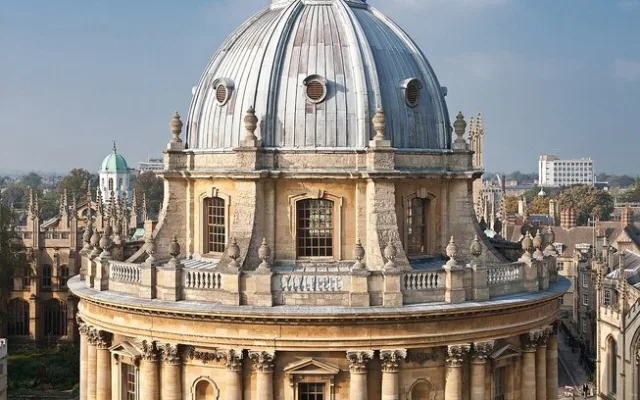
The Radcliffe Camera is an imposing circular building in the English Baroque-Palladian manner, raised in the 18th century. It was originally built as a science library and today forms part of the Bodleian Library — one of the oldest and largest libraries in Europe, entitled to a copy of every book published in the country. The rotunda of the Radcliffe Camera has become an architectural symbol of Oxford, and the Bodleian itself runs tours.
6. Blenheim Palace
Blenheim Palace stands in the town of Woodstock about 13 kilometres from Oxford and is easily reached on a day trip. This grand English Baroque palace was built in the early 18th century and given to the Duke of Marlborough for his military services. It is a UNESCO World Heritage Site and is known as the birthplace of Winston Churchill. Around it lies an extensive landscape park laid out by the celebrated Lancelot "Capability" Brown.
7. The University of Oxford
The University of Oxford is not a single building but dozens of colleges and faculty buildings scattered across the city. Beyond those already named, Merton College is of interest for one of the oldest medieval libraries, Magdalen College for its bell tower and deer park, and New College for its medieval walls and gardens. The ceremonial centre is the Sheldonian Theatre, built by Christopher Wren for formal occasions and degree ceremonies. Many colleges are open to visitors, and seeing their quads, chapels and dining halls gives the best sense of how university life works.
Free things to do
1. The parks
Green space is an important part of the city. University Parks on the bank of the Cherwell suits an unhurried walk, and the Botanic Garden — the oldest in Britain — displays its plant collections. South of the centre lie the water meadows of Christ Church Meadow, with views of the spires and the river. Beyond the centre stretches Port Meadow, an ancient common where cattle graze and townspeople walk.
2. The markets
The Covered Market has operated in the centre since the early 19th century and brings together stalls of produce, baking, cheese, flowers and souvenirs. Walking through it costs nothing and gives a feel for the city, and you can eat there or buy local delicacies if you wish. Street fairs are held in the city from time to time.
3. Free museums
Many of Oxford's key museums are free. Besides the Ashmolean, there is the Oxford University Museum of Natural History in its neo-Gothic building, with a rich collection of skeletons and minerals, and the adjoining Pitt Rivers Museum with ethnographic artefacts from around the world. The History of Science Museum, with its collection of early scientific instruments, is also free.
Entertainment and nightlife
The classic Oxford pastime is punting, in flat-bottomed boats propelled with a pole against the riverbed. You can hire a punt and handle it yourself or book a chauffeured trip along the Cherwell or the Isis. The city is known for its historic pubs: among them The Eagle and Child, where the Inklings literary circle met with Tolkien and Lewis — closed since 2020 and awaiting reopening after restoration — and the ancient Turf Tavern, tucked away in the lanes. The student population keeps the evenings lively — bars, cafés and clubs, along with a full programme of concerts, plays and lectures. A Harry Potter walking tour is another draw, as are theatre and music events in the historic halls.
Where to stay
Hotels
There are hotels of every standard in the centre and near the historic streets, from historic inns in old buildings to modern chains. Staying in the centre is convenient for seeing the sights on foot, but usually costs more.
Guest houses
Small guest houses and B&Bs are common in the residential districts closer to the edge of town and along the main approach roads. They are a compromise between price and comfort, with a traditional English breakfast.
Hostels
For travellers on a tight budget and for younger visitors there are hostels with dormitories and private rooms, usually near the station and the centre. Book ahead, especially in high season and around university ceremonies.
Local food
Restaurants and cafés
Oxford's dining is varied: traditional pubs with British cooking, cafés, steakhouses and places serving cuisines from around the world. Many pubs offer the classic Sunday roast. In the centre and at the Covered Market there is no shortage of places for an inexpensive bite, a cup of tea or a coffee.
Traditional dishes
From the British classics, try fish and chips, a meat or vegetable pie, a roast with Yorkshire pudding, and the full English breakfast. The culinary ritual is afternoon tea with scones, jam and clotted cream. Among local specialities, Oxford marmalade is well known, and the pubs serve English ale from local breweries.
Getting to Oxford
Oxford is well connected to London. Direct trains run from the London terminals and take about an hour. Regular express coaches leave from central London and from Heathrow and Gatwick airports — a convenient and usually cheaper option, including for those arriving on international flights. By car the city is reached on the M40; traffic and parking are restricted in the historic centre, so it is easiest to use the Park and Ride sites on the approaches and take the bus in. Inside the city everything is close, and it is best seen on foot or by bicycle.
Advice for travellers
Two days are enough for the essentials: give the first to the colleges, the Bodleian and the Radcliffe Camera, the museums and a punt, and the second to Blenheim Palace and Woodstock. Check college opening hours and access days in advance: during examinations, ceremonies and vacations many are closed or restrict entry, and some sites charge admission. Comfortable shoes help on the cobbles, and an umbrella is wise given the changeable English weather. In summer and on days of student celebrations the city is crowded, so book accommodation and popular tours ahead. To keep costs down, choose the free museums and parks, and eat cheaply at the Covered Market.