London
United KingdomDescription
London is a city in the United Kingdom known for historic and cultural landmarks such as Big Ben, Tower Bridge and Tate Modern.
Wiki
London is the capital of the United Kingdom and one of the world's key centres of finance, culture and diversity, where some 9 million inhabitants represent more than 200 nationalities. The city stands on the Thames and brings together the finest museums in the world (most of them free to enter), four UNESCO World Heritage sites, the living theatre scene of the West End and food from every corner of the globe.
History and general character
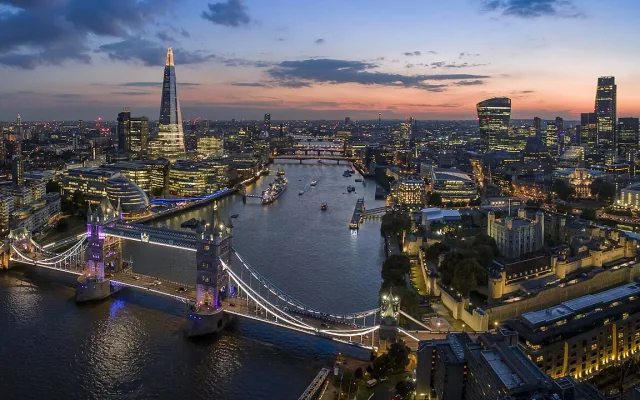
London grew out of the Roman settlement of Londinium, founded around AD 47–50 on the north bank of the Thames. Over two thousand years it has lived through the Romans, the Anglo-Saxons, the Norman conquest of 1066, the Great Fire of 1666, headlong growth in the industrial revolution and the bombing of the Second World War. Today it is a city of contrasts: the medieval Tower stands beside the glass skyscrapers of the City — the Gherkin (30 St Mary Axe), the Shard (the tallest building in the United Kingdom) and the Walkie-Talkie. The historic core is the square mile of the City and Westminster, around which dozens of distinctive boroughs have grown up.
Main sights
- Big Ben and the Palace of Westminster — the parliament building in neo-Gothic style; strictly speaking Big Ben is the name of the bell, while the tower is named after Elizabeth. Its restoration was completed in 2022.
- Westminster Abbey — the place of coronations and royal burials, a UNESCO site, Gothic architecture of the 13th century.
- Tower Bridge — a bascule bridge in Victorian Gothic style (1894), with a glass viewing walkway between the towers.
- The Tower of London — a fortress, palace and prison with almost a thousand years of history, and the home of the Crown Jewels.
- St Paul's Cathedral — Christopher Wren's domed masterpiece, with a panorama of the city from the top.
- Buckingham Palace — the monarch's official residence; the famous Changing of the Guard.
- The London Eye — the observation wheel on the South Bank with views along the Thames.
Museums and galleries
London is famous for free access to the permanent collections of its national museums. The British Museum holds the Rosetta Stone, Egyptian mummies and the Parthenon marbles. Tate Modern, in a former power station with its giant Turbine Hall, has gathered the art of the 20th and 21st centuries — Warhol, Beuys, Rothko. The National Gallery on Trafalgar Square shows Van Gogh, Vermeer and Monet. It is worth setting aside time for the Natural History Museum with its dinosaur skeletons, the Science Museum and the Victoria and Albert Museum (decorative arts).
Districts
- The West End — theatres, the shops of Oxford Street, busy Covent Garden and Soho.
- The City — the historic and business centre, the "square mile".
- Shoreditch and Dalston — the bohemian East End, with street art, bars and a creative scene.
- Knightsbridge — the Harrods department store, the South Kensington museums, expensive restaurants.
- Camden — the famous market and an alternative, rock-flavoured culture along Regent's Canal.
- Greenwich — the Royal Observatory, the prime meridian and maritime history (a UNESCO site).
Parks
London is one of the greenest of the great cities. Hyde Park (142 ha), with the Serpentine lake, boats and Speakers' Corner, runs on into Kensington Gardens. Also worth seeing are Regent's Park with its zoo, St James's Park by the palace, and the broad expanse of Hampstead Heath in the north.
Transport
The basis of getting around is the underground (the Tube), buses, and the Overground and Elizabeth Line. Payment is by Oyster card or contactless — from £2.80 per journey, £1.75 on a bus, with a daily cap on charges. From Heathrow airport, the Heathrow Express (about 15 minutes) and the cheaper Elizabeth Line (about 40 minutes) run into the centre. The red double-decker buses and the black cabs are part of the city's visual identity. The centre is good for walking; remember that traffic drives on the left.
Food
The British classics are fish and chips, the Sunday roast with Yorkshire pudding, the English breakfast, and afternoon tea with scones. Thanks to its diaspora communities, London offers the cooking of the whole world: Indian curry (the historic Brick Lane), the Chinatown by Soho, Middle Eastern and African places. Borough Market and Camden Market are made for eating your way around. An average lunch costs from about $15, a coffee around $5.
Practicalities
Five days are enough to cover the essentials without rushing: a day for Westminster and the parks, a day for the City and the Tower, a day for the South Kensington museums or the British Museum, a day for Tate Modern and the South Bank, and the last for the markets, Greenwich or the slower districts of the East End. The currency is the pound sterling. The weather is changeable in any season, so an umbrella and layers are useful all year round.
Photos