Description
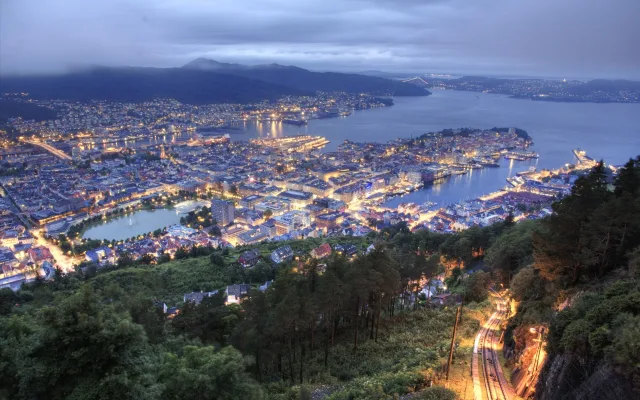
Gateway to the Norwegian fjords — Bryggen on the UNESCO list, the Fløibanen funicular, and cruises on the Sognefjord.
Wiki
Bergen stretches along the south-western coast of Norway between seven hills and the waters of the North Sea — the country's second-largest city and its unofficial "fjord capital." Founded in the eleventh century, it served for centuries as Scandinavia's trading gateway, and today welcomes travellers as the main departure point for Norway's most celebrated natural inlets.
History and atmosphere
Bergen was founded around 1070 by King Olav the Quiet and for a long time remained the largest and most important city in Norway, serving as a royal residence in the thirteenth century. Its golden age came during the Hanseatic League: from the fourteenth to the sixteenth century, German merchants maintained one of their key trading posts here, dealing in dried cod across Europe. That heritage shaped the city's character — commercial, maritime, always oriented towards the water.
A population of around 290,000, a standing as a cultural and university centre, and a reputation as one of the rainiest cities in Europe (precipitation falls on roughly 240 days a year) have forged a distinctive local identity. Rain stopped being a cause for gloom long ago — an umbrella and a waterproof jacket are considered part of the Bergen look.
Main sights
- Bryggen — the historic Hanseatic wharf, with rows of wooden buildings under pointed roofs painted in ochre, red and white. The quarter is a UNESCO World Heritage Site; behind the façades lie narrow alleyways, artisans' workshops and small museums.
- The Fløibanen funicular climbs Mount Fløyen (about 320 m), where a broad panorama of rooftops, the harbour and the surrounding fjords opens up. At the top, walking trails lead through forest and to Lake Skomakerdiket.
- The Ulriken cable car runs up to Ulriken (643 m), the tallest of the seven hills and a favourite spot for hiking and looking out over the city.
- The Fish Market (Fisketorget) on the main waterfront is a lively spot with stalls selling crab, prawns, salmon and more unusual fare such as whale meat.
- Troldhaugen — the composer Edvard Grieg's home museum, with its preserved interior, a garden hut by the lake, and a concert hall where his music is performed in summer.
- Bergenhus Fortress, with the Rosenkrantz Tower and the thirteenth-century Håkon's Hall, St Mary's Church — the oldest building in the city — along with the cathedral and the aquarium each speak to a different era of Bergen's past.
Nearby fjords
The city is the gateway to two of Norway's greatest inlets. Sognefjord is the longest and deepest in the country, with sheer cliffs and branches such as the scenic Nærøyfjord. Hardangerfjord is famous for its orchards in spring blossom and its waterfalls. The popular "Norway in a Nutshell" route combines a train journey, a fjord cruise and the celebrated Flåm Railway in a single day.
Food and drink
Bergen's cuisine is inseparable from the sea. Worth trying: the local fish soup (fiskesuppe), smoked salmon (røkt laks), cod dishes (torsk) and the traditional sweet brown cheese brunost. The market and the harbour-side cafés serve fresh seafood, while bakeries sell skillingsboller — soft cinnamon buns. Bear in mind that prices in Norway are high: lunch at a café runs 280–380 NOK (about $29–40), dinner at a restaurant 650–1,100 NOK ($69–115), a cup of coffee around 55 NOK ($6). Prices are as of 2026.
Getting there and around
Bergen Airport Flesland (BGO) is served by SAS, Norwegian, KLM, Wizz Air and others. The Bybanen light-rail line and the Flybussen airport express both connect it to the city centre. The historic centre is compact, so the best way to get around is on foot. The scenic Bergensbanen railway (the Oslo–Bergen line) and long-distance NOR-WAY coaches link the city to the fjords. Car hire costs roughly 880–1,300 NOK ($92–138) per day.
When to visit
The best time is May to September, when temperatures reach 12–20 °C and June brings near-endless daylight. Summer is ideal for mountain hikes and fjord cruises. Winter is mild by northern standards (0–5 °C) with little snow in the city itself; Christmas markets open in December. In any season, rain is a realistic prospect — build some flexibility into your plans.
How long to stay
Three days is enough to see Bergen at a comfortable pace. Spend the first on Bryggen, the market and the climb to Fløyen; the second on the museums, Bergenhus Fortress and Troldhaugen; and the third on a day trip to one of the fjords. That rhythm lets you take in both the urban atmosphere of this former Hanseatic capital and the grandeur of the Norwegian landscape.