Description
Caribbean beaches, Chichén Itzá, Tulum and diving in the cenotes of the Yucatán.
Wiki
Cancún is Mexico's largest seaside resort, on the north-eastern tip of the Yucatán peninsula facing the Caribbean. Founded in the early 1970s as a planned tourism project on an almost empty sand spit, in half a century it has become the main gateway to the Riviera Maya and the starting point for trips to ancient Maya cities, cenotes and coral reefs.
History and layout
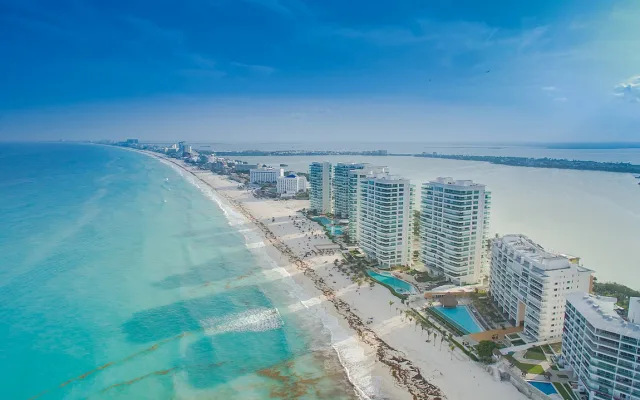
Before 1970 this was a fishing village of a few hundred people. The Mexican government picked the spot by computer analysis as an ideal resort location and built from scratch. Today the metropolitan area holds over 800,000 people, and the city splits into two very different halves. The Zona Hotelera is a narrow sand spit about 25 km long, shaped like a figure 7 and wedged between the Caribbean and the Nichupté lagoon; this is where the all-inclusive hotels, malls and nightlife are. El Centro is the working city on the mainland, where locals live, with markets, cheap loncherías and the bus station.
Beaches and nature
The coast is known for fine coral sand that stays cool underfoot, and for its gradations of turquoise water. Cancún's beaches are public by law, even along the hotels. The Nichupté lagoon is ringed by mangroves — boat trips and kayaking are popular here. To the south runs the Riviera Maya, with reefs belonging to the Mesoamerican Barrier Reef, the second largest in the world.
Maya archaeology
- Chichén Itzá — a UNESCO site and one of the New Seven Wonders. Beyond the famous stepped pyramid of Kukulkán (El Castillo) there is the Temple of the Warriors, the round El Caracol observatory, the largest ball court in Mesoamerica and the sacred cenote. At the spring and autumn equinoxes the pyramid's staircase throws a shadow shaped like a descending serpent.
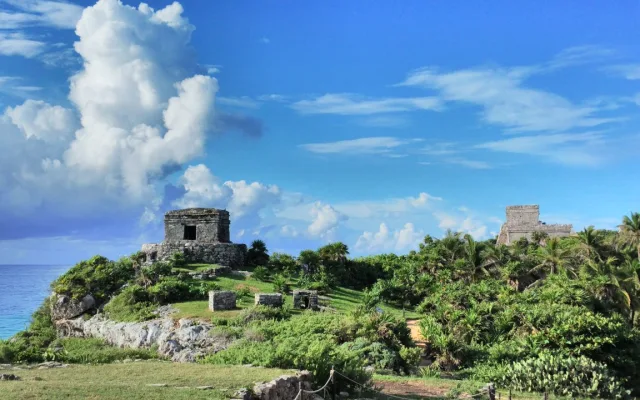
- Tulum — the only major Maya city built directly on a coastal cliff; walled, with El Castillo above the drop and a view over the sea.
- Cobá — a sprawling forest complex with the tall Nohoch Mul pyramid and a network of ancient white sacbé roads. Best explored by rented bicycle.
- Closer to town are the small ruins of El Meco and El Rey, the latter right in the Zona Hotelera.
Cenotes and diving
Cenotes are limestone sinkholes filled with fresh water, sacred to the ancient Maya. There are hundreds in the area: open wells, half-caves and fully underground grottoes hung with stalactites. The clarity of the water makes them world-renowned for snorkelling and technical diving — especially the Dos Ojos and Gran Cenote systems near Tulum. Besides Ik Kil, the Samulá cenote near Chichén Itzá is a favourite. The coastal reefs off Isla Mujeres and Cozumel offer classic sea diving, and in summer you can swim nearby with giant whale sharks.
Islands and parks
Isla Mujeres is a quiet island half an hour away by ferry, with Playa Norte, a turtle farm and the southern headland of Punta Sur. Larger and further out is Cozumel, a world capital of reef diving. Along the Riviera Maya, the eco-archaeological parks Xcaret and Xel-Há offer underground rivers, and there are dolphin centres and the Sian Ka'an biosphere reserve.
Food
Yucatecan cooking differs noticeably from the rest of Mexico. Try cochinita pibil (pork marinated in sour orange juice and achiote, baked in banana leaves), sopa de lima, the spicy papadzules and street-side marquesitas. From the Caribbean come lobster, octopus, ceviche and grilled tikin-xic fish. The local hot condiment is habanero paste.
Practical information
Cancún International is one of the busiest airports in Latin America and the region's main hub. The currency is the Mexican peso; dollars are taken in the tourist zone but at a poor rate. Buses R-1 and R-2 run the length of the Zona Hotelera, and ADO connects the city with Tulum, Playa del Carmen, Valladolid, Mérida and Chetumal.
Over five days it makes sense to combine the beach with two or three excursions: a full day at Chichén Itzá with a swim in a cenote, a separate day for Tulum and Cobá, and a day on Isla Mujeres. The dry high season runs from December to April; June to November brings rain and the risk of hurricanes, but lower prices. In summer brown sargassum seaweed sometimes washes up on the beaches. Use biodegradable sunscreen to protect the reefs, drink bottled water and keep some cash pesos for markets and buses.
Photos