Description
Culinary and cultural capital of Mexico: seven types of mole, Zapotec black pottery, Monte Albán, and the best mezcal on the planet.
Wiki
Capital of the Mexican state of the same name and one of the most culturally and culinarily rich cities in Latin America — around 300,000 people at 1,555 m in southern Mexico. A UNESCO World Heritage Site, founded by the Spanish in 1532 on the ruins of the Zapotec capital. Home to Mexico's greatest ethnic diversity (16 indigenous groups: Zapotecs, Mixtecs, Chinantecs and others), birthplace of Benito Juárez (President of Mexico 1858–72), and the world centre of mezcal production. The food scene is among the best on earth.
Main sights
- Zócalo (Plaza de la Constitución) — the main square, flanked by the cathedral and the Governor's residence.
- Templo de Santo Domingo — the finest Baroque church in Mexico (1572–1731), with a gilded interior.
- Museo de las Culturas (former Santo Domingo monastery) — the largest regional collection, including artefacts from Monte Albán Tomb 7.
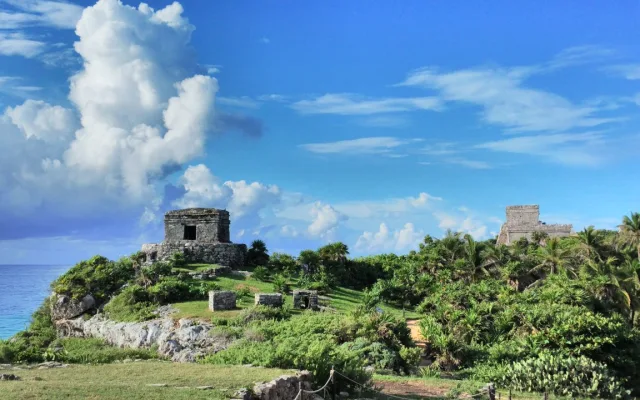
- Monte Albán — UNESCO World Heritage Site, the ancient Zapotec capital dating to the 6th century BC, 9 km from the city centre.
- Mitla — ancient Zapotec/Mixtec capital 45 km away, renowned for its extraordinary geometric wall ornamentation.
- Yagul — less-visited Zapotec ruins with underground tombs.
- Hierve el Agua — petrified waterfalls with natural rock pools, 75 km from the city.
- Mercado Benito Juárez and Mercado 20 de Noviembre — the city's main markets; try black mole, chapulines (grasshoppers), and tlayuda.
- Craft villages around Oaxaca: Teotitlán del Valle (hand-woven rugs), San Bartolo Coyotepec (black clay pottery), Arrazola (alebrijes — painted wooden figures).
- El Tule — a cypress tree 1,500–3,000 years old with a trunk circumference of 14 m, one of the largest in the world.
- Capilla del Rosario — a gilded chapel inside the church of Santo Domingo.
Food and prices
Oaxacan cuisine is considered one of the world's finest: seven moles (especially mole negro), tlayuda (a large crispy flatbread), memelas, chapulines (fried grasshoppers), tasajo, queso Oaxaca, tejate, and mezcal (more than 30 varieties). Lunch at a café runs 140–260 MXN (about $8–15); dinner at a restaurant 310–690 MXN ($18–40), and at a high-end spot such as Casa Oaxaca around 1,030–2,060 MXN ($60–120). Mezcal at a local mezcalería costs 70–140 MXN ($4–8) a glass. A litre of fuel is around 21 MXN ($1.20); a city taxi 70–140 MXN ($4–8); a local bus 9 MXN ($0.50). Prices are as of 2026.
Getting there and around
Oaxaca International Airport (OAX) is 8 km from the centre, served by Aeromexico, Volaris, and Viva. A taxi to the centre costs around 210–260 MXN ($12–15). From Mexico City: 1 hour by plane (roughly $50–100) or 6–7 hours by ADO bus ($25–40). Within the city, the compact centre is easily walkable; taxis and colectivos (shared taxis) cover the surrounding villages.
When to go
October to April is the dry season, with temperatures of 15–25°C. Día de los Muertos (1–2 November) is the city's defining celebration — Oaxaca is home to some of the most elaborate altars in Mexico. Guelaguetza (the last two Mondays of July) is the state's major folklore festival. The rainy season (May–September) brings short, heavy afternoon downpours with clear mornings. At 1,550 m, the climate is mild year-round.