Český Krumlov
Czech RepublicDescription
A fairy-tale pocket town curled inside a loop of the Vltava river, with a vast castle, a Baroque theatre, and medieval quiet far from the crowds.
Wiki
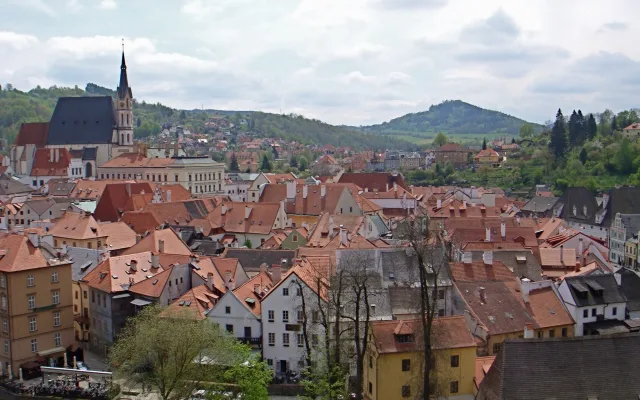
One of the most photogenic medieval towns in Europe — around 13,000 inhabitants in the South Bohemia region of the Czech Republic, 170 km from Prague. UNESCO World Heritage Site (1992). The castle was the seat of the Rosenberg (Rožmberk) dynasty (13th–17th centuries), then the Schwarzenbergs until 1947. The town is built on a meander of the Vltava river, giving it its distinctive loop shape. Often called the "Czech Salzburg" or "Prague in miniature." The second-largest castle complex in the Czech Republic after Prague Castle.
Main sights
- Český Krumlov Castle (Krumlovský hrad) — UNESCO-listed, the second-largest castle in the Czech Republic, with more than 40 buildings arranged around 5 courtyards. Guided tours are required to enter the interior rooms (two different tours available).
- Castle Tower (Hrádek Tower) — the defining postcard image of Český Krumlov, a multi-coloured tower with a viewing terrace.
- Castle Baroque Theatre — one of only two surviving Baroque theatres in Europe (the other is at Drottningholm, Sweden). The 18th-century stage machinery is still in working order.
- Castle Gardens — English and Italian gardens, featuring a revolving open-air theatre.
- Náměstí Svornosti (Svornosti Square) — the main square of the Old Town, with a plague column dating from 1716.
- Old Town — a labyrinth of cobbled lanes on the Vltava meander.
- Church of St Vitus — the town's principal Gothic church (14th century).
- Egon Schiele Art Centrum — a contemporary art centre honouring the Austrian Expressionist painter, who spent time here (his mother was from Krumlov).
- Museum Fotoateliér Seidel — a working photographic studio established in 1905.
- Vltava rafting — the main summer activity; a 30-minute canoe loop around the town.
- Festival of the Five-Petalled Rose — the town's biggest annual event, held on the third weekend of June: a medieval fair with jousting tournaments.
- České Budějovice — the neighbouring town 25 km away, home of Budvar beer.
- Šumava National Park — the largest national park in the Czech Republic, 30 km away.
- Hluboká nad Vltavou — a neo-Gothic castle dubbed the "little Windsor," 30 km away.
Food and prices
The cuisine is Czech and South Bohemian: vepřo knedlo zelo (pork with dumplings and sauerkraut), gulyás, smažený sýr (fried cheese), trdelník (sweet spit cake), with Budvar and Pilsner as the main beers. Lunch at a hospoda (pub-restaurant) runs 12–20 EUR (about $15–23), dinner at a restaurant 25–50 EUR ($29–58). A glass of Czech beer costs 2–3 EUR ($2–4). A litre of petrol is around 1.50 EUR ($2), a taxi across town 6–12 EUR ($7–15), and a bus from Prague 8–15 EUR ($9–18). Prices are as of 2026.
Getting there and around
There is no airport in Český Krumlov; the nearest are Prague (PRG, 170 km) and Linz, Austria (LNZ, 70 km). From Prague, Student Agency/RegioJet coaches take about 3 hours (10–15 EUR / $12–18); by train via České Budějovice the journey takes around 4 hours. Within the town, everything is walkable — the historic centre is compact, all sights lie within an 800 m radius, and most streets are closed to cars.
When to go
May–September: 12–25 °C, ideal conditions. The Festival of the Five-Petalled Rose falls on the third weekend of June. December brings a Christmas market. Winter (December–March) is snowy (−5 to +5 °C) and particularly atmospheric. Summer (July–August) is peak season — the tiny town can receive up to 25,000 visitors a day. May and September are the sweet spot: warm weather without the crowds.