Description
Delhi is known for historic and architectural monuments including India Gate, the Red Fort, the Qutub Minar and the Lotus Temple, and for its sprawling bazaars.
Wiki
Delhi is the capital of India and one of the oldest continuously inhabited cities on the planet, where seven historic cities have succeeded one another on the banks of the Yamuna. Today it is a vast metropolitan area in which Mughal minarets and colonial avenues stand beside 21st-century business districts, and whose official status is that of the National Capital Territory (NCT).
The city divides clearly into two parts. Old Delhi is Shahjahanabad, laid out by the emperor Shah Jahan in the 17th century: a labyrinth of narrow lanes, craft workshops and wholesale markets behind the line of the former walls. New Delhi was created by the British architects Edwin Lutyens and Herbert Baker in the 1910s to 1930s as the ceremonial capital of empire — with broad radiating streets, government buildings and spacious lawns. Delhi has more UNESCO monuments than any other Indian city.
Main sights
- The Red Fort (Lal Qila) — the vast Mughal citadel of red sandstone, a UNESCO site. It is from its walls that the prime minister addresses the country each Independence Day. Tickets for foreigners ₹600 ($6).
- The Qutub Minar — a victory minaret about 73 m high, the oldest of its kind in India (begun in the 12th century). In the same complex stands the famous 4th-century Iron Pillar, which has resisted corrosion for more than fifteen hundred years. Tickets ₹600 ($6).
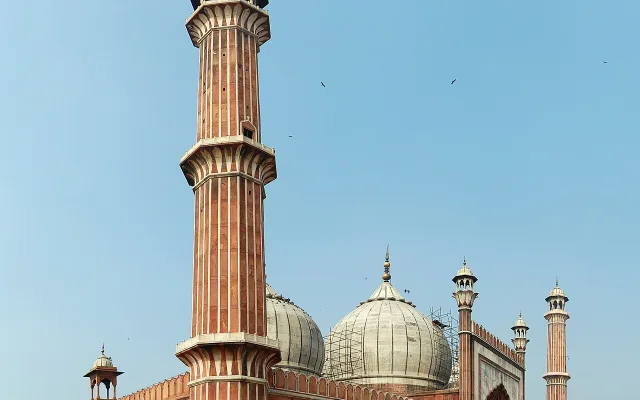
- The Jama Masjid — one of the largest mosques in the country, holding thousands of worshippers; it took about twelve years to build (1644–1656). Entry is free, with a charge to climb the minaret.
- Humayun's Tomb — an opulent mausoleum with a charbagh (a garden laid out in four parts), considered the model for the Taj Mahal. A UNESCO site. Tickets ₹600 ($6).
- India Gate — the arched war memorial of 1931 to the fallen, at the centre of the ceremonial Rajpath (now Kartavya Path). Free to see, and at its best at sunset.
- The Lotus Temple (Bahai) — a house of worship in the form of an opened flower of 27 marble petals; open to people of every religion. Entry is free.
- Akshardham — a large Hindu temple complex on the east bank of the Yamuna, with carved galleries and an evening fountain show.
- Raj Ghat — the memorial to Mahatma Gandhi on the site of his cremation, a quiet park with an eternal flame.
History and culture
Delhi remembers the Delhi Sultanate, the age of the Great Mughals and the British Raj. That layering shows in the architecture, the languages and the food. The city remains the cultural capital of northern India: the National Museum, the National Gallery of Modern Art and the Gandhi Memorial are here, and in autumn and winter festivals of classical music, dance and crafts take place. Diwali, Holi and Eid are celebrated with particular brilliance, with illuminations, fairs and street processions.
Food
Delhi's street food is a reason to travel here in itself. In Paranthe Wali Gali, a lane of the old city, dozens of kinds of stuffed paratha flatbread are fried and served with sharp achar pickles. It is worth trying chaat (snacks with yoghurt, spices and crisp elements), golgappe, the kebabs of the quarters around the Jama Masjid, and thick sweet lassi. Quieter restaurant areas are Connaught Place in the centre of New Delhi and the bohemian Hauz Khas village, with its view of medieval ruins and a lake. According to Numbeo, an inexpensive lunch costs from about ₹190 ($2), dinner for two around ₹1,150 ($12), a cup of coffee about ₹190 ($2). A night in a hostel costs from ₹570 ($6), a mid-range room about ₹3,800 ($40). Prices are as of 2026.
Transport
The basis of getting around is the Delhi Metro: an extensive network of several lines, clean, air-conditioned and safe, with tickets from ₹10 (about $0.10). The classic auto-rickshaws (tuk-tuks) are convenient for short distances, but it is better to agree the price in advance or ask for the meter; the Uber and Ola apps work everywhere. Indira Gandhi International Airport (IGI) is linked to the centre by a dedicated Airport Express metro line.
What to fit into 3 days
- Day 1. Old Delhi: the Red Fort, the Jama Masjid, a walk and lunch among the markets of Chandni Chowk, and the evening at Raj Ghat.
- Day 2. New Delhi: India Gate and the government ensemble, Humayun's Tomb, the Lotus Temple, dinner in Hauz Khas.
- Day 3. The Qutub Minar complex with the Iron Pillar, Akshardham, museums and unhurried shopping.
Practical advice
The best time to visit is October to March, when the heat eases; in summer the thermometer climbs very high, and the summer monsoon brings downpours. Covering clothing is needed for temples and mosques, and shoes are left at the entrance. Keep water with you, haggle at the bazaars and check your route in advance — then getting to know India's many-faced capital will be easy and rewarding.
Photos