Description
Galway is a city on Ireland's west coast, known for its street musicians, medieval walls and lively festivals. It sits at the gateway to the Wild Atlantic Way, with the Cliffs of Moher a short drive to the south.
Wiki
Galway spreads along Ireland's western seaboard where the River Corrib meets the Atlantic. Widely regarded as the cultural capital of the country, it blends living street music, a bohemian atmosphere and easy access to wild county landscapes into one of the most charismatic cities on the Emerald Isle.
History and character
The settlement grew around a Norman stronghold founded in the 13th century by the de Burgh family. Through the Middle Ages the trading port was controlled by fourteen merchant dynasties — the so-called Tribes of Galway — giving the city its enduring nickname, the City of the Tribes. Busy links with Spain and France shaped the old centre: narrow cobbled lanes, stone façades and merchant gates at the water's edge. Around 85,000 people live at the mouth of the Corrib today, a large share of them students at the University of Galway, which gives the city its young and creative pulse.
The surrounding region belongs to the Gaeltacht — an area where Irish (Gaelic) remains a living spoken language. Signs are displayed in both languages, and Irish is used in everyday conversation in the nearby villages.
What to see in the city
- The Latin Quarter and Quay Street — the heart of the pedestrian zone, lined with pubs, craft shops and restaurants serving fresh seafood. This is where street musicians are most often found.
- Spanish Arch — a surviving section of the 16th-century city walls right at the water's edge; beside it stands the free Galway City Museum, with archaeological and local-history displays.
- Eyre Square — the central plaza, officially named Kennedy Square; a convenient starting point for a walking tour of the city.
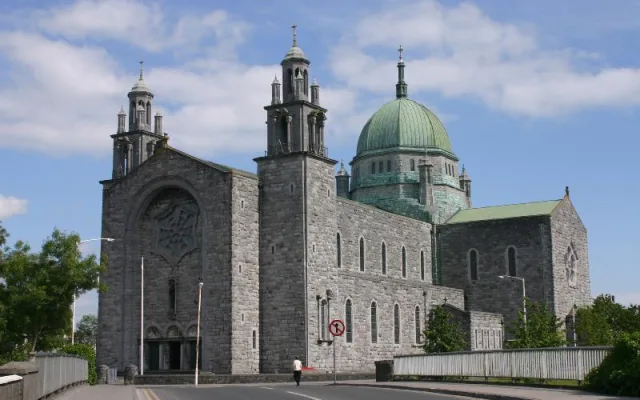
- Galway Cathedral — an imposing 1965 building with a green dome, built in neo-Renaissance style on the site of a former prison.
- St Nicholas' Collegiate Church — the largest medieval parish church in Ireland still in continuous use, finished by 1320; tradition holds that Columbus prayed here before his voyage.
- Salthill — a seaside suburb with a two-kilometre promenade; locals observe the custom of "kicking the wall" at the far end of the prom before turning back.
Atmosphere and culture
Galway is widely considered the most distinctly Irish of the republic's larger cities. Pub sessions of traditional music — fiddles and bodhrán played without a stage — are an everyday occurrence here, not a tourist performance. The city has a packed calendar: summer brings the Galway International Arts Festival, the Oyster Festival in September and the famous Galway Races. Art centres, independent theatres and galleries sustain its reputation as the creative hub of the west.
The natural surroundings: Wild Atlantic Way
Galway is one of the key waypoints on the Wild Atlantic Way, which runs the full length of the western coastline.
- The Cliffs of Moher — 214-metre sea cliffs about an hour and a half's drive to the south; Ireland's most iconic Atlantic panorama.
- The Aran Islands — three Irish-speaking islands with the prehistoric cliff-edge fort of Dún Aonghasa; ferries depart from Rossaveal and take around 40 minutes.
- Connemara National Park — mountains, bogland and lakes roughly an hour away, with the photogenic Kylemore Abbey nearby.
- The Burren — an extraordinary karst plateau of fissured limestone pavements, passed on the road to the Cliffs of Moher.
Food and prices
The local food scene is built on seafood and farm produce. Galway Bay oysters are a benchmark for connoisseurs worldwide, and menus regularly feature hearty seafood chowder, braised lamb, freshly baked brown bread and mussels. Lunch at a café runs roughly €18–25 (about $21–29), dinner at a restaurant €35–65 ($40–75), a pint of stout around €6–7 ($7–8) and a city taxi fare around €10–15 ($12–17). Prices are as of 2026.
Getting there and getting around
The nearest airports are Shannon (SNN, around 90 km away) and Dublin (DUB, around 230 km). From Dublin, Iarnród Éireann trains take roughly 2.5 hours; GoBus and Citylink coaches offer a frequent alternative. Local and regional bus services are run by Bus Éireann. The city centre is compact and very walkable, but for trips into Connemara or to the cliffs it is far more practical to hire a car or join an organised tour.
How long to allow
Two days are enough to absorb the city and make at least one excursion. The first day is best spent in Galway itself — the Latin Quarter, the Salthill promenade, the museums and an evening in the music pubs. The second suits a day trip to the Cliffs of Moher and the Burren, or out to the Aran Islands. Anyone wanting to explore Connemara properly should add a third day.