Jerusalem
Description
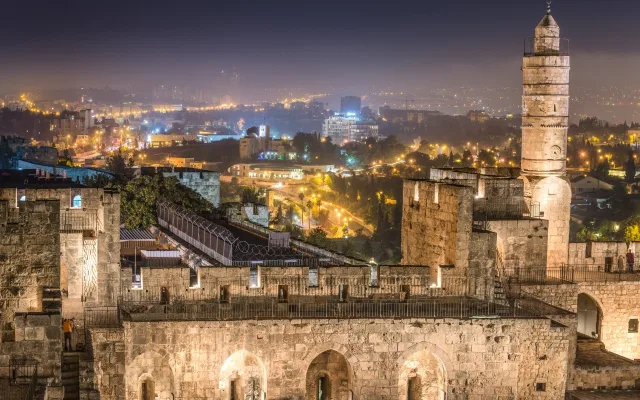
Jerusalem is a holy city for three faiths: the walled Old City, the Western Wall, the Church of the Holy Sepulchre and the Dome of the Rock on the Temple Mount.
Wiki
Jerusalem is one of the oldest continuously inhabited cities in the world, standing on the Judaean Hills at about 750 metres above sea level. Within roughly a single square kilometre it holds the principal shrines of Judaism, Christianity and Islam, which makes it a unique draw for pilgrims and travellers from every continent.
Background and history
Settlement on this spot goes back more than three thousand years. Biblical tradition holds that King David made Jerusalem the capital of the united Kingdom of Israel around the tenth century BC, and that his son Solomon built the First Temple. The city survived the Babylonian destruction, Persian and Hellenistic rule, the Hasmonean era and the reign of Herod the Great, under whom the Second Temple was rebuilt. In AD 70 the Romans burned the Temple, leaving only a retaining wall. Byzantine, Arab, Crusader, Mamluk and Ottoman periods followed, each adding its own architectural layer. The present walls of the Old City were raised under Sultan Suleiman the Magnificent in the sixteenth century.
Around 950,000 people live here today: Jews, Muslim Arabs, Christians of several communities, and Armenians. The status of Jerusalem remains the subject of international dispute — the eastern part has been under Israeli control since 1967, and that control is not recognised by most states. Security conditions can change, so it is worth checking the current situation before a visit.
Quarters of the Old City
The walled historic core is divided into four quarters. The Jewish Quarter was rebuilt after the damage it suffered in the twentieth century and adjoins the plaza at the Western Wall. The Muslim Quarter is the most populous and the liveliest, with a dense network of covered souks. The Christian Quarter is grouped around the Church of the Holy Sepulchre. The Armenian Quarter is the quietest and most enclosed, with the Cathedral of St James. Several historic gates lead inside: Jaffa, Damascus (Nablus), Lions', Zion and others.
The main holy sites
- The Western Wall (the Kotel, also known as the Wailing Wall) — the surviving stretch of the Temple Mount retaining wall and the most important place of Jewish prayer; visitors traditionally tuck written notes into the gaps between the ancient blocks.
- The Temple Mount, with the Dome of the Rock and Al-Aqsa Mosque — the third holiest site in Islam, linked to the night journey of the Prophet Muhammad. For Judaism it is the site of the Temple. Non-Muslims are admitted to the esplanade only during limited hours and may not enter the mosques.
- The Church of the Holy Sepulchre — by Christian tradition the place of the crucifixion, burial and resurrection of Christ. Six denominations share the building, and under a centuries-old arrangement the keys are kept by a Muslim family.
- The Via Dolorosa — the way of sorrows, fourteen stations retracing Christ's last route to Golgotha.
- Mount Zion — where the Cenacle, the room of the Last Supper, and the Tomb of King David are shown.
What else to see
Beyond the ancient walls the city continues in nineteenth- and twentieth-century neighbourhoods. Set aside time for the City of David, an archaeological park with Hezekiah's water tunnel, which you can wade through. The Mount of Olives offers the finest panorama of the Old City and holds an ancient Jewish cemetery and the Garden of Gethsemane. The Yad Vashem memorial commemorates the victims of the Holocaust and helps make sense of modern Israeli identity. The Israel Museum displays the Dead Sea Scrolls in the Shrine of the Book pavilion, along with a detailed model of the city in the Second Temple period. The Mahane Yehuda market has plenty of character too: rows of stalls by day, a strip of cafés and bars in the evening.
Food
The cooking combines Israeli and Palestinian traditions: thick hummus, crisp falafel, shakshuka, sabich with aubergine, fresh pita straight from the oven, sweet baklava and knafeh. Lunch in a modest place costs roughly 35–65 shekels ($12–22), dinner in a restaurant 90–180 shekels ($30–60). Prices are as of 2026. Many kosher establishments close for Shabbat, from Friday evening until sunset on Saturday, which is worth building into your plans.
Practicalities
Three days is enough for a first acquaintance. Give the first to the Old City and its shrines, the second to the City of David, the Mount of Olives and the viewpoints, the third to the museums, Yad Vashem and the newer neighbourhoods. Dress modestly: religious sites require covered shoulders and knees, and men are handed a kippah at the Western Wall. Walking and the light rail are the easiest ways to get around. Allow for the rhythm of Shabbat, when public transport and some businesses shut down.
Updated