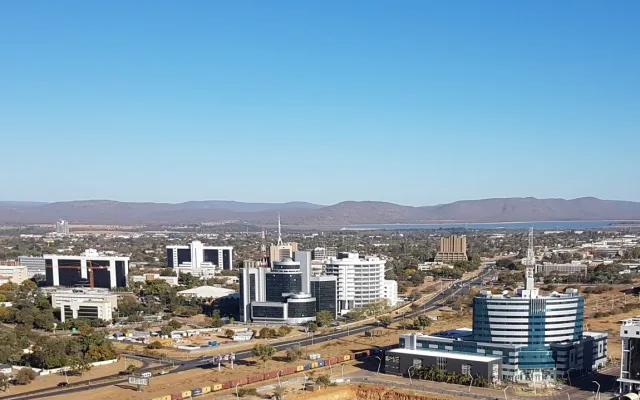
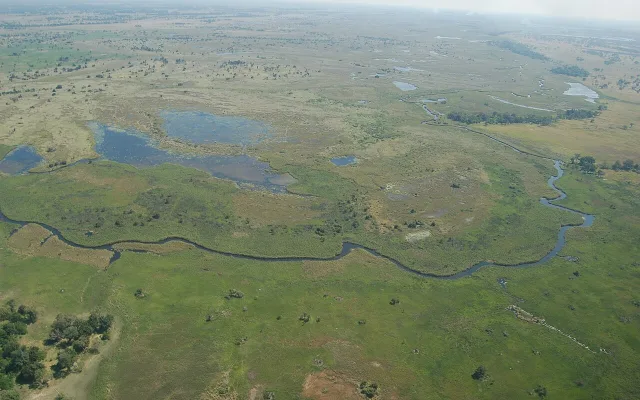
Description
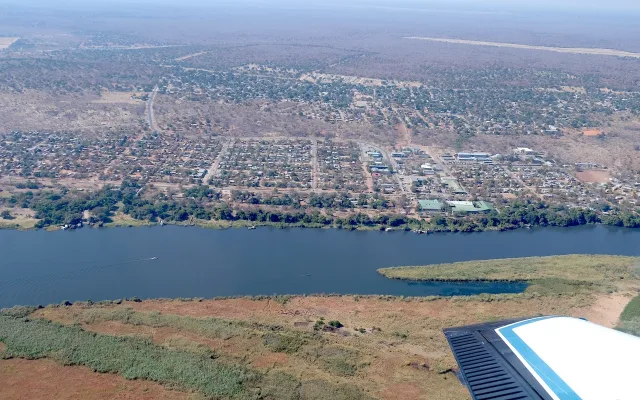
Kasane is the town safari routes run through, boat trips included. It sits beside the largest concentration of elephants in the world.
Wiki
Set in the far north of Botswana at the meeting of the Chobe and the Zambezi, Kasane is the main gateway to Chobe National Park and to the savannah of the whole Northern province. A small town of around ten thousand people, it holds a remarkable position: the borders of four countries — Botswana, Zambia, Zimbabwe and Namibia — very nearly meet at a single point here, which makes it a convenient starting point for travel across the region.
The setting
Kasane lies on low floodplain at around 930 metres, in dry savannah that comes alive along the full-flowing Chobe. The climate is subtropical, with a hot wet summer (November to March) and a dry, cool winter (May to August). The dry season is considered the best for watching wildlife: the waterholes shrink and the animals draw in towards the river. The neighbouring village of Kazungula, a few kilometres away, is the border crossing, with a ferry and a bridge over the Zambezi into Zambia.
Chobe National Park
Founded in 1968, Chobe is one of the oldest and best known reserves in the country. Its heart, the Chobe River Front, runs along the river and is famous for colossal herds of savannah elephant: the local population is estimated in the tens of thousands and reckoned the largest in Africa. Alongside the elephants live buffalo, puku and red lechwe antelope, giraffes, zebras, lions and leopards.
The park divides into several ecologically distinct zones:
- The Chobe River Front — the riverside strip accessible from Kasane, with the best waterholes and the main game-drive routes.
- The Savuti marshes — an inland area with an unpredictable channel, known for large prides and predators; reached on dirt roads.
- Linyanti — a remote wetland system in the west, where the chances of meeting the rare African wild dog are higher.
River safaris
Kasane's calling card is not only the classic game drive but the safari by water. A flat-bottomed motorboat on the Chobe lets you come almost within touching distance: elephants swim the channels, hippos bathe, Nile crocodiles sun themselves on the shallows. The river is rich in birds — fish eagles, African skimmers, kingfishers and herons. Sunset cruises are especially prized, when the herds come down to drink in soft evening light. Visitors typically combine a morning drive on land with an evening trip on the water.
Around Kasane and crossing borders
Kasane lies within the KAZA (Kavango-Zambezi) transfrontier conservation area, which links protected land across five countries. For visiting the neighbours, the single UniVisa valid in Zambia and Zimbabwe is convenient.
The main excursion is to Victoria Falls, one of the largest waterfalls in the world, about 80 kilometres away on the Zimbabwe-Zambia border. It is easily done in a day. Guests also value the chance to stand where four countries meet, near Kazungula.
Food
The local table combines Tswana tradition with South African cooking. The staples are pap (a stiff maize porridge, a relative of ugali) and seswaa, meat boiled down and pounded. In the street, kapana — strips of meat grilled over coals — is a popular cheap snack. At safari lodges, meals are usually included in the room rate; outside them the choice of places is modest. Lunch runs roughly $10-18, dinner at a lodge $30-60. Prices are as of 2026.
Practical information
Kasane airport (BBK) takes domestic flights linking the town with the capital, Gaborone, and other hubs; there are charter flights to remote lodges. Many travellers arrive overland from Victoria Falls. Accommodation ranges from budget guest houses in the town itself to expensive lodges inside the park (roughly $200-800 a night). A full safari day with two drives, a river cruise and lunch costs around $100-180.
Three days are enough to see the Chobe River Front from land and water without hurrying, make the trip to Victoria Falls and get a feel for this four-country frontier. Bring repellent, a hat and sun protection, and warm clothes for the evenings — dry-season drives are cold.