Description
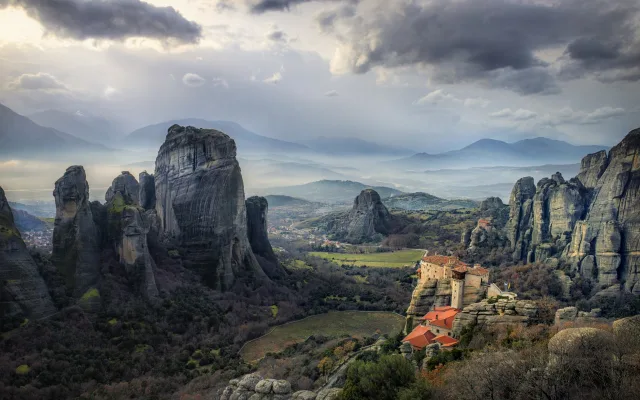
Meteora is a complex of cliff-top monasteries perched on towering sandstone pillars — one of the most extraordinary and spiritually powerful sites in Greece.
Wiki
Meteora is a place where the usual logic of tourism breaks down: people come not for beaches or museums, but for the sight of monasteries clinging to the tops of sheer rock columns hundreds of metres tall. Two days is enough to visit all six active monasteries at a comfortable pace and catch at least one sunset.
What's actually worth seeing
Of the 24 historic monasteries, six are open to visitors — and you don't need to see all of them. They are similar in layout, and each charges a separate admission fee. If you're short on time, choose by what appeals to you:
- Great Meteoron (Megalo Meteoro) — the largest and oldest, with a museum, ossuary and panoramic terraces. Essential, but also the most crowded: arrive at opening time.
- Varlaam — next to Great Meteoron, with outstanding 16th-century frescoes and a preserved winch mechanism complete with the net once used to haul up monks and supplies.
- Roussanou — a convent perched on its own narrow pillar, the most photogenic monastery both inside and out. Ideal for photography.
- St Nicholas Anapausas — small and compact, rarely overcrowded.
- Holy Trinity (Agia Triada) — the monastery made famous by a James Bond film, and the most secluded: a long staircase cut into the rock leads up to it, rewarded by fewer crowds and the best views over Kalambaka.
- St Stephen — the only monastery with no staircase climb; access is via a footbridge. Good for those who find the steps difficult.
Realistic planning: three to four monasteries in a day is a comfortable target, which is why two days is the right allocation.
Getting there and getting around
The nearest transport hub is Kalambaka. Direct trains run from Athens and Thessaloniki — the most convenient and affordable option, taking a few hours. KTEL buses also run, usually with a change in Trikala.
Within the area, everything revolves around the rock loop road — the single road that links all the monasteries. Options for getting around:
- Car or scooter rental — the best choice. The distances between monasteries are significant and the gradients are steep; a vehicle saves energy and gives you the freedom to stay for sunset.
- Walking the monastic trails — the most atmospheric option: ancient stone paths thread between the rocks away from the tarmac, with views that are incomparably better. But this is a proper multi-hour hike requiring suitable footwear and plenty of water.
- Organised tour from Kalambaka — if you'd rather not deal with logistics; most run for half a day.
Public transport to the top is limited and unreliable; don't count on it.
Where to stay and how many days
Kalambaka is the main town, with the widest choice of hotels, tavernas, ATMs and shops. Kastraki is a village directly beneath the rocks — quieter and more picturesque, with the pillars literally looming over the rooftops; it's also the better starting point for the walking trails. Staying in one of these two makes sense; they are within easy walking distance of each other.
Two days is the practical minimum: one day for the monasteries, the second for the trails, rock climbing, or a quieter revisit timed for sunset. One day is possible, but you'll be rushing.
Dress code and visiting practicalities
These are working monasteries, and entry rules are strictly observed:
- Women must wear a skirt below the knee (wraps are provided free at the entrance if you arrive in trousers) and have their shoulders covered.
- Men must wear full-length trousers — not shorts — and keep their shoulders covered.
- Each monastery has its own closing day (usually one or two days a week, varying between monasteries) and its own opening hours — check the schedule before you go, or you risk arriving to locked gates. Summer and winter hours differ.
Admission tickets are inexpensive and must be purchased separately at each monastery, in cash.
Sunset, rock climbing and food
Sunset is the defining ritual of Meteora. The viewpoints along the loop road fill up towards evening; arrive early to secure a good spot. The light on the sandstone pillars at that hour is the reason photographers make the journey.
For the active traveller, Meteora is one of the best rock-climbing destinations in Greece, with hundreds of equipped routes at varying grades of difficulty; guides and schools are available in Kastraki.
The food is straightforward Thessalian taverna fare: grilled meat, local wine, and prices that are low by Greek standards. Eating away from the main viewpoints is cheaper than the obvious tourist spots.
When to go and common mistakes
The best time to visit is spring and autumn: comfortable temperatures and smaller crowds. Summer is hot and busy, and climbing the staircases becomes hard work; in winter, mist sometimes hides the rocks entirely — though it can also create a dramatic, otherworldly atmosphere.
Things to avoid:
- Don't plan everything for a single day of the week without first checking each monastery's closing day.
- Don't arrive in open or revealing clothing — you will be turned away at the gate.
- Don't leave the sunset to chance — build it into your itinerary deliberately.
- Don't try to visit all six monasteries in a single push: fatigue and repetition will blunt the experience. Fewer monasteries, visited thoughtfully, is better.