Description
A hill town in northern Vietnam: the rice terraces of the Muong Hoa valley, Hmong and Dao villages, and a cable car to Fansipan, the highest point in Indochina.
Wiki
The main hill resort of northern Vietnam and the heart of rice terrace country — around 70,000 people in the district, with the town itself at 1,600 m at the foot of Fansipan (3,143 m, the highest mountain in Indochina). The French built a hill station here by 1922 as an escape from the heat of Hanoi. Today Sapa is the base for trekking through the villages of the mountain peoples: Hmong, Dao, Tay and Giay. It is cool all year, and in January it occasionally snows. Since 2016 a cable car has run to the summit — seven minutes instead of two or three days on foot.
The main sights
- The Fansipan cable car — a Guinness record holder: the longest three-rope cable car with no intermediate transfer, at 6.3 km. Seven minutes and you are at 3,143 m.
- Mount Fansipan (Phan Xi Pang) — the highest peak in Indochina. A Buddhist complex has been built on the summit, with a 21 m statue of the Buddha; on a cloudy day you will see nothing but fog from up there, so check the forecast.
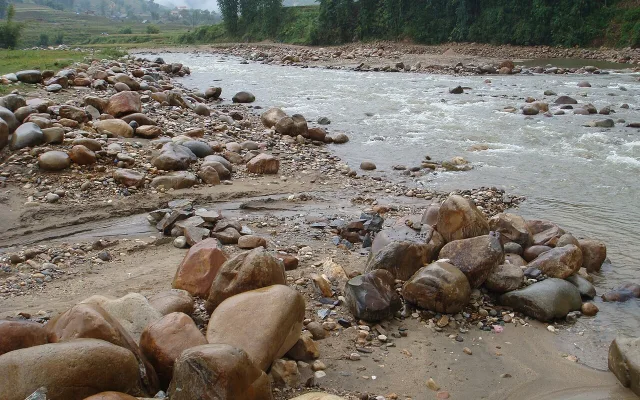
- The Muong Hoa valley — the rice terraces themselves, cut into the slopes by generations of Hmong and Dao farmers. Boulders carved with prehistoric petroglyphs are scattered along the valley floor.
- Cat Cat village — the closest to town and the most touristed, with a waterfall in the middle of it; fine if you have no time for real trekking.
- Lao Chai and Ta Van — the classic one- or two-day route, with a night in a local house.
- Ta Phin — a Dao village: traditional houses, embroidery for sale, and the famous soak in a wooden tub of mountain herb infusion.
- Ham Rong mountain — a viewpoint park right in the centre of Sapa, about an hour's climb on foot.
- The Silver Waterfall (Thac Bac) — a two-hundred-metre cascade 12 km out along the road to the Tram Ton pass.
- The Love Waterfall — next door to the Silver, reached by a path along a stream.
- The Sunday market at Bac Ha — the largest highland market in the region, 100 km from Sapa. It runs on Sundays only, so you leave before dawn.
- Ban Ho — a route further out and quieter, for anyone wanting to get away from the crowds.
- Sapa Stone Church — a French building of 1895 on the main square, which the whole town gathers around in the evening.
Food and prices
The cooking is Vietnamese with highland additions: thang co (a thick horse-meat soup, the Hmong speciality), rice pancakes and flatbreads, skewers grilled over coals at street braziers, and hotpot on the table. Lunch in a café runs 100,000–210,000 dong ($4–8), dinner in a restaurant 320,000–650,000 dong ($12–25) and coffee 50,000–80,000 dong ($2–3). A litre of petrol is about 26,000 dong ($1), a taxi ride 130,000–320,000 dong ($5–12), a scooter 210,000–320,000 dong ($8–12) a day, the Fansipan cable car around 800,000 dong ($30) return, and a Hmong guide for trekking 650,000–1,300,000 dong ($25–50) a day. Prices are as of 2026.
Transport
There is no airport at Sapa. From Hanoi (about 320 km) there are two ways up: the night train to Lao Cai, eight hours at 1,000,000–2,100,000 dong ($40–80) for a berth, then an hour by taxi or minibus into the mountains; or a direct sleeper bus in five to six hours for 320,000–650,000 dong ($12–25). Locally there are taxis, rented scooters (the mountain roads are steep and often wet, so not for beginners) and walking routes with a local guide.
When to go
March–May and September–November are the best months, at 12–22°C. In September the terraces turn gold as the rice is harvested. In May and June they are being planted, and the flooded steps work as mirrors. Winter (December–February) is 0–10°C, damp and sometimes snowy. Summer (June–August) is 18–26°C but it is the rainy season: cloud, fog and landslides on the mountain roads. At 1,600 m you want a warm layer in any month.