Description
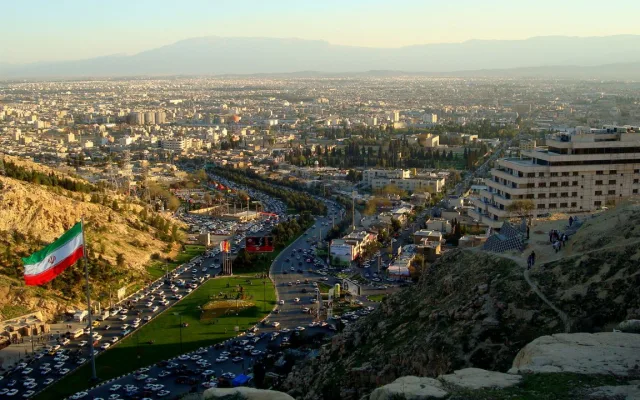
The city of the Persian poets: the tombs of Hafez and Saadi, the Nasir al-Mulk Pink Mosque, cypress gardens, and Persepolis an hour's drive away.
Wiki
Capital of Persia under the Zand dynasty (1751–1794) and the cultural heart of Iran — around 1.9 million people in Fars province, some 920 km south of Tehran. For Iranians themselves, Shiraz is above all the city of poets: Hafez and Saadi lived and are buried here, and people travel from all over the country to their tombs as if on pilgrimage. For a visitor it is also the base for Persepolis, the ceremonial capital of the Achaemenids, 60 km away. Arrange your visa in advance and bring cash: foreign cards do not work in Iran.
The main sights
- Persepolis (Takht-e Jamshid) — a UNESCO site 60 km from the city. Darius I began building it around 518 BC; in 330 BC the palaces were burned by the army of Alexander the Great. One of the greatest archaeological sites in the world; allow half a day, and note that there is almost no shade.
- Naqsh-e Rustam — the tombs of four Achaemenid kings (Darius I, Xerxes I, Artaxerxes I and Darius II) cut into a sheer cliff face, 12 km from Persepolis. Lower down the rock are Sasanian reliefs of royal triumphs.
- Pasargadae — a UNESCO site 130 km away: the first capital of Cyrus the Great and his tomb, a severe stone mausoleum on a stepped base (Cyrus died in 530 BC).
- The Nasir al-Mulk Mosque (the Pink Mosque) — built between 1876 and 1888, and still the most photographed mosque in Iran. Come at dawn, roughly between seven and nine, which is the only time the sun drives through the stained glass and floods the carpets with colour.
- The Eram Garden — a UNESCO site as part of the serial Persian Garden listing: the great 19th-century Shirazi garden, with an avenue of cypresses and a Qajar palace.
- The Karim Khan Citadel (Arg-e Karim Khan) — a squat 18th-century fortress right in the centre of town, with one corner tower noticeably out of true.
- The Tomb of Hafez (Hafeziyeh) — the main object of Iranian pilgrimage in Shiraz. People bring a copy of the Divan of Hafez, open it at random and read what falls out as a prediction.
- The Tomb of Saadi — the memorial to the other great Shirazi, the 13th-century poet, set in a garden with an underground pool reached by a flight of steps.
- Shah Cheragh — a shrine-mosque lined entirely with mirror mosaic inside; the city's principal holy site and a working place of pilgrimage, where non-Muslims are admitted with an attendant.
- The Vakil Bazaar — an 18th-century covered market: carpets, spices and tea houses in the courtyards of its caravanserais.
- The Vakil Mosque — of the same century, with a prayer hall carried on forty-eight spiral columns.
- Narenjestan-e Qavam and the Delgosha Garden — smaller gardens, worth a look if there is time left.
- Wine — Shiraz was a wine city for centuries and production stopped after the 1979 revolution. The name of the Syrah (Shiraz) grape is traditionally linked to the city, though genetic analysis traces the vine to the Rhône valley in France.
Food and prices
The cooking is Iranian with Shirazi additions: salad-e Shirazi (finely chopped tomato, cucumber, onion and mint), kashk-e bademjan (aubergine with whey sauce), kalleh pacheh, chelo kebab and, above all, faloodeh Shirazi — a cold dessert of thin rice noodles with rose water and lime juice. Lunch in a local canteen runs $4–8, dinner in a restaurant $12–25 and a taxi across town $1–3. Prices are as of 2026 and left in dollars, which is how visitors are normally quoted here. Petrol is among the cheapest in the world at roughly $0.03 a litre. Alcohol is banned nationwide. Foreign cards do not work: bring dollars or euros in cash and change them locally. Note too that prices are written in rials but quoted in tomans, which are simply rials divided by ten.
Transport
Shiraz International Airport (SYZ) handles domestic flights on Iran Air and Mahan Air plus a handful of Middle Eastern routes. A taxi into the centre is $5–7. From Tehran it is an hour and a half by air ($50–100) or twelve to fifteen hours on the night train. Around town there are ordinary taxis and the Snapp app, the Iranian equivalent of Uber, plus one working metro line. For Persepolis, Naqsh-e Rustam and Pasargadae the simplest approach is to hire a car with a driver for the day and take all three in one loop — by public transport it becomes three separate trips.
When to go
April–May and September–October, at 18–25°C, are the best months. In April the bitter orange trees flower in the city gardens and the whole of Shiraz smells of neroli. Summer (June–August) runs 35–42°C and going out in the middle of the day is hard work. Winter (December–February) is 5–15°C, cool and damp. At Nowruz (21 March) the city looks wonderful but much of it is closed and rooms cost noticeably more.