Skopje
North MacedoniaDescription
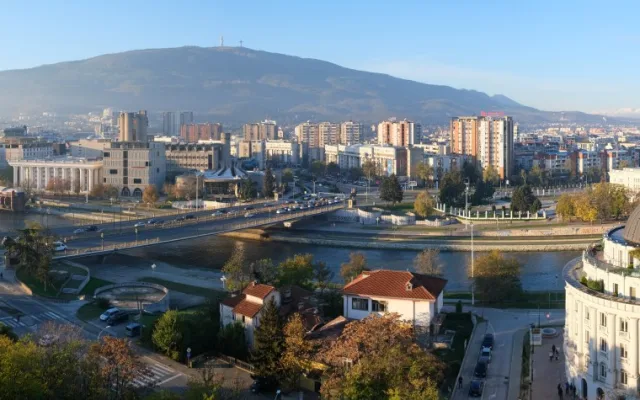
The capital of North Macedonia, home to the bombastic "Skopje 2014" urban project, a historic Ottoman bazaar, and the Kale fortress above the Vardar river.
Wiki
The capital of North Macedonia and Europe's most eccentric urban design project of the 21st century — around 540,000 inhabitants. After a devastating earthquake in 1963 (1,070 deaths, 80% of the city destroyed), Skopje was rebuilt in the 1960s–70s to a plan by Kenzō Tange in a modernist Brutalist style. From 2010, the "Skopje 2014" project overlaid this with a massive neoclassical rebrand: dozens of monumental buildings and over 100 statues. The result is deeply controversial, but the atmosphere is unlike anywhere else. Skopje is also the birthplace of Mother Teresa (1910).
Main sights
- Macedonia Square (Ploštad Makedonija) — the main square, dominated by a 22-metre equestrian statue of Alexander the Great, surrounded by eight fountains.
- Stone Bridge (Kamen Most) — the symbol of the city, a 15th-century Ottoman bridge across the Vardar.
- Old Bazaar (Stara Čaršija) — the largest Ottoman bazaar in the Balkans outside Istanbul, with mosques dating from the 15th and 16th centuries.
- Kale Fortress (Tvrdina Kale) — a 6th-century Byzantine fortress on the hill above the city, with sweeping views.
- Museum of the Macedonian Struggle — a contemporary museum in a neoclassical building opened in 2011.
- Memorial House of Mother Teresa — she was born in Skopje on 26 August 1910; the house is now a museum.
- Cathedral of Saint Clement of Ohrid — the main Orthodox cathedral.
- Mustafa Pasha Mosque — the city's principal Ottoman mosque, 15th century.
- Matka Canyon — the main natural attraction, 20 km from the centre; boat tours on a mountain lake and cave visits.
- Tikveš Wine Region — North Macedonia's leading wine-producing area, about 1.5 hours away.
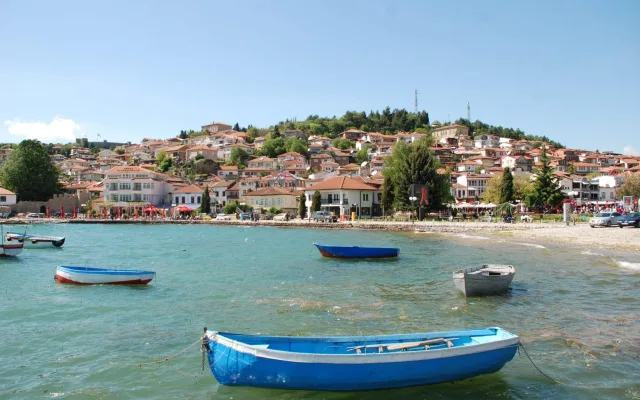
- Ohrid — 170 km away, a UNESCO World Heritage Site.
- Mount Vodno — viewpoint above Skopje, with the 66-metre Millennium Cross and a cable car.
Food and prices
Macedonian cuisine centres on tavče gravče (beans baked in a clay pot — the national dish), ajvar, shopska salad, muškalica (grilled meat with vegetables), and rakija. Lunch at a kafana costs 7–12 € (about $8–14), dinner at a restaurant 15–30 € ($17–35). A glass of Tikveš or Bovin wine is 3–5 € ($3–6). A litre of petrol costs around 1.4 € ($2), a fixed-rate city taxi 3–7 € ($3–8), and a single public-transport fare 0.7 € ($1). The national currency is the denar (MKD), pegged to the euro at about 61.5 MKD to €1. Prices are as of 2026.
Getting there and around
Skopje International Airport (SKP) is served by Wizz Air, Pegasus, Turkish Airlines, and Lufthansa. A shuttle to the centre costs 5 € ($6), a taxi 25–30 € ($29–35). From Sofia, buses take 5–6 hours (15–25 €/$17–29); from Pristina, around 2 hours (10–15 €/$12–17). The city centre is compact enough to walk; local buses are run by JSP. Buses to Ohrid take 3–4 hours (12–20 €/$14–23).
When to go
April to October brings temperatures of 12–30 °C. May–June and September are the sweet spot. Summer (July–August) is hot, reaching 30–37 °C. Winter (December–March) ranges from 0 to −5 °C with frequent valley fog. The Skopje Jazz Festival takes place in October. The classic itinerary combines Skopje with Ohrid for 3–5 days.