Description
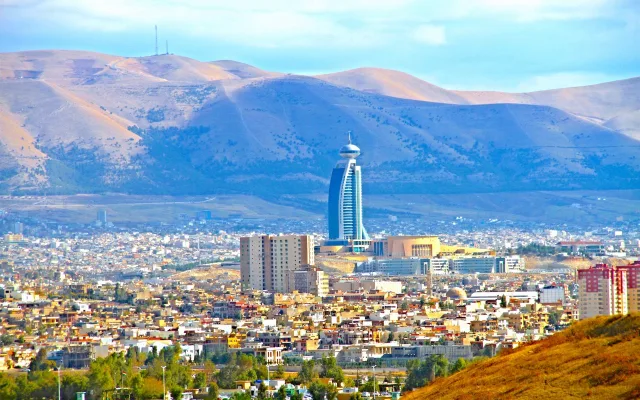
The cultural capital of Iraqi Kurdistan: the country's second-largest museum, the Amna Suraka prison memorial, a huge covered bazaar and green mountains on three sides.
Wiki
The cultural capital of Iraqi Kurdistan and one of the most liberal-minded places in the Middle East — around 880,000 people at 850 m altitude, in a valley between Mount Goizha and Mount Azmar. The city was founded in 1784 by the Kurdish emir Ibrahim Pasha Baban. Unlike businesslike Erbil, Sulaymaniyah is the university and literary centre of the Kurdish world: books are published here, the theatres work, and politics is argued out loud in the coffee houses. Check the current security situation before you travel: Iraqi Kurdistan is relatively calm, but it is an autonomous region of Iraq with its own visa rules — the Kurdistan Region visa is issued separately from the Iraqi one.
The main sights
- The Slemani Museum — the second-largest museum in Iraq after Baghdad's, and the best collection of Mesopotamian antiquities outside the capital: Sumerian and Assyrian material, plus a large Kurdish ethnographic section.
- Amna Suraka ("the Red Prison") — the former headquarters and jail of Saddam's security service, turned into a memorial museum to the victims of the regime. The walls are still riddled with bullet holes and wrecked armour stands in the yard. One of the most affecting museums in the Middle East — allow a couple of hard hours.
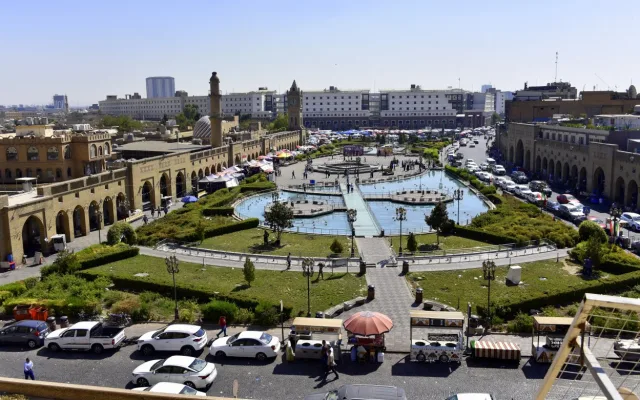
- The Grand Bazaar — the largest covered market in Iraqi Kurdistan: spices, fabric, tea houses, money changers.
- The Seray Mosque — the city's principal mosque, beside the old bazaar.
- Mount Goizha — a viewpoint directly above the city, reached by a surfaced road; people drive up in the evening to watch the valley light up.
- Mount Azmar — the city's other mountain, popular with locals for walks and picnics.
- Azadi Park — the main city park and the place families come out to in the evening.
- Halabja — a town 75 km east, the site of the chemical attack by Saddam's army in March 1988, in which by various estimates up to five thousand people died. The memorial and museum make for an essential and very heavy day out.
- Lake Dukan — the largest body of water in the region, 60 km away; in summer people drive out to swim and eat fish.
- Mount Halgurd (3,607 m) — the highest peak lying entirely inside Iraq, about four hours from Sulaymaniyah. Climb only with a local guide: there are still mines in these mountains.
- The northern mountain villages — Kurdish settlements of stone houses, terraced gardens and springs, worth at least half a day.
Food and prices
The cooking is Kurdish, with strong Iranian and Turkish influence: dolma (stuffed vine leaves), kebabs, saffron rice, kubba (meatballs in bulgur), buttered tea, pomegranates and other fruit. Lunch in a café runs $5–10, dinner in a restaurant $12–25. A litre of petrol is about $0.50, a taxi across town $2–5, a car from Erbil $50–80. Prices are as of 2026 and given in dollars, which are quoted here as readily as dinars. Alcohol is sold openly in Kurdistan, unlike in southern Iraq. The region runs on cash: cards are rarely accepted and dollars circulate alongside dinars.
Transport
Sulaymaniyah International Airport (ISU) has links to Istanbul, Doha, Dubai and Amman, and a seasonal Condor service from Düsseldorf. The choice of flights is noticeably thinner than at Erbil (EBL, 200 km away), so it is often cheaper to fly there and continue overland. Citizens of the EU, the UK, the US, Canada, Australia and several dozen other countries are given a 30-day Kurdistan Region visa on arrival. Note that it is valid only in Kurdistan — travelling on to Iraq proper requires a separate Iraqi visa. In town there are taxis and shared minibuses; there are no meters, so agree the fare first. For anything outside the city it is simpler to hire a car with a driver for the day.
When to go
March–May and October–November, at 18–28°C, are the best months. Summer (June–September) runs 35–42°C and going out in the middle of the day is hard work. Winter (December–February) is 0–12°C, damp in the city and snowy in the mountains. The event of the year is Newroz, the Kurdish new year on 21 March: bonfires are lit on the hillsides the night before, and it is worth seeing. Once again: check the current security situation before you go.