Description
Estonia's university capital — home to the country's oldest university, Town Hall Square, and the AHHAA science centre.
Wiki
Tartu is Estonia's second-largest city and its recognised intellectual and student capital. It is home to the country's oldest university, and its compact historic centre — with its Baroque Town Hall Square, the green hill of Toome (Toomemägi), and the celebrated AHHAA science centre — makes the city easy to explore at a leisurely pace over one or two days.
Overview
Tartu lies in south-eastern Estonia, on the banks of the Emajõgi river, roughly 185 kilometres south-east of Tallinn. With a population of around 90,000–95,000, it is the country's second-largest city after the capital. Tartu is traditionally contrasted with Tallinn's commercial and port character: while Tallinn is Estonia's political and economic hub, Tartu is considered the heart of Estonian science, education, and culture. Life here moves at a measured, academic pace shaped largely by the university around which the entire city revolves.
The historic core is small, and most of the main sights are within walking distance of Town Hall Square. This makes Tartu ideal for exploring on foot — the principal attractions can be covered without needing public transport. Many visitors come for a day trip from Tallinn, but two days allow you to see not only the centre but also the museums, parks, and the atmosphere of the student quarters.
Geography and Climate
The city stands on the Emajõgi ("Mother River"), which connects Estonia's two largest lakes — Võrtsjärv and Lake Peipus. The terrain is broadly flat, but the centre is enlivened by Toomemägi (Dome Hill) — a wooded rise with a park, the ruins of a medieval cathedral, and university buildings. The river divides the city into two halves linked by several bridges, including the symbolic Arch Bridge (Kaarsild) and the "Angel Bridge."
The climate is temperate, transitional between maritime and continental, with more pronounced seasonal swings than on the coast. Winters are cool and snowy, with average temperatures around −5 °C; summers are mild and pleasant, averaging +17–+20 °C. Autumn and spring are often rainy and windy.
History
Tartu is one of the oldest cities in the Baltic region: the first written record dates to 1030, when Yaroslav the Wise, Grand Prince of Kyiv, established a fortification here called Yuryev. Later, during the German expansion into Livonia, the settlement became known as Dorpat and grew into an important episcopal and trading centre of the Hanseatic League. Over the centuries the city changed hands many times — it was held by the Livonian Order, the Polish–Lithuanian Commonwealth, Sweden, and the Russian Empire.
A turning point came with the founding of the university: in 1632 the Swedish king Gustavus II Adolphus established the Academia Gustaviana. That date secured the city's status as an educational centre. Under the Russian Empire (from the eighteenth century onward), the university was re-established in 1802 and became one of the leading scientific institutions of its day, attracting many distinguished scholars. In the nineteenth century Tartu played a key role in the Estonian national awakening, hosting the first All-Estonian Song Festival in 1869. In 1920 the Treaty of Tartu was signed here between Soviet Russia and the Republic of Estonia. Much of the historic fabric was damaged during the Second World War, but the historic centre was subsequently rebuilt.
Best Time to Visit
The best season runs from late spring to early autumn, when outdoor cafés fill Town Hall Square, the parks of Toomemägi and the Emajõgi riverbank turn green, and the weather invites long walks. The atmosphere is especially lively during term time, when the city is full of students. Summer is the peak season for festivals, concerts, and events. In winter Tartu is quieter, but the Christmas market and the illuminated Old Town create a cosy mood. Bear in mind that student life winds down considerably during the summer holidays.
Getting to Tartu
Tartu has a small airport, but international services are limited, so most travellers arrive overland. The most convenient approach is to fly into Tallinn first and continue to Tartu from there.
- Bus. The most popular option. Regular services connect Tartu with Tallinn (about 2.5 hours), as well as with Riga, Pärnu, and other cities. The bus station is close to the centre.
- Train. Comfortable trains run between Tallinn and Tartu, with a journey time of around two hours. The railway station is within easy walking distance of the historic core.
- Car. A good road leads from Tallinn; the drive takes about 2–2.5 hours and allows for stops along the way.
Travellers arriving via Finland typically fly into Helsinki (Helsinki-Vantaa Airport), cross the Gulf of Finland by ferry to Tallinn, and continue to Tartu by bus or train. Within the city itself, public transport is served by buses, but they are barely needed in the centre — everything is compact and walkable.
Main Sights
Tartu's sights lend themselves to a logical circuit: start at Town Hall Square, climb Toomemägi, descend to the university buildings, and finish the day at one of the museums. Most key sights lie within a half-hour's walk of each other.
Old Town
Tartu's historic centre is a place of cobbled lanes, Baroque and Neoclassical buildings, and an abundance of cafés and bookshops. The heart of the Old Town is the block around Town Hall Square and Rüütli Street. Particular attention is due to Toomemägi, which has been laid out as a picturesque English-style park: it preserves the ruins of the Gothic Dome Cathedral (Tartu Cathedral), now partly converted into a museum, as well as several symbolic bridges and pavilions. The hill offers views over the river and tiled rooftops. A walk through the Old Town conveys the distinctive student atmosphere and brings several centuries of history to life.
Town Hall Square
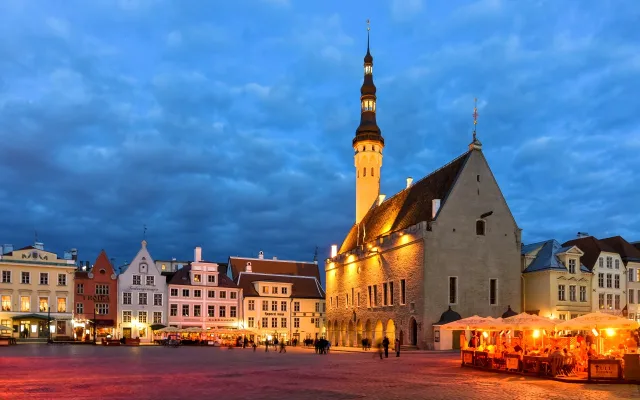
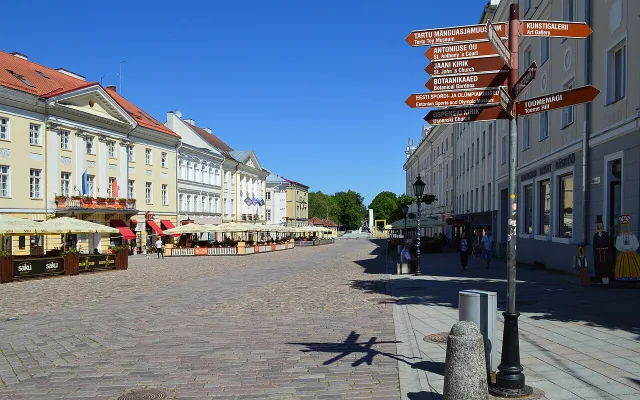
Town Hall Square (Raekoja plats) is Tartu's main and most elegant square, stretching from the town hall building down toward the river. At its centre stands the eighteenth-century town hall in an early Neoclassical style, with a pink-cream façade and a clock tower. In front of the town hall stands one of the city's symbols — a fountain with the sculpture of the "Kissing Students." The square is lined with colourful merchant houses, among which the famous "leaning house" stands out — a noticeably tilted building that now houses an art museum. In summer the square fills with café terraces, markets, and street musicians; in winter a Christmas tree and festive lights take over. It is the natural starting point for any walk through the city.
The Kissing Students Fountain
The bronze "Kissing Students" sculpture is Tartu's most recognisable image and the unofficial symbol of its youth and romanticism. A couple sharing a kiss beneath an umbrella, set in the middle of Town Hall Square, appears in almost every photograph taken in the city. The composition underscores Tartu's identity as a student capital and has become a favourite spot for meetings, dates, and memorable photos. Small in scale but rich in symbolic weight, the fountain fits naturally into the Baroque ensemble of the square.
Estonian National Museum
The Estonian National Museum (Eesti Rahva Muuseum) is one of the country's foremost cultural institutions and Tartu's largest museum. It is devoted to the history, ethnography, and everyday life of the Estonian people, as well as the cultures of the Finno-Ugric peoples. The modern museum building, opened in the second half of the 2010s, has itself become an architectural attraction: the elongated glass structure was built on the site of a former Soviet military airfield and appears to "take off" over the open ground. The permanent galleries cover Estonian traditions, crafts, costumes, and national identity in depth, while interactive sections make a visit engaging for both adults and children.
Tartu University History Museum
Tartu University is the oldest in Estonia, and its history is closely intertwined with that of the city. The University History Museum occupies the former Dome Cathedral building on Toomemägi and traces the development of science and education in the Baltic region. The exhibition covers the institution's history from its founding, and features distinguished scholars, student traditions, and scientific discoveries. Particularly worth seeing are the historic lecture halls and the old student detention cell, its walls still covered in inscriptions left by former inmates. The main university building — a Neoclassical structure with columns — is another architectural landmark of Tartu.
Tartu University Botanic Garden
The university's Botanic Garden is a green oasis in the city centre and one of the oldest scientific institutions of its kind in the region, founded in the early nineteenth century. On a relatively modest plot it holds a rich plant collection, from local flora to exotic species displayed both outdoors and in glasshouses with tropical and subtropical zones. The garden serves as a research base for the university and a favourite retreat for residents. Strolling among palms, cacti, and flowering beds makes a pleasant end to any tour — particularly on a cool day, when the warm glasshouses offer a welcome refuge.
More to See
If time allows, the AHHAA Science Centre is well worth a visit — the largest interactive science museum in the Baltic states, where experiments and exhibits can be handled and operated directly; it is especially popular with families. Also of interest are the Emajõgi embankment with its excursion boats, the Supilinn ("Soup Town") neighbourhood with its timber architecture, and the many cosy cafés and bookshops that draw visitors back to Tartu again and again. Two days in the city allow you to combine the main sights with an unhurried immersion in its distinctive student atmosphere.