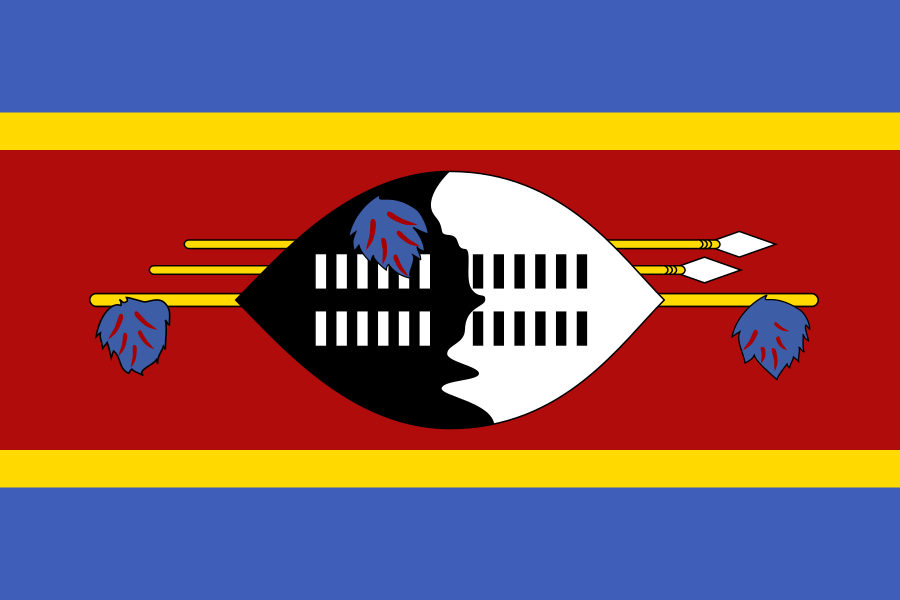
Eswatini
SZAfrica's last absolute monarchy — a tiny kingdom wedged between South Africa and Mozambique, known as Swaziland until 2018. A young king rules, and thousands of young women dance at the annual Umhlanga ceremony. For its size, Eswatini is remarkably varied: mountain ranges and savannah, rhino and elephant, traditional villages and lively craft markets. It is one of the most affordable safari destinations in Africa.
Where to go #
Mbabane
The administrative capital sits in hill country above a thousand metres, and it feels startlingly calm and tidy. It is the practical place to stock up at a big supermarket before heading into the reserves. One day is enough: adjust to the pace of the country and walk through the craft market.
Manzini
The commercial hub and the busiest town in the kingdom, right in the middle of the country. For independent travellers the draw is the huge Thursday market, where baskets and carving cost far less than in the capital. It also works as a transport hub for the pineapple country.
Lobamba
The legislative capital, in the heart of the Ezulwini valley and the spiritual centre of the nation. Parliament, the national museum and the King Sobhuza II memorial are all here, and this small place hosts the royal ceremonies that foreign visitors are officially allowed to watch.
Ezulwini
The main tourist valley, with the best choice of places to stay and things to do, all wrapped in green hills. Come for the Mantenga cultural village with its beehive huts and the waterfalls behind it. Ideal if you want comfortable rooms within reach of wildlife.
Piggs Peak
A small town in the north-west, surrounded by forest and deep canyons that look more like Alpine foothills than southern Africa. Good for hikes into the high reserves and to the oldest mine in the world, with atmospheric lodges by the waterfalls nearby.
Malkerns
A scenic valley south of the capital, and the arts and crafts centre of the whole region. It is known for its candle workshops and recycled glass studios. Half a day is enough to watch people work and eat lunch somewhere pleasant.
What to see #
Mlilwane Wildlife Sanctuary: the one place you can walk among zebra and antelope without a guide or a vehicle. There are no big predators, which is exactly why it works, and it is startlingly cheap to enter.
Hlane Royal National Park: where to go for lion, elephant and white rhino in open country. Game drives here cost a fraction of what the equivalent costs across the border in South Africa.
Sibebe Rock: the enormous granite dome above Mbabane, the second largest monolith on earth. The scale only registers once you start climbing it, which takes a hard couple of hours.
Mantenga cultural village: a concentrated introduction to Swazi daily life and to dancing performed with real force rather than for a camera. Half a day, and the falls are next door.
Mkhaya Game Reserve: a hidden reserve specialising in the protection of black rhino, accessible by prior arrangement only. You are collected at a meeting point and driven in, which is part of the appeal.
Malolotja: the high-altitude park, where the canopy tour and zipline take you across a gorge. Also some of the best hiking in the region, with almost nobody on the trails.
Umhlanga: the reed dance in August, when tens of thousands of young women dance together. It is a genuine national event rather than a show, and the scale of it is difficult to convey.
Ngwenya Mine: considered the oldest mine in the world, where red ochre was dug forty-three thousand years ago. Short visit, long perspective.
Prices #
Currency: the lilangeni, pegged one to one with the South African rand.
Cash: rand is accepted everywhere, so there is no point changing money if you are arriving from South Africa. Bring rand and spend it as normal.
Spend it before you leave: emalangeni cannot be exchanged outside Eswatini, and you will get change in local notes constantly. Empty your pockets before the border.
Cards: Visa and Mastercard work in the big shopping centres in Mbabane and at the larger hotels. Reserves, markets and anywhere rural want cash.
Tipping: around ten percent in cafes and restaurants where no service charge is added, and something for a guide after a game drive.
| Item | Price (USD) |
|---|---|
| Street food (fat cakes) | 1.20 |
| Lunch at a town cafe | 8.00 |
| Dinner for two | 28.00 |
| Bottled water, 1.5 l | 0.60 |
| Cappuccino in a mall | 2.30 |
| Sibebe beer | 1.90 |
| Petrol, per litre | 1.10 |
| Taxi across town | 5.00 |
| Kombi between towns | 1.30 |
| Mlilwane entry | 4.00 |
| Game drive at Hlane | 35.00 |
| Cultural village entry | 10.00 |
| Guesthouse, per night | 40.00 |
| Traditional hut in a park | 24.00 |
| Local SIM with data | 3.00 |
Getting around #
Kombis: shared minibuses are how most people move between towns. They leave the ranks when full, cost almost nothing, and are perfectly usable for short hops.
Taxis: there are no ride-hailing apps here, so agree the fare with the driver before you get in. Your guesthouse will call one it trusts.
Car hire: the best option for the reserves, since kombis do not run to the park gates. Most visitors pick up a car in South Africa and drive across.
Driving: traffic keeps to the left, the tar between towns is good, and livestock on the road in the bushveld is a constant hazard. Avoid driving after dark for that reason.
Shuttles from South Africa: comfortable minibuses run daily between Johannesburg and Mbabane or the Ezulwini valley, which is the easiest way in without a car.
The airport: King Mswati III International sits at Sikhuphe, some distance east of the main valley, and the transfer into the capital is not cheap. Factor it into the cost of flying rather than driving.
On foot: towns are fine to walk around by day, though the steep terrain and the absence of pavements on the main roads make it tiring rather than pleasant.
Where to stay #
Beehive huts: sleeping in a traditional grass hut at Mlilwane or Hlane is the distinctive experience here, and it costs very little. Basic, comfortable and much better than it sounds.
Guesthouses: Mbabane and Manzini have plenty of family-run places offering breakfast and local knowledge, which is worth more than a star rating.
Camping: most national parks have proper sites with showers and cooking areas, and this is a country where self-drive campers do very well.
Lodges: the Ezulwini valley and Piggs Peak have atmospheric places with pools, gardens and mountain views at prices that would be impossible over the border.
Book ahead: rooms in the popular state-run reserves need reserving in advance, particularly around the big festivals in August and December.
Bring a layer: nights in the highlands are cool even in summer, so ask about blankets and heating when you check in.
Plugs: British-style type M sockets with three round pins. Buy the adapter in South Africa, since they are hard to find locally.
What to eat #
The staple: maize porridge, pap or sishwala, is the base of any meal, usually with a thick meat stew ladled over it.
Water: don't drink from the tap. Bottled water is cheap and sold in every supermarket, and the reserves all stock it.
Braai: open-fire barbecue is a serious cultural institution across this region. Try boerewors, the spiced coiled sausage, from a roadside stand.
Game meat: restaurants attached to the national parks often serve kudu or impala, which is leaner than beef and genuinely good.
Fat cakes: deep-fried dough balls sold at the Manzini markets, and the cheapest way to fill up in a hurry.
Beer: the local lager Sibebe, named after the monolith, is among the better beers in southern Africa and costs under two dollars.
Emasi: thick soured milk, traditionally eaten with boiled maize kernels. An acquired taste, and the single most Swazi thing on any table.
Safety #
The general picture: Eswatini is one of the calmest countries on the continent, and people are unusually welcoming to visitors.
After dark: don't walk around Manzini or Mbabane at night. Have your hotel call a taxi, which costs a few dollars.
Malaria: the low-lying east, including Hlane, carries a moderate risk. Take advice on prophylaxis if your trip includes those parks, and use repellent at dusk.
In the reserves: never leave the vehicle outside the designated camps. Lion and hippo are both present, and hippo cause more injuries than anything with teeth.
Valuables: watch your pockets at the busy bus ranks and don't display expensive cameras or phones.
Health: HIV prevalence here is among the highest in the world, which is worth being aware of.
Politics: discussing the monarchy or the king with strangers is taboo and can create serious problems. Check your own government's travel advisory before travelling, since there have been periods of unrest.
Etiquette and culture #
The monarchy: the country is proud of having kept its king, whose portrait hangs in essentially every business. That pride is genuine, not performed.
Greetings: getting straight to the point is rude. A greeting and a short exchange come before any question, including asking for directions.
Which hand: pass money or objects with the right hand, or with both. The left alone reads as disrespect.
Umhlanga: the reed dance is a living tradition of national unity rather than a tourist show, and Swazis regard it with real reverence. Behave accordingly if you attend.
Incwala: during the sacred December ritual, photography restrictions are absolute and cameras can be confiscated. Ask before you even take your phone out.
Dress: in rural areas and at the royal villages, women should cover knees and shoulders.
Age: seniority carries status in Swazi culture, and older people are addressed with marked respect. Following that lead makes every interaction easier.
Connectivity #
Languages: English and siSwati are both official, and English is spoken by essentially everyone working in tourism.
Mobile: MTN provides solid 4G in the towns and along the main roads linking Mbabane with South Africa.
Buying a SIM: register at any official operator shop with your passport; it takes a few minutes and data bundles are cheap.
Wi-Fi: slow at budget lodges, so a local data bundle is the better bet if you need to work.
Dead zones: signal disappears entirely in the deep canyons of Malolotja and in remoter parts of the bushveld, which is worth planning around.
Post: sending a postcard from here is a genuine pleasure, and the main office in Mbabane is efficient and sells attractive stamps.
Messaging: all the usual apps work without restriction, so calling home over Wi-Fi or data costs nothing.
Phrasebook #
| English | siSwati | Pronunciation |
|---|---|---|
| Hello (to one person) | Sawubona | sah-woo-BOH-nah |
| Hi (slang) | Eita | AY-tah |
| How are you? | Unjani? | oon-JAH-nee |
| I'm fine | Ngiyaphila | ngee-yah-PEE-lah |
| Thank you | Ngiyabonga | ngee-yah-BON-gah |
| Yes | Yebo | YEH-boh |
| No | Cha | chah |
| Sorry / Please | Ngiyacolisa | ngee-yah-koh-LEE-sah |
| Goodbye (to one staying) | Sala kahle | SAH-lah GAH-shleh |
| How much is it? | Malini? | mah-LEE-nee |
| OK / Cool (slang) | Sharp | sharp |
| Water | Emanti | eh-MAHN-tee |
| Food | Kudla | KOOD-lah |
| Friend | Umngani | oom-NGAH-nee |
| The King | Ingwenyama | ing-weh-NYAH-mah |
| Mountain | Intsaba | in-TSAH-bah |
| Beautiful | Kuhle | KOO-shleh |
| Help me | Ngisiteni | ngee-see-TEH-nee |
| I don't understand | Angivisisi | ahn-gee-vee-SEE-see |
| Welcome | Wemukelekile | weh-moo-keh-leh-KEE-leh |
Good to know #
Getting there: almost everyone comes through Johannesburg. From OR Tambo it is a four-hour drive or a daily shuttle bus to Mbabane, or a short flight to King Mswati III International. Long-haul connections into Johannesburg run from London, Frankfurt, Doha, Dubai, Istanbul, Atlanta and Newark.
When to go: May to September, the dry winter, when the grass is low, the mosquitoes are gone and the game viewing is at its best.
What to pack: a fleece for highland evenings, because the temperature drops sharply once the sun goes down, whatever the season.
Insurance: take a policy covering activities and, if needed, transfer to a private clinic in South Africa, which is where serious cases go.
Hire car paperwork: if you pick up a car in South Africa, arrange the cross-border Letter of Authority from the rental company in advance, or you will be turned back.
Souvenirs: the lutindzi grass baskets from the Malkerns valley are the thing to buy, and buying them at the workshops means the money reaches the weavers.
Borders: most land crossings close between eight and ten in the evening, so don't plan a late-night arrival.