 Города и дороги
Description
A Georgian spa town in a wooded gorge, built around its mineral springs: a park with a free pump room and sulphur baths, a Romanov palace at Likani, and a national park with bears above it.
Wiki
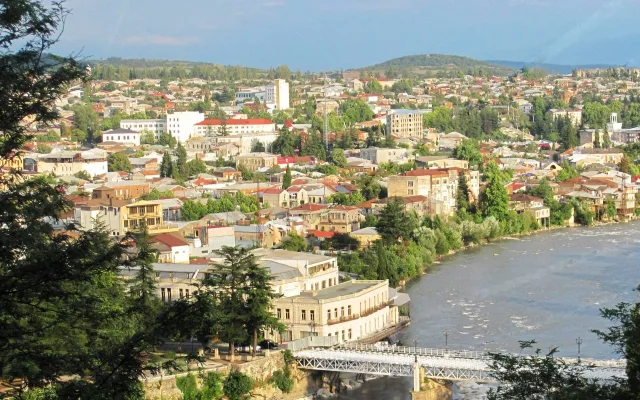
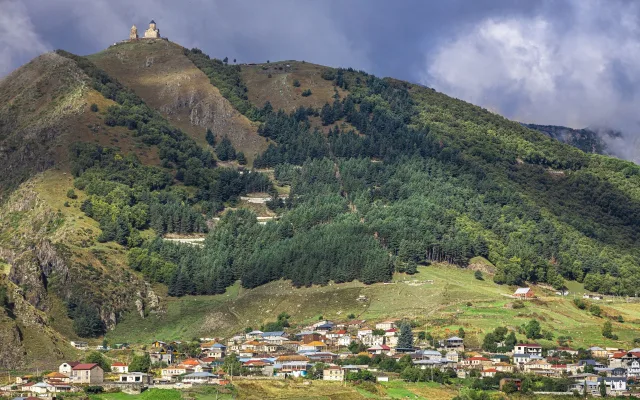
Borjomi is a spa town in Samtskhe-Javakheti, strung out along the Mtkvari on the floor of a narrow wooded gorge; a little over 11,000 people live here, the altitude is around 800 metres, and Tbilisi is some 160 kilometres away. The name first appears in written sources in the 1810s, and the place became known for the mineral springs that soldiers from a regiment quartered nearby came across in the 1820s. In 1871 the estate passed to Grand Duke Mikhail Nikolayevich, and under him and his son Borjomi turned into a summer residence with a park, a palace and a hydropathic establishment; bottling of the water began in the 1890s. The town still lives on that water.
Why come and what to actually see
The Central Mineral Water Park, laid out in 1850, is the axis of the whole resort. It runs along the Borjomula river into the depth of the gorge, and entry is charged at a modest price. At the near end of the park is the main pump room: the water is warm, brackish and alkaline, poured free of charge, and you bring your own container. Some three kilometres from the entrance, by which point you are almost in the forest, there are open sulphur baths — concrete basins of hot water under a rock face.
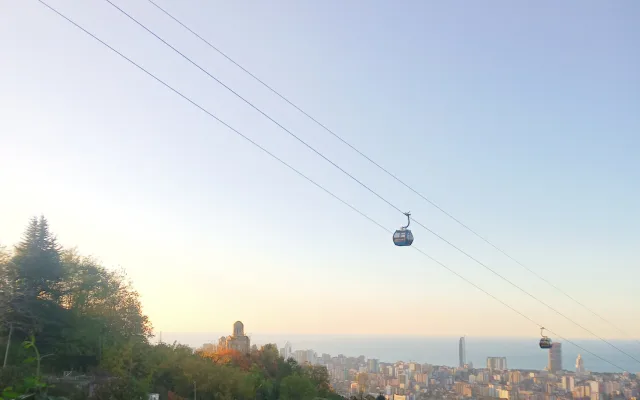
The cable car has been running since 1962 and lifts you from the park entrance to a plateau at about a kilometre: its length is only 376 metres, and there is a viewing platform at the top. The neatest way to do it is to ride up in the cabin and walk back down the forest path straight to the pump room.
Three kilometres downstream, in the village of Likani, stands the Romanov palace. It was designed by the St Petersburg architect Leon Benois and built between 1892 and 1895, with façades handled in a Moorish idiom; to light it, one of the first hydroelectric stations in the Russian Empire was built on the Kura. The building served for a long time as a state residence, so it is not always open inside, but the park around it is.
There is also a local history museum in the former house of the estate manager.
Getting there and getting around
Marshrutkas leave Tbilisi from the Didube station and the journey takes two and a half hours. The train is slower, about four hours, but it arrives at Borjomi-Park station a few steps from the park entrance. From Kutaisi the trip is around three hours. Marshrutkas run between Borjomi and Bakuriani every hour: 30 kilometres and about 40 minutes of road.
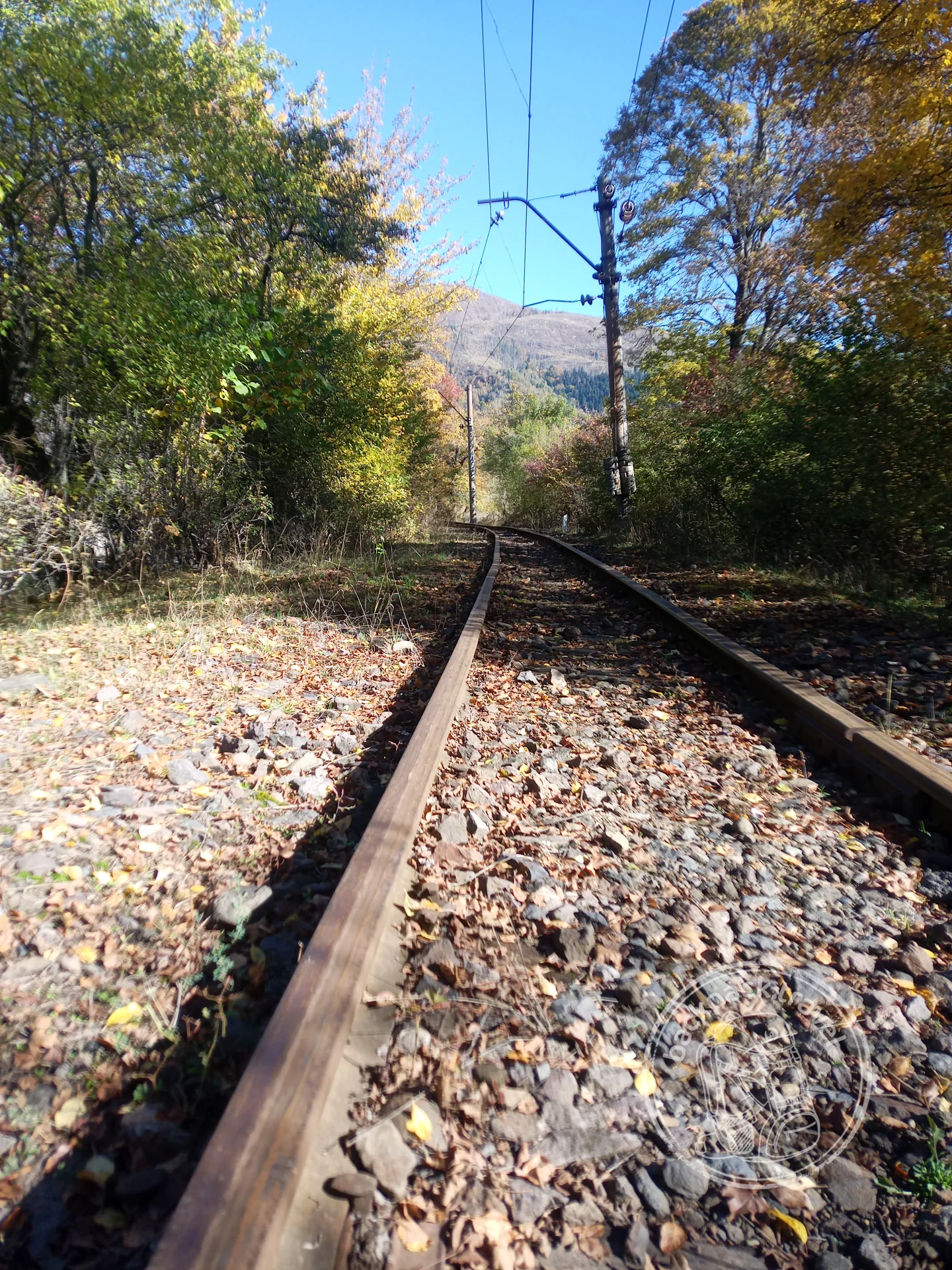
The Borjomi–Bakuriani narrow-gauge line, built in 1898–1901 to a gauge of 900 millimetres, is not operating: the little train known as the kukushka has not run since the early 2020s, the track is stuck in a drawn-out repair, and nobody is naming a date for its return. The arched bridge over the Tsemistskali, attributed to Eiffel's office, is still in place.
Where to stay
The bulk of the accommodation is guesthouses and small hotels on the slopes above the park and along the main street, all within walking distance of the pump room. A category of its own is the Soviet-built sanatoria, some with treatment facilities. Likani is quieter and greener but further from everything. In summer the town fills up, and rooms are scarce in July and August; in winter the flow moves to Bakuriani and prices drop markedly.
Day trips
The Green Monastery, also known as the Chitakhevi church of St George, stands 10 kilometres to the west: a basilica of the ninth or tenth century, with a stream around it whose stones carry red blotches, tied to a grim legend about monks put to the sword.
Timotesubani, 18 kilometres out, is a monastery on the right bank of the Gujaruli. The Church of the Dormition was built between 1195 and 1215, and the paintings of the same date survive almost in full: this is one of the major ensembles of the reign of Queen Tamar.
Bakuriani, 30 kilometres away, is a ski resort at about 1,700 metres, cool in summer and well supplied with trails; in 2023 the village hosted the world freestyle and snowboard championships, after which the lifts were renewed. Abastumani, some 50 kilometres off, is known for its astrophysical observatory of 1932, the first high-altitude one in the USSR.
Further south are Akhaltsikhe with its Rabati fortress, rebuilt by 2012, and the twelfth-century cave monastery of Vardzia — about 130 kilometres away and a full day.
When to come
Altitude takes the edge off summer: the days here usually run to 25 degrees, and nights in the gorge are noticeably colder, so something warm is needed even in July. This is the main season and the busiest one: the park, the pump room and the cable car all work at full load, and hotel rooms are in short supply.
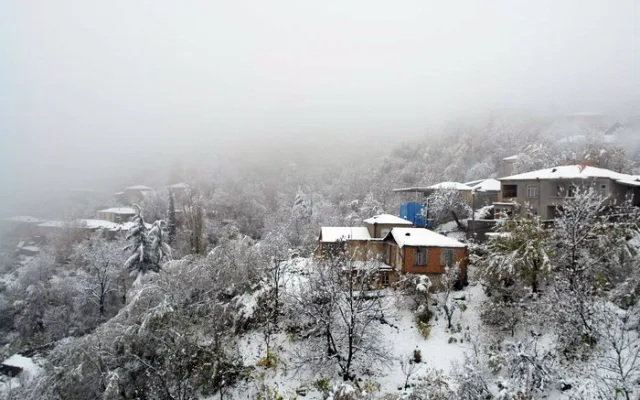
May, June, September and October are the best compromise: warm without the crush, and in autumn the slopes of the gorge turn yellow and rust-coloured. Spring is wet, the paths turn to mud, and some of the higher routes only open by June. Winter is snowy, around zero and below; the park and the baths stay open, but most arrivals drive straight past to Bakuriani, where the ski season holds from December to March.
Food and money
The cooking here is Meskhetian, which is to say Georgian with a few things of its own: tatarberaki, boiled dough with meat and onion, apokhti made from air-dried meat, Imeretian khachapuri, and a lot of trout from the mountain streams. In season there are mushrooms everywhere, along with cornel jam and honey.
Water from the pump room is free, but drinking it by the litre is a bad idea: it is medicinal and heavily mineralised, and warm water from the spring tastes nothing like the bottled version. Cards are accepted in hotels and shops; the market and the marshrutkas need lari in cash.
What to know
Borjomi-Kharagauli National Park covers more than 85,000 hectares, was established in 1995 and opened to visitors in 2001. Trails are meant to be started through the visitor centre in Borjomi, where you register, are given maps and can book huts on the multi-day routes. This is not a formality — there are bears in the park, mountain weather changes within an hour, and there is no signal in a good many places.
The sulphur baths at the far end of the park have no changing rooms, so you change in the forest. The walk out to them from the entrance takes about an hour, and there is no lighting along the way.
Updated