 Города и дороги
Description
The centre of Shida Kartli, 86 km from Tbilisi: a fortress hill above two rivers, the Stalin Museum with its birth house and railway carriage, and the cave city of Uplistsikhe nearby.
Wiki
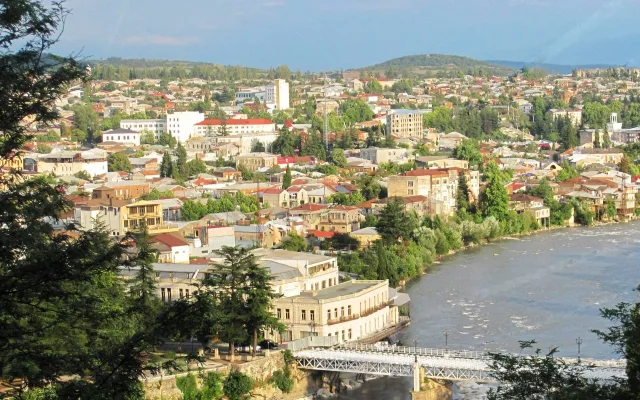
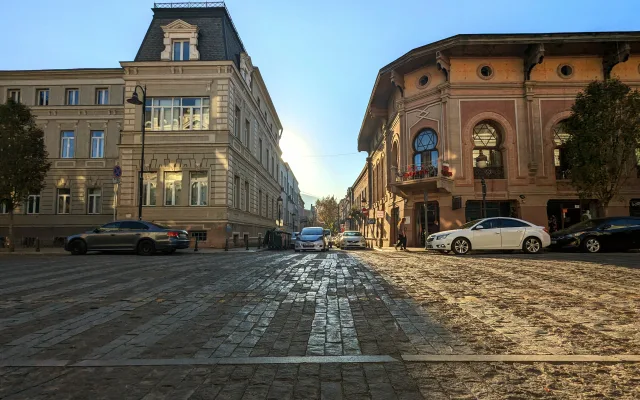
Gori stands 86 kilometres west of Tbilisi, where the Greater Liakhvi joins the Mtkvari, at about 590 metres. It is the fifth largest city in Georgia, with a little over 40,000 residents, and the centre of Shida Kartli — a flat, warm, agricultural region. The chronicles credit the founding of the city to King David the Builder, who reigned from 1089 to 1125; the fortress on the hill appears in sources from the thirteenth century, though excavation shows the hill was occupied a good deal earlier. In 1920 an earthquake destroyed almost all of Gori, so what stands today is Soviet, with straight streets and a large square in the middle. In August 2008 the city found itself inside a combat zone and was held by Russian troops for about two weeks.
Why come and what to actually see
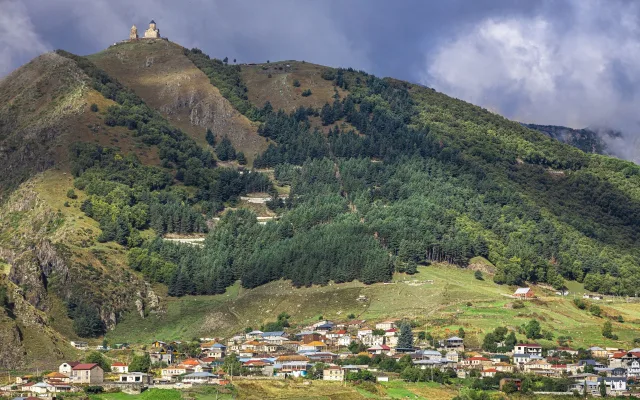
Gori Fortress rises above the city on a free-standing hill. Inside it is almost empty: the same earthquake of 1920 brought down most of the buildings. The climb takes about 15 minutes, entry is free, and from the top you can see the confluence of the two rivers and the whole valley.
The main draw is the Stalin Museum on the central square, which comes in three parts. The first is the house in which Stalin was born in 1878: a small wooden structure, covered by a pavilion with columns. The second is the main building in the late Stalinist manner, begun in 1951 and opened as a museum in 1957; six halls hold personal effects, documents, gifts and the death mask. The third is the armoured Pullman carriage he used from 1941, brought here from Rostov-on-Don in 1985.
The display has barely changed since Soviet times and is arranged according to the logic of that period; the subject of the repressions is confined to a separate small section added later. The museum remains disputed: in 2010 and in 2012 there were plans to turn it into a museum of Stalinism or of the Soviet occupation, and both were abandoned, while the statue of Stalin was removed from the square in front of the building in 2010. It is worth going in the knowledge that this is a museum not only about the man but about how he is remembered.
The city also has a museum of history and ethnography and a small display on the events of 2008.
Getting there and getting around
Marshrutkas leave Tbilisi from the Didube station roughly every 20 minutes, and the run along the motorway takes about an hour and a half. Trains to Kutaisi, Zugdidi and Batumi stop in Gori: the same journey time, cheaper, and the station is in the centre. Kutaisi is about two hours from here, Borjomi roughly an hour and a half.
Gori itself is small: 20 minutes on foot from the station to the square with the museum, another 10 to the foot of the fortress. There is no city transport to Uplistsikhe — take a taxi, or a marshrutka to Kvakhvreli with a walk of a couple of kilometres at the end.
Where to stay
The choice is limited: a few hotels in the centre and fifteen or so guesthouses, at prices noticeably below Tbilisi's. Most visitors sleep in Tbilisi and come to Gori for the day, so rooms can be found in season, but the stock is small and it is better to arrange things in advance.
Day trips
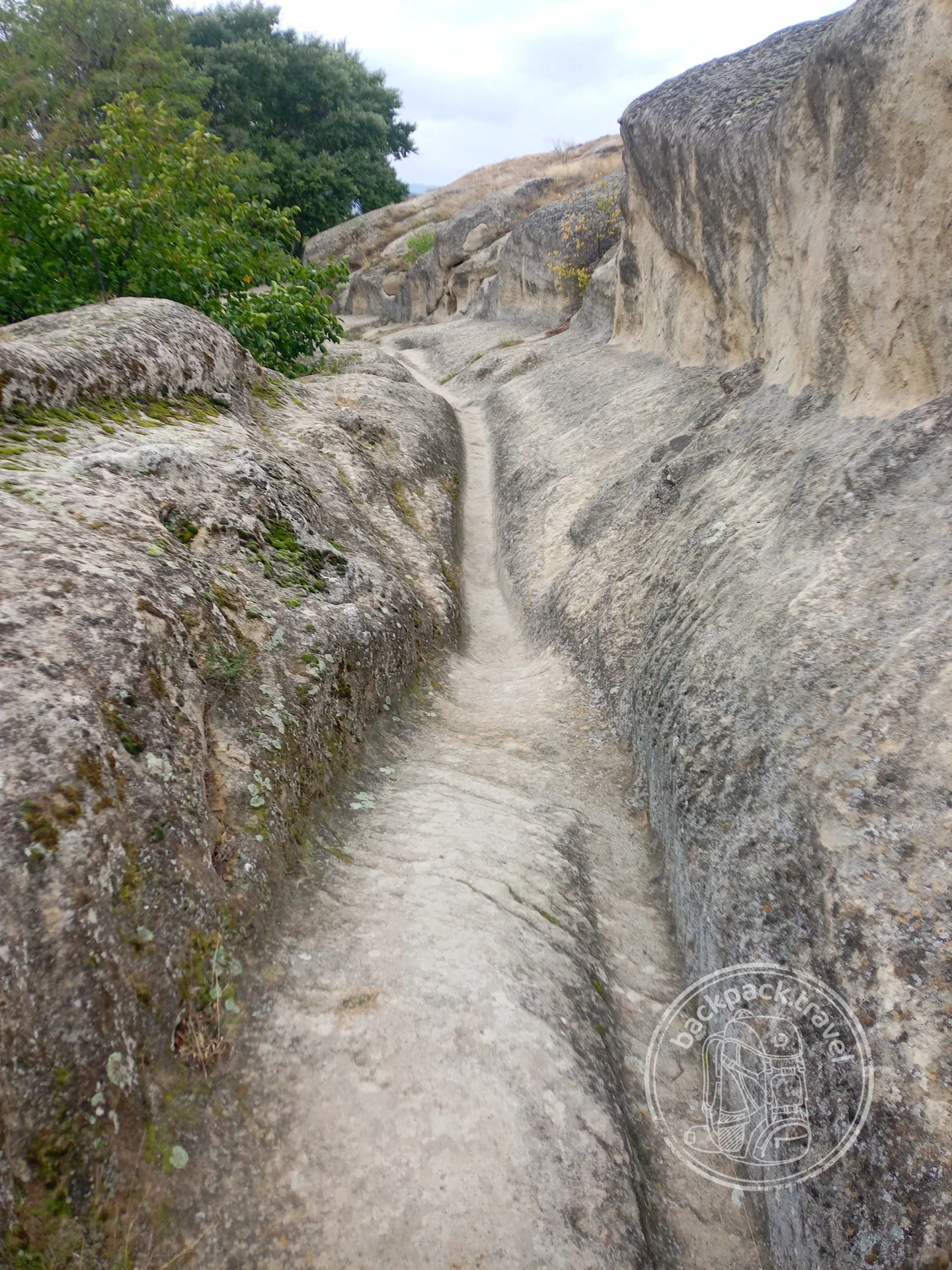
Uplistsikhe, 10 kilometres to the east, is a cave city carved into the rock above the Mtkvari. Traces of human presence appear here at the end of the second millennium BC, the city's height came in antiquity and the early Middle Ages, and it emptied out after the Mongol campaigns. At the top stands a three-aisled basilica of the ninth or tenth century, and below it a hall with a stone bench that is conventionally called the hall of Queen Tamar, along with wine cellars and a rock-cut sanctuary. The stone is polished smooth by feet and slippery, and there is no shade anywhere.
Ateni Sioni is a domed church of the early seventh century, 12 kilometres to the south. It repeats the plan of Jvari, eleventh-century frescoes survive inside, and the gorge itself is known for wine made from the atenuri grape.
Twenty-five kilometres to the west, beyond Kareli, is Kintsvisi monastery, with its church of St Nicholas of the early thirteenth century and paintings of the same date, including the well-known angel against a blue ground.
When to come
Shida Kartli lies in a basin and the summer is hot and dry: daytime temperatures climb towards 35 degrees, and on the open rock of Uplistsikhe there is nowhere to get out of the sun. Better to come between April and June or in September and October, when the days sit a little above 20 and the valley is either green or already harvested.
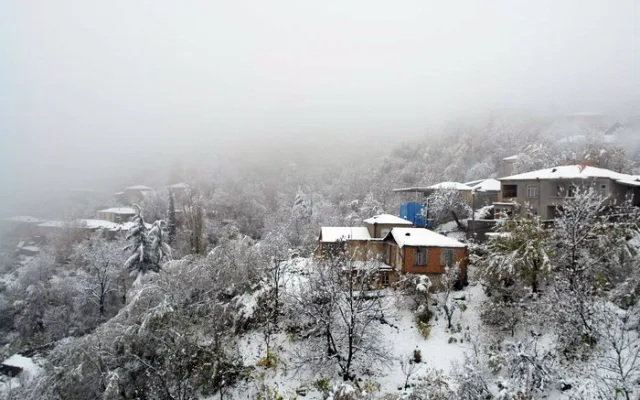
Winter is colder than in Tbilisi, around zero, with snow that does not lie long; the fortress and the cave city are empty at that point, but the wind goes straight through both. Autumn has the grape and apple harvest to recommend it as well — Gori sits in the middle of apple orchards, and it shows at any roadside market.
Food and money
The cooking here is Kartlian, which means basic Georgian without regional extremes: khinkali, chashushuli, shkmeruli, mtsvadi grilled over vine wood. The fruit is more prominent than the meat: apples, peaches and dried fruit are sold the length of the highway. The wine is mostly homemade, from the Ateni gorge.
Cards are accepted in hotels and chain shops, but the market, the marshrutka and family-run cafés need lari in cash. ATMs are only in the centre.
What to know
The northern edge of the municipality runs up to the dividing line with South Ossetia, about 20 kilometres from the city. The line is guarded, it is not marked along its whole length, and people who cross it unaware are detained on a regular basis; driving towards the villages near it without a clear idea of where it runs is not advisable.
The Stalin Museum produces a range of reactions in visitors, and attitudes to the subject within the city itself are not uniform; it is better not to start pointed conversations about it. Otherwise Gori is quiet and provincial: the centre empties early in the evening, English is spoken in hotels and almost never in taxis, and the older generation understands Russian.
Updated