Description
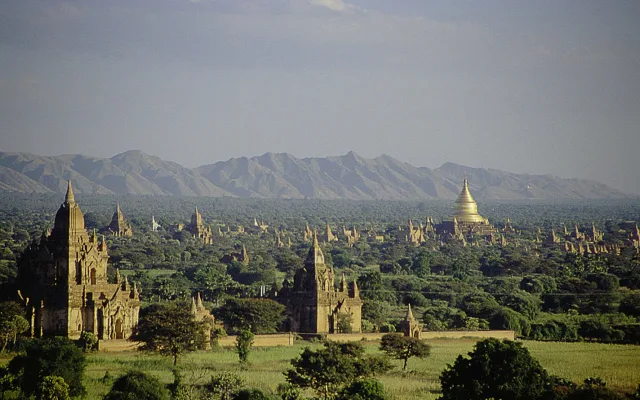
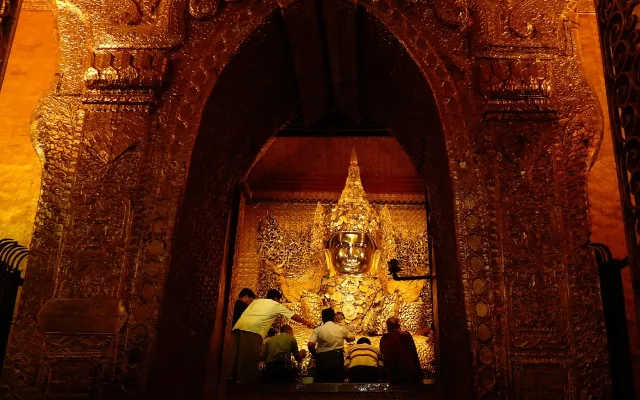
The plain of temples — more than 2,200 Buddhist stupas among the scrub, and balloons over the mist at sunrise.
Wiki
Bagan is the legendary plain in central Myanmar where thousands of red-brick Buddhist temples rise from acacia scrub and fields along the Irrawaddy. It is one of the most extraordinary historical landscapes in Southeast Asia and the emblem of the golden age of Burmese civilisation.
Bagan
This was the capital of the Pagan Kingdom (ninth to thirteenth centuries) and it is the densest concentration of temples on earth: across roughly 40 km² more than 2,200 stupas, pagodas and monasteries survive, from tiny shrines to towering multi-tiered temples. At its height, under King Anawrahta and his successors, thousands of buildings went up here — as many as ten thousand, tradition says. Earthquakes, time and the river destroyed a great many, but what remains is overwhelming, above all at dawn, when mist rises off the plain along with dozens of balloons. Bagan was inscribed on the UNESCO World Heritage List in 2019.
An important warning: check the current situation in the country before you plan anything. An internal armed conflict has continued in Myanmar since 2021, and many governments advise their citizens against travel to the region.
How Bagan is laid out
The area divides into several parts. Old Bagan is the heart of the archaeological zone, where the largest temples stand inside the old walls. Nyaung-U to the north is the liveliest settlement, with the market, cheap guesthouses, cafés and the airport. New Bagan to the south was built in the 1990s when residents were moved out of the historic core; the mid-range hotels are here. Dirt roads winding between the temples connect the villages.
The main sights
- Ananda Temple — Bagan's whitewashed jewel with gilded finials, one of the most revered and best preserved. Inside stand four colossal standing Buddhas.
- Dhammayangyi — the most massive temple of all, a monumental pyramid that was never finished, known for its dark bricked-up corridors and a grim legend about the cruel king who built it.
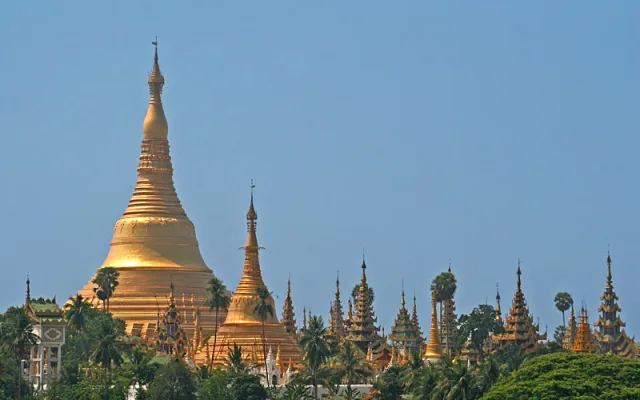
- Shwezigon — a gilded bell-shaped stupa that set the standard for later Burmese architecture.
- Sulamani — the "crowning jewel", a temple of refined brickwork with delicate frescoes on its inner walls.
- Thatbyinnyu — the tallest temple on the plain, a slender white mass in two main tiers.
- Mount Popa — a sacred extinct volcano about an hour and a half away; a monastery sits on the Taung Kalat rock outcrop, reached by a staircase of hundreds of steps. The place is bound up with the cult of the nat spirits.
History and culture
The kingdom of Pagan united the lands of the Irrawaddy valley and became the first great Burmese state. Having adopted Theravada Buddhism, its rulers demonstrated both piety and power through temple building. In the thirteenth century the state weakened under Mongol pressure and broke up, but the religious tradition survived. Many pagodas are still in use: local people come to pray, leave offerings and mark festivals here. At shrines it is customary to remove shoes and socks and to dress modestly, covering shoulders and knees.
Food
The local cooking blends Burmese and Shan traditions. Try mohinga, the fish soup with rice noodles widely regarded as the national dish; lahpet thoke, an unusual salad of fermented tea leaves with nuts and beans; rich curries with rice; and Shan noodles. The market at Nyaung-U sells tropical fruit, palm sugar and local sweets. Lunch in a simple café comes to about $3–5, dinner in a restaurant $8–15.
Transport and practicalities
Nyaung-U airport (NYU) takes domestic flights from Yangon and Mandalay. From Mandalay you can also come down the Irrawaddy by boat (9–12 hours, scenic, $40–60) or by bus in four hours (about $10). The best way to get around the plain itself is an electric scooter, hired at $7–10 a day; bicycles and horse carts are also popular, especially for the sunset spots. Petrol costs around $0.80 a litre. The archaeological zone ticket is about $20 and is valid for several days. A balloon flight at dawn is expensive but unforgettable, at $350–450 a person. Prices are as of 2026.
When to go
The best season is October to February: dry, 20–30°C by day, with cool mornings ideal for sunrises and flights. From March to May the heat becomes punishing, above 40°C. The rainy season (June–September) leaves the plain green and empty, but the balloons do not fly and the dirt roads wash out.
How long to stay
Three days is enough to cover the essentials without hurrying. Give the first to the largest temples of the central zone and a well-chosen sunset spot. Spend the second on sunrise (from a balloon or a high terrace if you can), then work slowly outwards to the further pagodas by scooter. The third is best kept for Mount Popa and for the market and daily life of the villages.