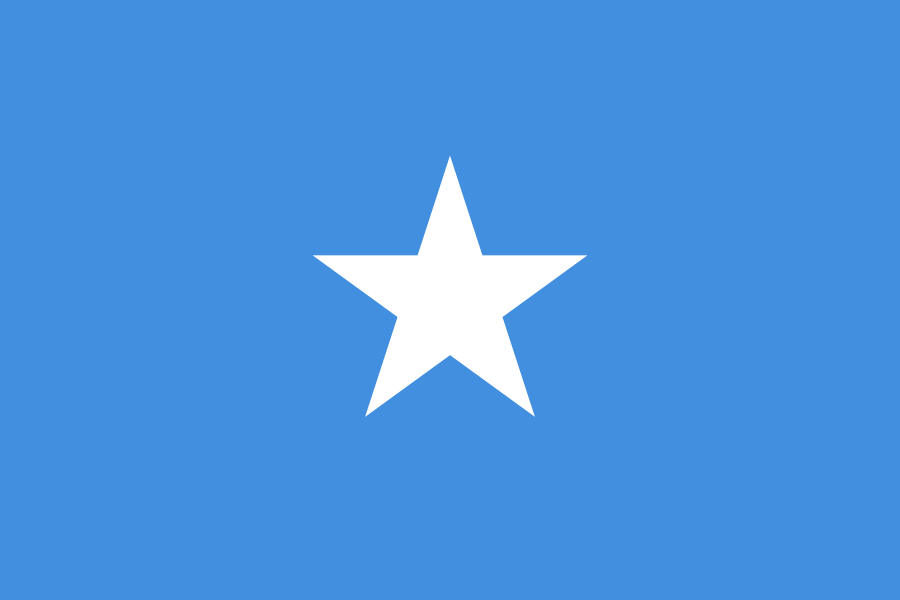
Somalia
SOThe country with the longest coastline in Africa, the ancient rock paintings of Laas Geel and a distinctive nomadic culture. Federal Somalia, in the south around Mogadishu, remains an active conflict zone contested by al-Shabaab. Somaliland, the self-declared republic in the north-west, functions as a separate state with its own currency, visas and relative stability, and receives a growing number of visitors. Somaliland can be visited independently, though going through an operator is advisable.
Where to go #
Hargeisa
The capital of Somaliland feels like a calm, dusty hub where everything revolves around the markets and the coffee houses. It's worth the trip for the atmosphere of an unrecognised but very much functioning state. The centre is safe to walk and people will happily talk to you for an hour over tea.
Berbera
This ancient port on the Gulf of Aden draws people with its abandoned Ottoman-era quarters and turquoise water. For quiet, head to the beaches at Batalale, where the sand is still pristine. Summer heat here is brutal, so plan a winter visit.
Mogadishu
The seat of Somalia's federal government remains a destination for the very determined only. What there is to see: the ruins of the Hamarweyne district and the famous Lido beach. Visiting independently is extremely difficult and demands serious security planning.
Borama
A quiet university town in the west, close to the Ethiopian border. Stop in to see everyday life in the Somali highlands without the bustle of the capital. It has a reputation as one of the most educated and peaceable towns in the region.
Sheikh
A mountain settlement with cool air and a British colonial past. You can fit it into a day from Hargeisa on the way to Berbera. The views over the passes and the Golis mountains are the finest landscapes in the north of the country.
Bosaso
The main economic centre and port of semi-autonomous Puntland. The town runs on trade and fishing and remains an important node on the Horn of Africa. The security situation is unstable, so travelling here carries high risk.
What to see #
Laas Geel: This cave complex holds some of the oldest rock art on earth, and the pigment is still vivid after five thousand years. The stylised figures of people and cattle in ceremonial dress are extraordinarily detailed. It's the single most important place in the country to see.
Camel market: Hargeisa hosts the largest livestock market in East Africa. Get there early in the morning for thousands of animals and fierce haggling. It's loud, pungent and completely genuine, and it tells you more about local life than any museum.
MiG memorial: A downed fighter jet stands on a plinth in central Hargeisa as a symbol of independence. It commemorates the heavy bombing of the city in the late 1980s. It matters deeply to residents and is a standard meeting point.
Old Berbera: You can wander for hours among the ruins of Egyptian and Ottoman buildings. The architecture is crumbling but the grandeur of a former maritime empire is still legible. It's superb material for photographers chasing the vanishing history of the Horn.
Gold market: In Hargeisa, jewellers trade openly on the pavement in the open air. Cases of heavy gold sit next to money changers with enormous bricks of banknotes on the ground. Visually it's the most striking district in the capital.
Golis mountains: The road from Hargeisa to the coast climbs through spectacular passes. Stop on the way to watch the climate zones change abruptly around you. The scenery looks like something staged for a film about untouched wilderness.
Prices #
Currencies: The US dollar is the working currency for anything substantial, hotels included. Somaliland shillings are what you need for markets and transport. In Mogadishu it's the same arrangement, though the notes in circulation are often in poor condition.
Cash: Bring US dollar notes issued after 2013 only. They need to be clean, unmarked and untorn or they'll be refused. Small denominations, 1s, 5s and 10s, are what you'll actually spend on tea and snacks.
Cards: Visa, Mastercard and everything else are simply not accepted, in shops or hotels. Withdrawing cash is close to impossible; a couple of machines exist in Mogadishu and that's it. You carry your entire trip budget in cash.
Mobile money: The local ZAAD and EVC Plus systems let people pay by phone for a single banana. Setting up a wallet as a visitor is hard without a local SIM. Plan on changing physical currency instead.
| Item | Price (USD) |
|---|---|
| Cafe lunch | 4 |
| Restaurant dinner | 15 |
| Litre of camel milk | 1 |
| Cup of spiced tea | 0.5 |
| 1.5l water | 0.8 |
| Sambusa (one) | 0.3 |
| Hargeisa guesthouse | 25 |
| Hotel with security | 60 |
| Taxi across town | 4 |
| 4WD hire per day | 85 |
| Laas Geel entry | 25 |
| Litre of petrol | 0.7 |
| Local SIM card | 3 |
| Transfer to Berbera | 8 |
| Kilo of bananas | 1.5 |
Getting around #
City taxis: In Hargeisa this is the most straightforward way for a foreigner to get around. There are no meters, so fix the fare before you get in. A trip within the centre normally runs two or three dollars.
Shared minibuses: Minibuses connect the towns and leave when they're full. They're cheap but cramped and slow because of the many checkpoints. You'll be showing your passport at every one of them.
Car with driver: The most dependable option for reaching the rock art or driving to Berbera. A 4WD with a driver costs around a hundred dollars a day. It removes both the navigation problems and the friction with security forces.
Domestic flights: Between Mogadishu, Garowe and Bosaso, flying with the local carriers is the safest way to move. Tickets are expensive, from a hundred and fifty dollars one way. Delays are frequent and rarely explained.
SPU escort: To leave Hargeisa, the authorities require you to hire an armed guard. The officer travels in your vehicle and costs roughly fifteen to thirty dollars a day. It applies to every foreigner without exception.
Roads: The highway from the capital to the sea is paved and in decent shape. Secondary routes are more like suggested directions across the desert. Driving between towns after dark is prohibited on security grounds.
Getting here: Hargeisa and Mogadishu are reached via regional hubs, most commonly Addis Ababa, Dubai, Nairobi or Djibouti. Ethiopian Airlines and the Gulf carriers offer the most workable connections from Europe and North America.
Where to stay #
Where to stay: In Hargeisa, the 26 June district is the best base. The city's hotels, coffee houses and money changers are concentrated here. It's the easiest area for walking and for finding transport.
What's available: The choice comes down to concrete hotels and plain guesthouses. In Hargeisa the reliable names are the Ambassador and the Mansoor. Both have enclosed grounds, their own generators and guards on the gate.
Facilities: Hot water is not a given and is often replaced by tanks heated in the sun. Electricity comes on a schedule or from diesel sets. Wi-fi is generally slow, enough for text messages and not much more.
Mogadishu: Accommodation here means fortified compounds in the green zone by the airport. Those hotels sit behind concrete walls with armed security. Prices start around a hundred dollars and climb from there.
Booking: The big international platforms work badly here and don't list most places. The reliable method is messaging hotels directly through the contacts on their social media pages. Payment is always cash on arrival.
Watch out: Cheaper places may ask to hold your passport, which you should decline. Carry several paper copies of your documents instead. Air conditioning is rare and most rooms just have a fan.
What to eat #
Camel: The defining thing to eat here is camel meat, grilled, stewed or served as soup. It tastes like a denser beef with a distinctive aroma and is considered very good for you. If your stomach is delicate, start with a small portion.
Rice and banana: The classic lunch is a mountain of bariis rice with a piece of goat. Somalis always eat rice with a banana alongside it. The sweet fruit against spiced meat works far better than it sounds.
Street food: Sambusa, triangular pastries filled with spiced minced meat, are fried on every corner. Sabaayad flatbreads, similar to Indian paratha, are equally common. This is the cheapest way to eat on the move.
Tea: Shaah is strong tea with milk and a pile of spices including cardamom and clove. It's drunk from small glasses with a lot of sugar. Coffee houses are the centre of men's social life.
Camel milk: Fresh camel milk is slightly salty and extremely filling. It's sold at markets from large plastic jerrycans. Approach with caution if you aren't used to unpasteurised farm produce.
Alcohol: The country is strictly dry. Alcohol isn't sold in hotels or shops anywhere. Attempting to bring any in can lead to serious trouble with police and deportation.
Safety #
The regions differ hugely: Somaliland has been running its own peaceful affairs for thirty years and street crime is lower than in Nairobi. Southern Somalia remains an active armed conflict zone, which is a completely different proposition.
Armed escort: Leaving Hargeisa means taking an SPU guard whether you want one or not. The officer with a Kalashnikov is as much a pass through the checkpoints as protection. It's a legal requirement, not an option.
Clans: Society rests on a complex web of clan ties. Disputes between clans can flare up instantly, especially in the contested eastern territories. Follow the news and take your local guide's advice seriously.
Photography: Photographing military sites, checkpoints, government buildings and airports is absolutely forbidden. Always ask before pointing a camera at anyone. Women in particular may react sharply.
Health: The medical system is weak and competent care exists only in the capital. Buy insurance that specifically covers evacuation to Nairobi. Pack antibiotics and something for diarrhoea.
Mosquitoes: There is malaria risk along the coast around Berbera. Use repellent and cover up in the evening. Drink only sealed bottled water and skip the ice in drinks.
Advisories: Most Western governments advise against all travel to large parts of Somalia, and against all but essential travel to Somaliland. Read your own government's current advice, since it also affects whether your insurance is valid.
Etiquette and culture #
Islam: Religion runs through everything. Five times a day the towns pause for prayer. On Fridays most shops stay shut until evening. Respect local practice and don't enter mosques uninvited.
Dress: Men should not wear shorts; long trousers only. Women need loose clothing to the ankle and a headscarf covering the hair. Dressing revealingly is taken as a genuine insult.
Poetry: Somalis are often called a nation of poets. The spoken word is valued above visual art. Poetry is used to settle disputes, campaign politically and carry clan history forward.
Hospitality: Nomadic tradition obliges people to receive a traveller with honour. Complete strangers will invite you for tea. Declining politely is fine, but a couple of sips will do more for you than anything else.
Khat: Most men chew the leaves of this mild stimulant from early afternoon. Business activity drops off and everyone settles into long philosophical conversation. For a visitor it's simply part of the local rhythm.
Camels: These aren't just animals but the measure of wealth and standing. Camels are used to reckon bride price and the compensation owed for wrongdoing. The attitude towards them is reverent, almost sacred.
Connectivity #
SIM cards: Telesom dominates in Somaliland, Hormuud in Mogadishu. Buy a card at the airport or any small shop with your passport. Mobile data is cheap and surprisingly stable within the cities.
WhatsApp: It's the main communication tool in the country. Hotels are booked, drivers arranged and guides contacted through it. Save every local contact you're given into the app.
Wi-fi: Hotel internet is often nominal, fast enough to check email and no more. For anything real, rely on mobile 4G, which reaches almost everywhere inside the city limits.
Dialling: Somalia uses the country code +252. Somaliland numbers sit under +252 63, which matters when calling local mobiles. Connections between regions can be intermittent.
Language: English is understood at the bigger hotels and among educated younger people. In ordinary shops and taxis you'll be using gestures and short phrases. A handful of Somali words opens doors immediately.
Power: Bring a serious power bank. Because so much runs off generators, mains voltage fluctuates. Sockets are usually British three-pin, so pack an adapter.
Phrasebook #
| English | Somali | Pronunciation |
|---|---|---|
| Hello | Assalamu Alaykum | ah-sah-LAH-mu ah-LAY-kum |
| How are you? | Iska warran? | IS-ka wah-RAHN |
| Thank you | Mahadsanid | ma-had-SA-nid |
| Yes / No | Haa / Maya | hah / MY-ah |
| Please | Fadlan | FAD-lahn |
| Good | Waa fiican | wah fee-CHAHN |
| How much? | Imisa? | ih-MEE-sah |
| Expensive | Waa qaali | wah kah-AH-lee |
| Water | Biyo | BEE-yo |
| Food | Cunto | KOON-toh |
| Tea | Shaah | shah |
| Meat | Hilib | HI-lib |
| Where's the hotel? | Xaggee hudheel? | ha-GHEH hu-DHEEL |
| Right | Midig | MI-dig |
| Left | Bidix | BI-dih |
| Help me | I caawi | ee KAH-wee |
| Is it safe? | Ammaan ma tahay? | ah-MAAN ma ta-HAI |
| Mate (slang) | Saaxiib | sah-KHEEB |
| Let's go (slang) | Kalla soco | KAL-la SO-ko |
| Peace | Nabad | na-BAD |
| Goodbye | Nabadgelyo | na-bad-GEL-yo |
Good to know #
When to go: November to March is the window. Hargeisa is cool and dry then. In summer the coast at Berbera pushes past forty degrees, which makes walking anywhere impossible.
Insurance: A standard travel policy probably won't cover you here. Look for insurers who write cover for high-risk regions. Make sure the policy includes evacuation, because local healthcare is very limited.
Documents: Make at least ten paper copies of your passport and visa. Soldiers at checkpoints will keep one each time. It saves time and means never handing your original to a stranger.
In an emergency: In Somaliland, police are reached on 999. In practice, call your guide or your hotel first. Local connections resolve problems far faster than official channels.
Clothing: Buy a local macawis, the men's wrap, or a scarf once you arrive. It handles the heat better than anything you brought and earns you real goodwill. You immediately stop looking like a tourist passing through.
Medical kit: Bring a full supply of anything you normally take. Local pharmacies carry a lot of counterfeit and expired stock. Pay particular attention to hand sanitiser and dressings.