
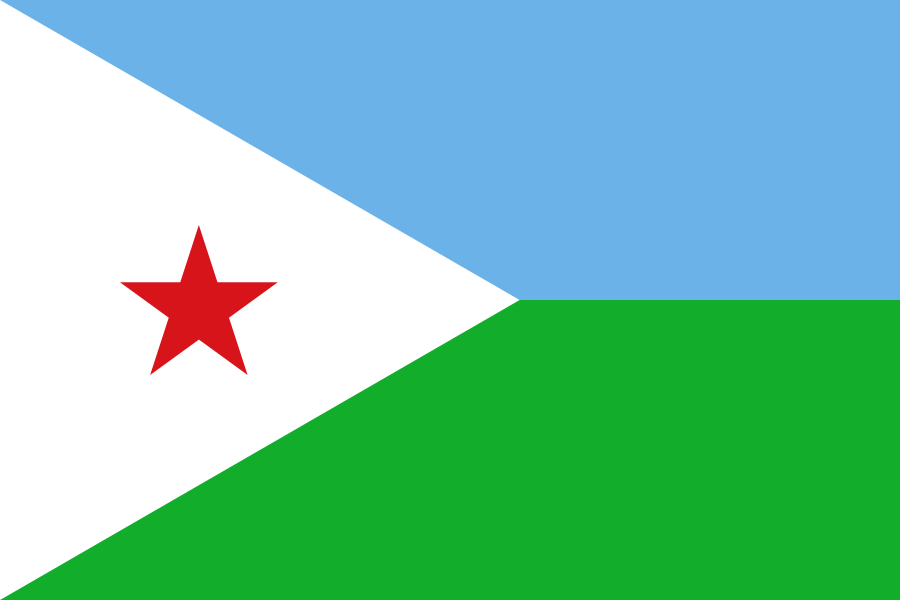
A tiny state on the Horn of Africa where three tectonic plates meet and a new ocean is being born. Lake Assal is the lowest point in Africa at −155 m, Lake Abbe is ringed by otherworldly limestone chimneys, and the coast offers some of the best whale-shark swimming in the world. Djibouti is a strategic crossroads: the only permanent American military base in Africa sits here, alongside French, Japanese and Chinese ones. It is also among the hottest and least visited places on the planet.
Where to go
#Djibouti City
The capital and the only real city, worth a couple of days simply to acclimatise. Look at the colonial centre, the noisy Le Caisse market and the modern Corniche waterfront. It is the base for every trip out, with the best choice of rooms and restaurants in the country.
Tadjoura
A brilliant white town on the northern shore of the gulf, worth a trip for the atmosphere of an ancient port. From here you can head up into the Goda mountains or along the coast to snorkel. They call it the White City for its architecture and its many mosques.
Obock
A remote fishing village in the north, visited for the Ras Bir lighthouse and utterly clear water. This is where to go to see ordinary life without any crowd at all. Getting here by ferry across the gulf is an adventure in its own right.
Ali Sabieh
A town on the road to Ethiopia, ringed by desert plateaus and low mountains. People use it as a base for the south-western landscapes and the old colonial forts. You can still see working caravan tracks here with camels on them.
Dikhil
The transit junction for routes to Lake Abbe. The town gives you a look at nomadic life and a rest in an oasis before pushing into the desert. It is the strategic point for topping up water and fuel before a long drive.
What to see
#Lake Assal: The first thing to see, because standing there puts you at the lowest point in Africa. Turquoise water against blinding white salt looks like a different planet.
Whale sharks: From November to February they gather in the Gulf of Tadjoura. Swimming alongside them is the reason a lot of divers come this far in the first place.
Lake Abbe: Famous for its limestone chimneys venting steam across the desert floor. If you want photographs that look like a science-fiction set, this is where to go.
Moucha and Maskali islands: Proper beach time only half an hour from the capital's port. The best way to swap dust for clean coral reef without a long drive.
Day Forest: Up in the Goda mountains, unexpectedly cool and green with relict junipers. Worth the trip purely to escape the coastal heat in the shade of old trees.
Ardoukoba volcano: Right next to Assal, with fresh lava fields you can walk across. It makes it possible to see the tectonics of the region in a single outing.
Prices
#Currency: The Djiboutian franc is pegged hard to the US dollar and has not moved in decades. One dollar buys exactly 178 DJF, which makes mental arithmetic easy.
Cash: Bring crisp dollar notes, which are accepted almost everywhere alongside local money. It saves hunting for an exchange office out in the provinces.
Cards: Terminals are very rare and confined to a couple of expensive chain hotels. Do not plan any part of your trip around paying by card.
ATMs: The capital has machines, but they fail often and sometimes dispense only francs. Always keep an untouched cash reserve for when one refuses you.
Prices: Life here is expensive because almost everything is imported. Lunch in an ordinary café or a day's car hire will cost noticeably more than in neighbouring countries.
| Item | Price (USD) |
|---|---|
| Street sambusa | 0.80 |
| Coffee in town | 1.50 |
| Bottle of water | 0.60 |
| Rice with meat | 6.00 |
| Fish dinner | 22.00 |
| Taxi across the centre | 5.00 |
| Ferry to Tadjoura | 12.00 |
| SIM card | 5.00 |
| Gigabyte of data | 10.00 |
| Guesthouse night | 45.00 |
| Three-star hotel | 95.00 |
| Day trip to Assal | 75.00 |
| Whale shark excursion | 100.00 |
| Park entry | 25.00 |
Getting around
#Taxis: Yellow-and-green cars wait on every corner in the capital. There are no meters, so agree the fare firmly before you open the door.
Minibuses: The cheapest way to move, running along the main city streets. Cramped and loud, but the most economical way to see the outer districts.
Walking: Feasible only within the central quarter of the capital. In this heat, even a short walk can turn into a serious ordeal by mid-morning.
Car hire: If you take a vehicle, take a 4x4. Getting into the desert requires real competence on sand and sharp rock, and a saloon car will not survive it.
Ferries: Boats cross the gulf between the capital and the northern ports, a good alternative to the long dusty road around and several hours faster.
Excursions: For the lakes, hire a car with a driver through a local agency. Driving inland alone without local knowledge and fuel reserves is genuinely risky.
Getting there: Ambouli airport has services from Paris, Istanbul and Dubai, plus frequent regional links through Addis Ababa and Nairobi. From North America the routing is via Europe or the Gulf.
Where to stay
#City hotels: Choice in the capital is limited and prices often outstrip the quality on offer. Look along the waterfront so you have restaurants nearby and somewhere safe to walk.
Guesthouses: The cheapest option for an independent traveller. Rooms are sparsely furnished but the atmosphere is livelier and more welcoming than the hotels.
Air conditioning: Treat this as a booking requirement rather than a preference. Night temperatures rarely fall to anything you could sleep through without it.
Desert camps: At Lakes Abbe and Assal there are no buildings, only simple tented camps. It is the only way to see a desert sunrise without driving back to the city first.
Booking: The global platforms function here but cover only the larger properties. Smaller guesthouses usually have to be contacted directly.
Remote areas: In Tadjoura and Obock, expect the most basic accommodation, with intermittent hot water and no internet in the rooms at all.
Choosing a district: Stay near the European quarter for comfort and quiet, or in the African quarter for a much closer look at everyday life.
What to eat
#Skoudehkaris: The national dish of spiced rice with tender lamb. Filling, cheap and available in any local canteen, and the thing to order first.
Sambusa: Crisp fried triangular pastries filled with meat, and the ideal snack. Made on the street, always fresh, and consumed in enormous quantities by everyone.
Seafood: The small restaurants by the port serve excellent grilled fish and large lobster. The Red Sea catch arriving here is genuinely first rate.
Fah-fah: A thick goat soup for when you want something hot. It usually comes with sour lahoh flatbread, which soaks up the broth properly.
Drinks: Tea is brewed with clove and cardamom, and the coffee is strong and served in tiny cups. Both are part of conversation, and refusing is not really done.
Hygiene: Drink bottled water only and avoid ice in juices and cocktails. Pick places to eat by counting how many locals are already inside.
Camel milk: A local delicacy sold in the city markets. The salty taste takes adjusting to, but it is considered highly nutritious and worth trying once.
Safety
#Overall: The country is one of the calmer places in the region, partly because of the foreign military bases. Serious crime against visitors is rare.
Heat: This is your main risk. Summer temperatures pass forty degrees easily and heatstroke arrives fast, so wear a hat and drink continually.
Borders: Avoid the frontier zones with Eritrea and northern Somalia entirely. Conditions there can be unstable and some ground remains mined.
At night: In the capital, do not walk alone through the dark lanes of the African quarter. Stick to the busy waterfront and use official taxis.
Photography: Photographing military installations, ports and government buildings is firmly prohibited and leads to detention and confiscated equipment.
Insurance: Buy a policy that covers transport to hospitals in another country. Local medicine is limited and complex cases are typically flown to Dubai.
Wildlife: Watch for sea urchins and strong currents when swimming in the gulf. In the desert, shake out your boots before putting them on because of scorpions.
Etiquette and culture
#Peoples: The population divides into the nomadic Afar and the Somali Issa. Their traditions overlap closely, but each group keeps its own language.
Religion: Djibouti is a Muslim country and social norms are conservative. Be particularly considerate during Ramadan, when eating in public in daylight is not done.
Dress: Cover shoulders and knees when out in town. Women are not required to cover their heads, but very revealing clothing will draw disapproval.
Khat: Chewing the leaves of this shrub is a mass habit among local men after lunch. City life more or less stops for a few hours while it happens.
Photography of people: Always ask before you take someone's picture. Locals are generally warm towards visitors who show genuine respect.
French legacy: The colonial past shows in the architecture of the centre and in an enduring love of fresh baguettes. Morning queues outside bakeries look distinctly European.
Timing: Everything important gets done before noon, before the heat peaks. Factor that into any meeting or trip to an official office.
Connectivity
#Languages: French and Arabic are official and every official speaks them. For a traveller, basic French is the key that unlocks almost every practical problem.
English: Spoken only by staff at expensive hotels and by some professional guides. An ordinary taxi driver or market trader will need gestures rather than English.
Mobile: The market is a single-operator monopoly, so prices are high. Buy a SIM at an official office and bring your passport to register it.
Internet: Hotel Wi-Fi is often slow and unreliable. Mobile data works well in the capital but disappears completely in the desert and at the far lakes.
eSIM: International eSIM providers cover Djibouti and are worth activating for your first day, though a local SIM works out cheaper for a longer stay.
Navigation: Download good offline maps in advance, since printed ones date quickly. In the old town's identical narrow lanes, GPS is what stops you getting lost.
Local phrases: Learn a few words of Afar or Somali. Even a simple greeting in the local language changes how a conversation goes.
Phrasebook
#| English | French | Pronunciation |
|---|---|---|
| Hello | Bonjour | bon-ZHOOR |
| Good evening | Bonsoir | bon-SWAR |
| How's it going? | Ça va? | sa VA |
| Thank you | Merci | mer-SEE |
| You're welcome | C'est rien | say RYAN |
| Yes | Oui | wee |
| No | Non | non |
| How much? | Combien? | kom-BYAN |
| That's too expensive! | C'est trop cher! | say tro SHEHR |
| Discount | Rabais | ra-BAY |
| Water | Eau | oh |
| Bread | Pain | pan |
| Coffee | Café | ka-FAY |
| Where is the taxi? | Où est le taxi? | oo eh luh tak-SEE |
| Right | À droite | a DRWAT |
| Left | À gauche | a GOHSH |
| Help! | Au secours! | oh suh-KOOR |
| I don't understand | Je ne comprends pas | zhuh nuh kom-PRON pa |
| Friend | Mon ami | mon a-MEE |
| Peace (local greeting) | Salaam | sa-LAAM |
| Goodbye | Au revoir | oh ruh-VWAR |
Good to know
#Power: Sockets are the European round two-pin type. UK and US travellers need an adapter, and the supply voltage can be unstable, so use a surge protector for laptops.
Time zone: The country runs on GMT+3 year-round, the same as East Africa. There is no daylight saving to catch you out.
What to pack: Maximum-factor sunscreen, reef shoes for swimming and loose covered linen clothing. Anything tight or synthetic will be unbearable.
Friday: The main day of rest, when many shops and government offices are closed. Schedule shopping and official errands for other days.
Medical kit: Bring treatments for stomach upsets, strong antiseptics and rehydration salts. Finding specific medication outside the capital is close to impossible.
Water: Buy properly sealed bottles from larger shops. Never drink from a tap, however respectable the hotel looks.
Telling the time: Locals often use a 12-hour clock counted from sunrise, which confuses visitors. Confirm any appointment against the 24-hour standard.
Frequently asked questions
#Most nationalities do, and it must be arranged in advance as an e-visa through the official evisa.gouv.dj portal. Getting a stamp on arrival at the airport is no longer possible, so apply around two weeks before you fly.
November to February, when the coastal waters fill with plankton. December and January are the peak, with the best chance of encounters in the Gulf of Tadjoura.
The country is expensive. A budget independent trip runs 70-100 dollars a day before tours, and a 4x4 excursion to the remote lakes can cost several hundred dollars for a single outing.
Take an official taxi from the rank outside the terminal for 5-10 dollars. Public transport from the airport is infrequent and impractical with luggage.
Broadly yes, with ordinary precautions and no trips into the closed border zones. The genuine risks here are the climate and the sun rather than crime.
No. Cards work in a couple of upmarket hotels and nowhere else, so bring enough cash in dollars or francs to cover the whole trip.
Lake Assal, whose surface sits 155 metres below sea level. This extraordinary salt lake is about two hours by road from the capital.
The classic is the local rock salt formed into balls, harvested at Lake Assal for centuries. Bright ethnic-patterned fabrics and traditional leatherwork are the other common choices.
Updated
The data on this page goes out of date. Visa rules and permitted stays, border requirements, prices and budgets, transport and local conditions all change fast, and we do not re-check every page every day. We show the date of our last check where we have one, but before you travel, verify with official sources: the country’s consulate, its immigration service, its e-visa portal and your carrier.