Description
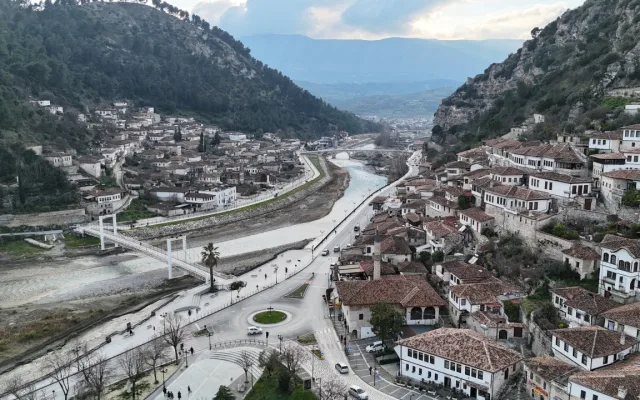
Berat is a city of white Ottoman houses cascading down a hillside around a majestic citadel above the Osum River.
Wiki
Albania long stayed off the beaten track, and Berat is one of the best reasons to make the detour. It is a living open-air museum, and two days is the ideal amount of time: one for the old town and citadel, the second for the surrounding countryside.
Why visit and how to split your time
Berat's strength is its coherence: the Ottoman character of the city has survived almost without modern intrusion, and these are lived-in neighbourhoods, not a tourist stage set. A sensible first day combines a walk through Mangalem, the climb up to the citadel, and a crossing of the river into Gorica. The second day works well for a trip to the Osum Canyon or Mount Tomorr if you are drawn to the outdoors; if not, you can move on — the city can also be covered in one full day.
The famous "cascade of windows" that defines Berat's silhouette is best appreciated not from inside the quarter but from the opposite bank. Walk over to Gorica and photograph Mangalem from there, especially at sunset when the white facades are lit from the side.
The citadel: what makes it special
Kala is not a ruin but a living neighbourhood inside the fortress walls. People still live here; small guesthouses and tavernas are open for business; laundry dries between ancient churches. Entry to the grounds is generally free (fees are charged only for individual museums and churches inside). The walk up is steep, on cobblestones — allow enough energy and wear shoes with a decent sole, as the stone pavements are slippery. At the top, dozens of Byzantine churches in varying states of preservation are scattered across the hillside, with views down the Osum valley in both directions.
The Onufri Museum inside the citadel covers the local school of icon painting from the 16th century; Onufri is celebrated for a distinctive red pigment. If icons are not your thing, a separate museum visit is not essential — the atmosphere of the fortress is reward enough on its own.
Getting your bearings and finding a place to stay
The centre is compact: Mangalem, the riverside promenade and the bridge over the Osum are all within a half-hour walk. The most convenient bases are Mangalem itself or the citadel — guesthouses in old Ottoman houses offer both character and proximity to the main sights. Staying in Kala suits those willing to haul their bags uphill in exchange for quiet and views; Mangalem is easier for logistics and evening life. Gorica is quieter and cheaper, but every trip into town means crossing the bridge.
Accommodation in Berat is inexpensive by European standards. Family-run guesthouses with breakfast included are the norm, often with a complimentary home-made rakia from the host.
Getting there and moving on
Berat has no airport of its own — everyone arrives via Tirana, from where buses and shared minibuses (furgon) run to the city. Services to Tirana and Durrës are frequent throughout the day, but schedules are fluid and evening departures dry up early — do not plan a late departure. Buy tickets from the driver, in cash.
Berat fits naturally into a wider Albanian itinerary: it sits between the coast (Vlorë, Durrës) and the south (Gjirokastër, Sarandë), so it pairs well with both. There is virtually no public transport to the Osum Canyon — you will need to rent a car or join a tour from town. Rafting is worthwhile in spring and early summer when the river runs high; by midsummer the canyon can dry out in places and is explored on foot.
Money, food and safety
The currency is the Albanian lek, though euros are widely accepted in tourist areas — the exchange rate offered is poor, so withdraw leks from an ATM instead. Cards are not accepted everywhere; keep cash for transport, markets and smaller tavernas.
Local dishes worth trying include tavë kosi (baked lamb under a yoghurt crust) — effectively the national dish — byrek for breakfast, and fergesë. Portions are generous and prices are low even by Albanian standards. Local wine is inexpensive: this is wine-growing country, so look out for home-produced varieties.
Berat is safe, street crime is rare, and travellers are treated with friendliness and genuine hospitality. The main practical hazards are steep, slippery cobblestones, the heat of July and August (shade at midday is scarce — carry water), and unpredictable transport schedules.
When to go
The best months are May–June and September–October: warm but not punishing, and the canyon still has water. July and August are hot and busy; if you visit in summer, shift your walks and the citadel climb to early morning or evening. Winter is quiet and picturesque, but many guesthouses and tavernas close, and excursions into the hills are off the table.