Description
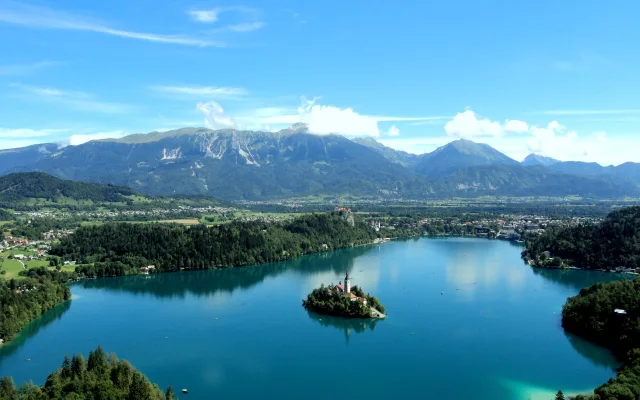
An emerald lake with a tiny island church and a castle perched on a cliff — Slovenia's iconic image, framed by the Alps with views of Triglav.
Wiki
Bled is that postcard lake everyone has seen before they ever visit Slovenia: a church on an island, a castle on a cliff, emerald water. The good news for independent travellers — everything is compact, easy to reach from Ljubljana, and two days is enough to cover not just the town itself but the surrounding area, which is often more rewarding than the famous centre.
What's actually worth seeing
- Circular walk around the lake — a roughly 6 km loop, flat with no elevation gain, passing all the key viewpoints. This is free and arguably the best thing to do in Bled. Allow 1.5–2 hours at a relaxed pace.
- Ojstrica and Mala Osojnica viewpoints — two rocky outcrops on the western shore where the famous overhead shot of the island and castle is taken. The climb is short but steep (20–40 minutes); proper footwear is essential. Go at sunrise or sunset — in the middle of the day the crowds are thick and the light is flat.
- Bled Castle — you're essentially paying for the terrace panorama. The museum inside is modest; if you're on a budget, the view from Osojnica is free and equally good.
- The island — the pletna (traditional wooden rowboat) is pricey and runs on the oarsman's schedule, but it's an authentic experience. Cheaper and more enjoyable: hire a rowing boat or swim across in summer (the water is warm and the distance is short). On the island, ring the wishing bell — it's a local tradition.
- Vintgar Gorge — a must-see nearby, with wooden walkways above turquoise water. The path runs one way, so plan your return (walk back, take the local bus, or leave a bike at the far end).
How many days and how to plan the trip
Two days is enough. A sensible layout: day one — the lake, the island, the castle, a sunrise or sunset viewpoint. Day two — out of Bled: Vintgar plus either Lake Bohinj (quieter, wilder, better for swimming and hiking than Bled itself) or a trip into Triglav National Park. If you love mountains, Bohinj easily fills a full day.
Getting there and getting around
The nearest airport is Ljubljana (LJU), about 35 km away. Regular buses run from the capital to Bled (roughly 1.5 hours) — this is the cheapest option. There is a train, but Bled Jezero station is isolated and Lesce-Bled is several kilometres from the lake, so the bus is usually more convenient.
Once in Bled, a car is unnecessary and can be a nuisance: parking in season is paid and perpetually full. Everything is walkable, and Vintgar and the surrounding area are easily reached by bicycle (rental is inexpensive) or the local bus. If you're planning to explore Bohinj and the deeper reaches of Triglav National Park, that's where a rental car makes sense — public transport there is infrequent.
Where to stay
Accommodation right on the lake is the most expensive and the most touristy. A better-value and often more pleasant option is guesthouses and apartments a little higher up the hillside or in quiet streets 10–15 minutes' walk from the water: same views, lower prices, easier parking. Backpackers have a couple of hostels to choose from. In summer, book well in advance — Bled is small and fills up fast.
Food and drink
Bled is frankly tourist-oriented, so prices near the waterfront run higher than the Slovenian average. A practical move is to eat a little away from the lakeside, at a gostilna (family-run tavern), where a hearty lunch is cheaper than a restaurant dinner.
Make sure you try kremšnita — the local custard-and-cream pastry considered Bled's signature dish. On the savoury side: Carniolan sausage, štrukli, and lake fish. Coffee with kremšnita on a terrace overlooking the lake is the classic Bled ritual, even if it's not the most budget-friendly.
Ways to save: buy food at a supermarket for snacks and a picnic at a viewpoint; drink tap water (safe everywhere); do the lake circuit and use the free viewpoints instead of paying for every attraction.
When to go
May–September is the warmest and most convenient period; swimming is comfortable in July–August, though that's also peak crowds and peak prices. June and September are the sweet spot: warm, green, noticeably fewer people. In winter Bled is quiet and snow-covered; some activities close, but the views without queues are a different kind of reward.
Common mistakes
- Arriving just to tick the box and spending only a couple of hours — the magic is in the early light and in the surroundings, not in the midday crowd at the jetty.
- Paying for the pletna without first considering a hire boat or a swim.
- Limiting the trip to Bled alone — Bohinj and Vintgar nearby offer far more in the way of wild nature.
- Driving into the centre in season and spending ages hunting for parking.
- Heading to the rocky viewpoints in flip-flops: the trails are short but steep and slippery after rain.