Description
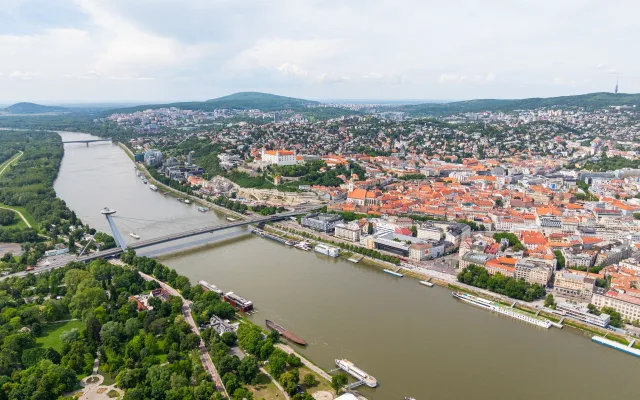
A compact Danube capital with a hilltop castle, a charming old town, and Vienna just an hour away — perfect for a weekend trip.
Wiki
Bratislava is a rare capital city you can genuinely see in a weekend without burning out: the Old Town fits into a square kilometre, the Danube runs alongside, there's a castle on the hill, and Vienna is an hour away. Many travellers zip through between Vienna and Budapest, but a day or two here is well worth it — cheaper than its neighbours and without the crowds.
What's actually worth seeing
The centre is laid out so that every point of interest connects on foot within 10–15 minutes, and the whole circuit works well as a loop.
- Bratislava Castle — the famous white "upturned table" on the hill. Inside is the Slovak History Museum, but the real draw is the terrace: the best views of the Danube, the UFO Bridge, and on a clear day, fields stretching to the Austrian border. The climb is worth it even without a museum ticket.
- Old Town and Hlavné námestie — pastel facades, the Maximilian Fountain, and the Old Town Hall. Duck into the side streets: they're scattered with quirky bronze sculptures (Čumil, the "watcher" peering up from a manhole; Napoleon leaning on a bench) that visitors hunt like a treasure trail.
- Michael's Gate (Michalská brána) — the only surviving city gate, a landmark and the start of the Old Town's pedestrian spine.
- Blue Church (Modrý kostolík) — a Secessionist design by Ödön Lechner, entirely blue, almost like a gingerbread house. It sits about ten minutes' walk from the centre, slightly off the beaten track, but absolutely worth it for the photos.
- UFO Bridge — a restaurant and observation deck perched nearly a hundred metres up on the pylon. Entry to the viewing platform is ticketed; if you'd rather save the money, the castle terrace gives you the same angle for free.
- Devín Castle — a fortress at the confluence of the Danube and the Morava, 10 km to the west. A stronghold is recorded here as early as 864, but the ruins you see belong to the medieval castle, blown up by Napoleon's troops in 1809. A city bus runs there; allow half a day. A good option on day two if you want to get out of the centre.
Honestly: there are no museums here on the level of Vienna. Bratislava wins on compactness and the pleasure of wandering, not on collections.
How many days and how to plan your route
Two days is more than enough. Day one — Old Town, castle, riverfront, dinner with a view of the bridge. Day two — either Devín and the countryside, or a day trip to Vienna (60 km away, with regular buses and trains). If you only have one day, the Old Town plus the castle can comfortably fit into half a day.
Getting there and getting around
- Bratislava Airport (BTS) — served by Ryanair and Wizz Air. A city bus runs to the centre (roughly 20–30 minutes) for a modest fare; taxis are considerably more expensive.
- Via Vienna (VIE) — often more convenient and cheaper in terms of connections. The direct Slovak Lines / RegioJet bus gets you to central Bratislava in about an hour. Trains between the two cities run frequently as well.
- Within the city, you'll barely need transport: the Old Town is a 1×1 km square and everything is walkable. DPB trams and buses are useful only for Devín, the main train station, or outlying areas. Buy a time-based ticket at a machine or through the app and validate it on board.
Where to stay
The best base is the Old Town itself or right on its edge: step out of your hotel and you're already there. The next sensible option is the area around the main train station (Hlavná stanica) or along the riverfront — slightly cheaper, with a 10–15-minute walk to the centre. Petržalka, across the bridge, has the cheapest accommodation, but it's a Soviet-era panel-block neighbourhood — factor in the extra commute.
Food and money
The cuisine is hearty and inexpensive: bryndzové halušky (potato dumplings with sheep's cheese), kapustnica (cabbage soup), bread dumplings, goulash. Lunch at an ordinary reštaurácia works out noticeably cheaper than dinner at a tourist-facing place on the square — the gap is real, so make lunch your main meal and wander away from the main fountain. Local wines (Frankovka modrá, Grüner Veltliner) are worth trying — the quality is good and they're cheaper than their Austrian equivalents.
Overall, Bratislava feels roughly 1.5–2 times cheaper than Vienna: coffee, beer, transport — all noticeably lower. Ways to save: eat at self-service canteens and spots popular with locals, drink local wine instead of imported, catch the views from the free castle terrace rather than the paid UFO platform.
When to go and what to know
The best time is April through October, when it's warm and everything is open. December brings a Christmas market to Hlavné námestie that is among the cosiest in the region: mulled wine, lángos, deep-fried cheese. In summer the centre can get crowded for a few hours when Danube cruise ships dock — go out in the morning or evening when the rush thins out.
The city is safe by European standards; the usual awareness around pickpockets applies in busy tourist spots and at the train station. A common mistake is arriving "for two hours from Vienna" and only seeing the main square — give Bratislava at least an evening and a morning, and it will genuinely open up.