Bucharest
Description
The "Little Paris of the East" — home to the Parliament Palace, the world's second-largest administrative building, and a famously vibrant nightlife scene.
Wiki
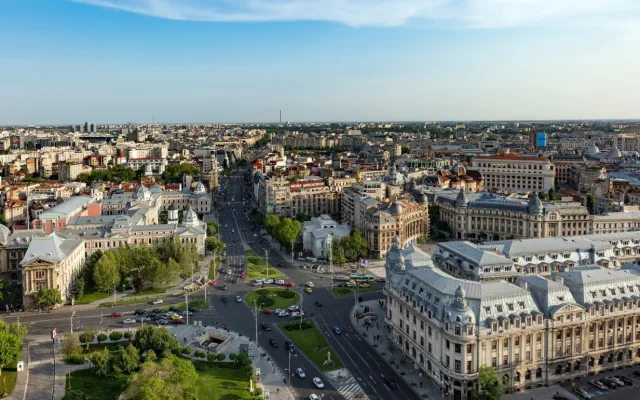
Bucharest is the capital and main economic hub of Romania, situated in the south of the country in the historic region of Wallachia, on the banks of the small Dâmbovița River. With a population of around 1.8 million, it is the sixth-largest city in the European Union and one of the most affordable capitals in Europe. The nickname "Little Paris" dates to the turn of the twentieth century, when the local elite lined the central boulevards with Belle Époque mansions and commissioned designs from French architects.
History and character
The first written mention of Bucharest dates to 1459 and is associated with the Wallachian prince Vlad the Impaler. The city became Romania's capital in 1862, following the union of the Danubian Principalities. Its golden age came during the interwar period, when elegant villas, banks and theatres appeared across the city. Nicolae Ceaușescu's regime then embarked on a radical reconstruction of the centre: throughout the 1980s, entire historic neighbourhoods, churches and monasteries were demolished to make way for the grandiose "Civic Centre." The result is a city of striking contrasts — exuberant Art Nouveau, sober interwar modernism, monumental socialist classicism and the glass shopping complexes of the post-communist years.
Main sights
- Parliament Palace (Casa Poporului) — a colossal building covering around 365,000 m², the second-largest administrative building in the world by floor area after the Pentagon, and the heaviest building on earth. Entry is by guided tour only; visitors are shown marble halls, enormous chandeliers and a balcony overlooking Boulevard Unirii.
- Old Town (Lipscani) — a compact maze of pedestrian lanes packed with restaurants, cafés, bars and clubs. It also contains the historic Hanul lui Manuc inn, the Stavropoleos Church and the picturesque Cărturești Carusel bookshop.
- Romanian Athenaeum — a concert hall from 1888 with a dome and colonnaded façade, the main venue of the George Enescu Philharmonic.
- Triumphal Arch (Arcul de Triumf) — a 27-metre monument, modelled on its Parisian counterpart, commemorating Romania's victory in the First World War and national unification.
- Village Museum (Muzeul Satului) — an open-air ethnographic complex on the shore of Lake Herăstrău, with hundreds of authentic peasant houses, windmills and churches gathered from every region of the country.
- Cotroceni Palace, the National Museum of Art in the former royal palace, and the Memorial of the Revolution's Victims on University Square round out the itinerary.
Just outside the city, Therme Bucharest is one of Europe's largest thermal spa complexes, with pools, saunas and a palm-lined pavilion, about half an hour from the centre.
Food and drink
Romanian cuisine is hearty and carries a Slavic-Balkan spirit. Must-tries include sarmale (stuffed vine or cabbage leaves), mititei (grilled skinless sausages), mămăligă (cornmeal porridge), ciorbă soup and pălincă, a home-distilled fruit brandy. Local wines — Fetească Albă and Fetească Neagră — are affordable and well worth exploring.
- Lunch at a family tavern: around 40–75 RON (about $9–16).
- Dinner at a restaurant: 90–175 RON ($19–37).
- A glass of wine: 20–30 RON ($4–6); a coffee: 10–15 RON ($2–3).
- A metro ride: around 3.5 RON ($0.70); a taxi across town: 15–35 RON ($3–7).
Prices are as of 2026. Cards are widely accepted; cash in Romanian leu (RON) is handy at markets.
Getting around
Henri Coandă International Airport (OTP) in Otopeni is served by TAROM, Wizz Air, Ryanair, Lufthansa and others. A suburban train connects the terminal to Gara de Nord (North Station) in about 40 minutes — fast and cheap; a taxi to the centre costs more. Within the city, several metro lines run alongside trams, trolleybuses and buses. For taxis, always use an app — Bolt, Uber or FreeNow — to avoid inflated fares.
Bucharest is a convenient base for exploring the country. Brașov and Transylvania are roughly 2.5–3 hours by train; popular day trips include Peleș Castle in Sinaia and Bran Castle, associated with the Dracula legend.
When to go
The best season runs from April to October, with temperatures ranging from roughly 15 to 30 °C. Spring and early autumn are ideal for walking and visiting the parks. July and August can be hot, but this is peak festival season and the terraces are in full swing. Winters are cold and quiet, though Christmas markets open in the centre in December.
How long to allow
Three days is enough to cover the highlights comfortably: day one for the Parliament Palace and the Civic Centre; day two for the Old Town, the Athenaeum and the museums; day three for King Michael I Park (the former Herăstrău), the Village Museum and a thermal spa visit or a day trip out of the city.
Updated