Description
The northern capital of Thailand — jungle, elephant parks, yoga retreats and cheap markets.
Wiki
Chiang Mai is the largest city in northern Thailand, founded in 1296 as the capital of the kingdom of Lanna. Today it is the calm alternative to noisy Bangkok: mountain jungle, hundreds of ancient temples, craft traditions and a reputation as one of the world's centres for remote work and spiritual practice.
History and general character
The name of the city translates as "new city" — so it was christened by King Mangrai, who moved his capital here. For centuries Lanna was an independent state with its own language, script and architectural style, distinct from central Thailand. Traces of that inheritance are visible everywhere: in the curving temple roofs, the woodcarving, the food and the soft northern dialect. In the 16th to 18th centuries the region was under Burmese influence, which also left its mark on the shrines. The historic centre, the Old City, is still outlined by a moat and the remains of brick walls with their gates, the chief of which is Tha Phae on the eastern side.
Main sights
- Doi Suthep (Wat Phra That Doi Suthep) — a golden stupa on a mountain some 1,676 m high, the city's guardian temple. You can climb the staircase of 309 steps with its naga-serpent balustrade, or take the funicular. From the top a panorama of the valley opens up.
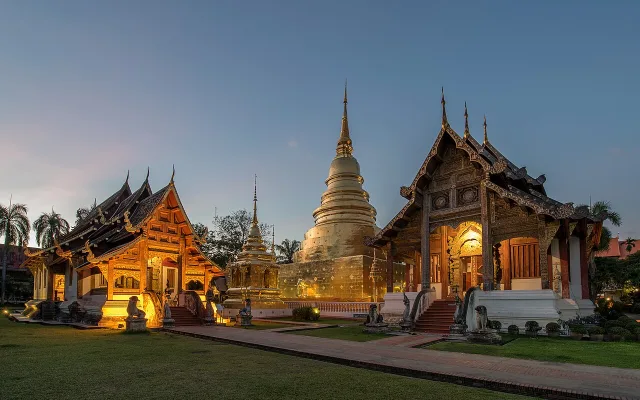
- The Old City — a compact square inside the moat, where dozens of monasteries are concentrated. Wat Chedi Luang has a massive half-ruined 15th-century stupa, Wat Phra Singh an elegant Lanna hall, and Wat Chiang Man is the oldest temple in the city.
- The night markets — the daily Night Bazaar on Chang Khlan road opens in the evening, but the high point of the week is the Sunday Walking Street on Ratchadamnoen: crafts, textiles, silver, street food and live music.
- Elephant sanctuaries — it is worth choosing ethical projects with no riding and no circus tricks, for example Elephant Nature Park, where animals are bought out of heavy labour.
- Trekking — one-day and multi-day walks to the villages of the hill peoples (Karen, Akha, Hmong, Lisu), with overnight stays, waterfalls and rice terraces.
- Doi Inthanon — the highest point in Thailand (2,565 m), in the national park to the south-west, with a cool climate, walking trails and two royal chedis.
Districts and atmosphere
Beyond the eastern wall, in the Nimmanhaemin (Nimman) quarter, modern life is concentrated: design cafes, coworking spaces, galleries and bars — this is where freelancers and digital nomads gather. The banks of the Ping river attract quiet restaurants and markets. West and north of the city are scattered yoga studios, meditation centres and retreats, many of them attached to monasteries where vipassana is practised.
Food and coffee
Northern cooking differs noticeably from the familiar Thai menu. Its emblem is khao soi, a curry with egg noodles, coconut milk and crisp noodles on top. Also popular are larb (a spicy salad with minced meat), sai ua (a herby sausage), nam prik num (a paste of roasted green chillies) and sticky rice. Chiang Mai is considered the coffee capital of the country: arabica is grown in the surrounding hills, and hundreds of small roastery cafes are scattered across the city.
Transport
From Bangkok the easiest way is to fly — the flight takes about an hour. The alternatives are the night train (roughly 12–13 hours) or the bus. Around the city run the songthaew, red pick-up shared taxis, along with tuk-tuks. For independent trips out of town people hire a motorbike, but a licence is needed and care on the mountain hairpins. The centre is compact and much of it can be covered on foot.
When to go
The best season is the cool, dry period from November to February, when the days are comfortable and the evenings fresh. November brings the festivals of Loi Krathong and Yi Peng: thousands of paper lanterns rise into the sky while decorated rafts float on the water — one of the most spectacular events in Asia. March to May is hot, and at that time the valley is often shrouded in haze from agricultural burning, which worsens the air and the visibility. The rainy season (June–October) brings downpours, but also lush greenery.
How long to allow
Four days are enough to get to know the city: a day for the temples of the Old City, a day for Doi Suthep and its surroundings, a day for an elephant sanctuary or trekking, and one more for the cafes, the markets and the unhurried atmosphere of Nimman.