Дуз: что посмотреть, ворота в Сахару, Тунис
Description
The gateway to the Tunisian Sahara — camel caravans into the Grand Erg Oriental, the Thursday market and the Sahara Festival.
Wiki
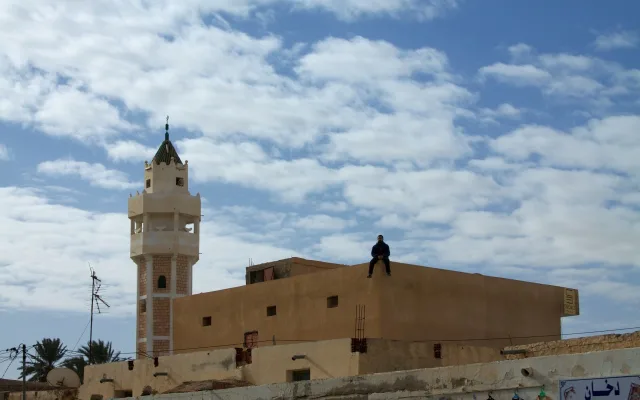
Douz is not a tourist stage set but a working entrance to the real Sahara: the caravans leave from here into the Grand Erg Oriental, where the dunes run to the horizon without a single building. The town is small, dusty and utilitarian — people come not for the place itself but for what begins beyond its edge.
Why go, and for how long
Two days is more than enough. The logic is simple: a day for arriving, the oasis and the market, then the second half of the day and the night for going out into the desert and sleeping in a camp — that is the main experience of the trip. You return in the morning. If your dates fall on a Thursday, aim for the camel market; if on December, for the Sahara Festival.
There is no point coming to Douz for several days for the town itself: the sights can be counted on one hand, and all the value lies in the desert and in using Douz as a base for trips out — Chott el Djerid, Matmata, the ksour of the south.
What is genuinely worth the time
- A night in the desert. The key item. A two or three hour camel ride is only a taster; to see the Sahara properly — the sunset, the silence, stars without light pollution, sunrise over the dunes — you need a camp with an overnight stay. Plan for that.
- The dunes a few kilometres from the centre. The nearest "threshold of the desert" is the start of the sand near town. Fine for a short walk and photographs, but this is not the deep Sahara yet.
- The Thursday market (Souk el Khamis). Alive rather than staged: livestock, silver, cloth, tools. Come early in the morning, as it winds down by midday. Worth it simply to see how people here live rather than to look at other tourists.
- The palm oasis and the deglet nour dates. A walk in the shade of the palms is a relief from the daytime heat. The dates here are the best in the country and worth buying on the spot; the fresh harvest comes in from October.
- The Sahara Museum. Compact nomadic ethnography — worth a look if you want the context rather than a tick on a list.
Trips out
- Chott el Djerid — a vast salt lake a couple of dozen kilometres away. The causeway road runs straight across the salt crust, and mirages form in the heat. A good half-day trip.
- Matmata and the Berber villages — underground dwellings and Star Wars locations, a couple of hours away. Realistically combined as a stop on the way to or from Djerba or Tozeur.
- Kebili — the neighbouring oasis; it adds little on its own, but is convenient as a staging point.
Getting there and getting around
There is no airport of its own. The nearest are Tozeur (TOE) and Djerba (DJE), around 100-150 km from Douz. The practical plan is to fly into Djerba or Tozeur, then take a hire car, an intercity taxi or a louage shared minibus, or a transfer arranged by the camp.
There is a bus from Tunis (TUN), but it is a long 7-8 hours. If time is worth more than money, flying south makes more sense than driving the length of the country.
Douz itself is easy: the centre is walkable, and trips out need transport. A hire car or a louage is the best option for Chott el Djerid and Matmata. In season it is worth writing to the camp in advance — they normally arrange both the pick-up and the camels.
Money and food
Southern Tunisia is cheap. Lunch at a café comes to a modest sum and dinner at a restaurant noticeably more, but it is still inexpensive by European standards. The cooking is simple and filling: couscous, brik (a crisp parcel with an egg inside), mechoui (grilled meat) and lamb stewed with dried fruit. Buy dates by the kilo — they are cheap and the best souvenir you can take home.
The main expense is the desert tour. A short camel ride costs a token amount; a night in a camp with dinner is considerably more, but it is what justifies the whole trip. Bargaining at the market and over excursions is normal and expected here.
When to go
The optimum is autumn (October and November) and spring (March and April): comfortable by day, cool at night. December brings the Sahara Festival, and the crowds that come with it. Skip the summer: the daytime heat in the Sahara is exhausting, and enduring 45°C and more for a couple of hours on a camel is not worth it.
Common mistakes
- Settling for a day trip without the overnight, and leaving without ever having seen the real desert.
- Taking the bus from Tunis "to save money", and losing a whole day each way.
- Underestimating the temperature swing: hot by day, genuinely cold in the desert at night — warm clothes are essential even in autumn.
- Forgetting water, sunscreen and a scarf against the sand — there is nowhere to buy them at the camp.
- Planning more than two or three days in Douz itself: the town runs out quickly, and after that you need either a trip out or a move on.
Updated