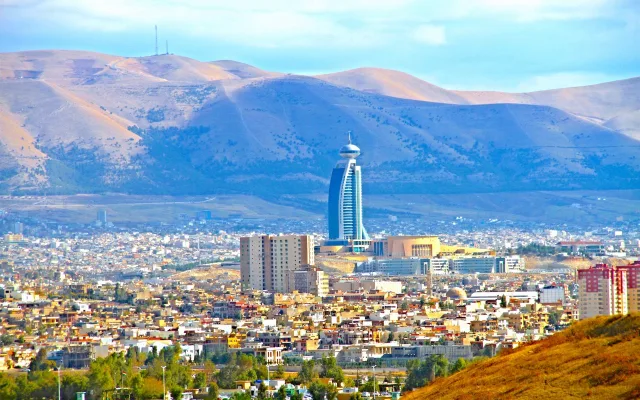
Description
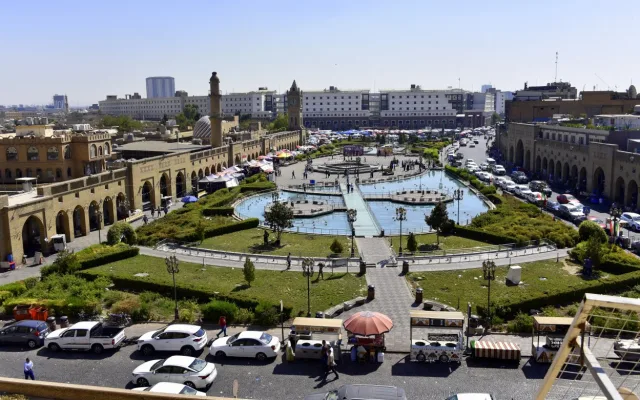
The capital of Iraqi Kurdistan: a UNESCO-listed citadel on an artificial mound, the Qaysari Bazaar at its foot, and the Kurdish mountains a couple of hours away.
Wiki
The capital of Iraqi Kurdistan and one of the oldest continuously inhabited cities in the world — around 1.7 million people in northern Iraq, 80 km from Mosul. The core of the city is the Erbil Citadel, a UNESCO World Heritage Site: a mound built up layer by layer out of the ruins of earlier settlements over more than six thousand years. Since 2003 Kurdistan has become a relatively safe and self-contained part of Iraq, with its own government, its own airport and a visa on arrival for citizens of several dozen countries. Check the current security situation before you travel: the region borders Syria, Turkey and Iran, and tension returns periodically.
The main sights
- The Erbil Citadel (Qelay Hewlêr) — the city's great monument: a mound about 32 m high, ringed by the blank outer walls of its houses so that from below it reads as a fortress. Until 2007 it was an ordinary residential quarter; the residents were rehoused for the restoration, with one family left in place so that the chain of habitation would not formally be broken.
- The Qaysari Bazaar — the historic covered market at the foot of the citadel: spices, fabric, carpets, Kurdish costume and tea houses in the inner courtyards.
- Sami Abdulrahman Park — the largest park in the city, some 200 hectares on the site of a former military base, with a memorial to the victims of the Anfal campaign (1986–1989; by Kurdish estimates up to 180,000 people were killed).
- Minare Park — the other large park, southwest of the centre, with a cable car, a Ferris wheel and crowds every evening. It takes its name from the old minaret standing beside it.
- The Mudhafaria Minaret (also called the Choli Minaret) — virtually the only medieval structure left in Erbil: a brick minaret of the late 12th century, all that survives of a vanished mosque.
- The Kurdish Textile Museum — inside the citadel, the best collection of Kurdish carpets, kilims and traditional dress.
- The Erbil Civilization Museum — the city's historical museum, covering the archaeology of the region.
- Shanidar Cave — about 100 km away, the key archaeological site in Kurdistan. The remains of ten Neanderthals were found here, roughly 60,000 to 45,000 years old, including the famous "flower burial" — though the idea that the body was strewn with flowers has long been disputed by archaeologists.
- Lalish — the principal Yazidi shrine, about 120 km away by road. It is not a tourist attraction but a working place of pilgrimage: you enter barefoot and behave accordingly.
- Korek Mountain — a mountain resort with a cable car about 110 km out, with a ski slope in winter.
- The Rawanduz gorge — a dramatic canyon in the same direction, around 110 km from the city.
- Gali Ali Beg — a waterfall and valley about 130 km away, the classic stop on a Kurdish family day out.
- The Hamilton Road — the mountain highway built between 1928 and 1932 by the New Zealand engineer Archibald Hamilton; the road to Rawanduz is that road.
- Sulaymaniyah — the other Kurdish capital, 200 km away and the cultural counterweight to businesslike Erbil.
Food and prices
The cooking is Kurdish and Iraqi: dolma (stuffed leaves and vegetables), kufta (meatballs), masgouf (carp split open and baked beside an open fire, the great Iraqi dish), tashreeb, kebabs and roasted aubergine. Lunch in a café runs $6–12, dinner in a restaurant $18–35, cardamom coffee $1–2. A litre of petrol is about $0.50 and a taxi across town $5–15. Prices are as of 2026 and given in dollars, which are quoted here as readily as dinars. Alcohol is sold openly, unlike in southern Iraq. Cash rules: cards are rarely accepted and dollars circulate alongside dinars.
Transport
Erbil International Airport (EBL) is the largest in Kurdistan, served by Turkish Airlines, Pegasus, Qatar Airways, flydubai and others; Istanbul is about two and a half hours away. The Kurdistan Region visa is issued on arrival for 30 days to citizens of several dozen countries, including the EU, the UK, the US, Canada and Australia. Important: it is valid only in Iraqi Kurdistan — Baghdad or Basra requires a separate Iraqi visa. Around town there are taxis and ride-hailing apps; there are no meters, so agree the fare in advance. For the mountains it is easiest to hire a car with a driver for the day.
When to go
March–May and September–November, at 15–28°C, are the best months. Summer (June–August) hits 35–45°C, and the city empties in the daytime and comes alive after sunset. Winter (December–February) is 0–12°C, with snow in the mountains and skiing at Korek. And once more: Kurdistan is calmer than the rest of Iraq, but the districts along the Iranian and Syrian borders are best avoided.