Description
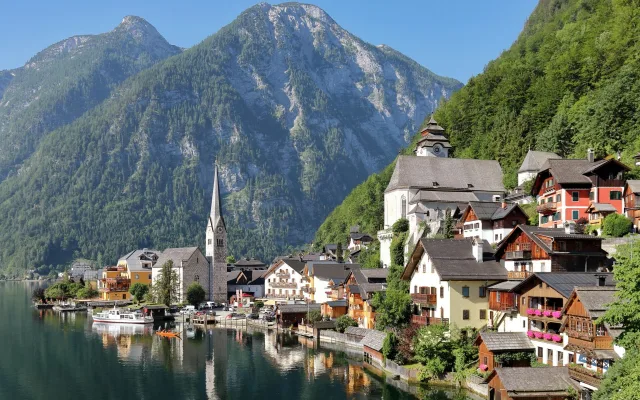
Hallstatt is a picturesque village on the shore of an Alpine lake, a UNESCO World Heritage Site and one of the most photographed places in Europe.
Wiki
Hallstatt is a village of eight hundred people wedged between a sheer slope and a glacier lake in the Austrian Salzkammergut, and one of the most photographed views in Europe. Salt has been mined here longer than anywhere else on the planet, and the excavations in the valley above the village gave their name to an entire archaeological era — the Hallstatt culture of the European Iron Age, roughly 800 to 450 BC. Since 1997 the "Hallstatt–Dachstein / Salzkammergut Cultural Landscape" has been on the UNESCO World Heritage list.
A little history
Salt was already being cut from these mountains in the Bronze Age: the oldest workings found here are around three and a half thousand years old. The trade fed the valley for centuries and made a tiny settlement disproportionately rich — hence the three- and four-storey stone houses on a strip of shore only a few dozen metres wide. In 1595 a wooden brine pipeline forty kilometres long was laid from Hallstatt to Ebensee; it is reckoned the oldest industrial pipeline in the world. And between 1846 and 1863 the mine official Johann Georg Ramsauer excavated a burial ground of almost a thousand graves in the valley — those finds are what gave the Hallstatt culture its name.
What to see
- Marktplatz — a tiny triangle of a square with a fountain and coloured facades. The other classic viewpoint is the northern end of the lakeside promenade, where the spires of both churches rise above the roofs.
- The Lutheran church — the white neo-Gothic church with its sharp steeple at the water's edge, the defining silhouette of Hallstatt. Plain inside, but worth stepping into.
- The Catholic parish church of the Assumption — higher up the slope, with an early 16th-century Gothic winged altarpiece and a terraced graveyard.
- The bone house (Beinhaus) — the charnel chapel beside the graveyard. More than a thousand skulls, some six hundred of them painted with wreaths, crosses and names: there was never enough room on the terraces, graves were reused, and the bones were moved here. The custom of painting the skulls took hold around 1720. It is a quiet place, and not in the least ghoulish.
- The Salzwelten salt mine — the Salzbergbahn funicular carries you up, and the tour then goes underground past wooden miners' slides, a subterranean lake and the spot where the "man in the salt" was found. This is the oldest working salt mine on earth.
- The viewing platform above the village — a steel skywalk by the upper funicular station, cantilevered 350 metres above the roofs. This is the view down over the lake.
- The Hallstatt Museum on the square — the finds from Ramsauer's burial ground and a clear account of what this valley was three thousand years ago.
Dachstein and around
Opposite, from Obertraun, a cable car climbs the Dachstein massif (the summit stands at 2,995 m). Three stops give three different things: the Five Fingers platform, with steel walkways jutting over the drop; the skywalk on Krippenstein; and the ice caves, with their lit chambers of ice — the temperature is below freezing even in July, so bring a jacket. Nearby is the Mammoth Cave, one of the largest cave systems in Austria.
Half an hour away lies Bad Ischl, the spa town where the Habsburgs spent their summers, with Emperor Franz Joseph's villa and an old confectioner's. Further on is the village of Gosau, with the Gosausee lake reflecting the Dachstein: a view every bit as good as Hallstatt's, and a fraction of the people.
Food and prices
The cooking is Salzkammergut, which is to say Alpine: grilled lake trout and whitefish, Käsespätzle (home-made noodles with cheese), Wiener schnitzel, dumplings, and apple strudel with whipped cream. A glass of Grüner Veltliner usually goes with lunch.
Lunch in a cafe costs €18-28 (about $21-32), dinner in a restaurant €30-60 ($35-69), a glass of white wine €4-6 ($5-7), coffee and cake €8-10 ($9-12). The combined ticket for the funicular and the salt-mine tour is around €42 ($48), and a boat trip on the lake €4-10 ($5-12) depending on the route. Prices are as of 2026.
Getting there
The nearest airports are Salzburg (SZG, about 70 km) and Vienna (VIE, about 280 km). From Salzburg the simplest route is a bus to Bad Ischl and then a bus or train onwards, around two and a half hours in all. From Vienna it is a train with a change at Attnang-Puchheim, about four hours. Hallstatt railway station stands on the far side of the lake: a small ferry meets every train, and those ten minutes on the water are the best possible first sight of the village.
Cars have to be left in the paid car parks at the entrance; there is no access to the centre. Inside the village everything is within half a kilometre and no transport is needed.
When to go
May to September: 12-22°C, with every cable car and cave running. July and August are the peak, with up to ten thousand visitors a day in a village of eight hundred, which is why a cap on tourist coaches has been in force since 2020. December to March is snowy and deeply atmospheric, though some of the mountain attractions close. The best light is at dawn and before sunset; at midday the village sits in the shadow of the slope and is packed.
Common mistakes
- Arriving by coach for two hours in the middle of the day: you will see the crowd on the square and little else.
- Sleeping in Hallstatt itself is expensive. Obertraun and Bad Goisern nearby are markedly cheaper and the views are the same.
- Treating the ice caves as an easy stroll: there are hundreds of steps and it is cold.
- Limiting yourself to the village. Half a day on the Dachstein or at the Gosausee gives you more than a third lap of the promenade.