Description
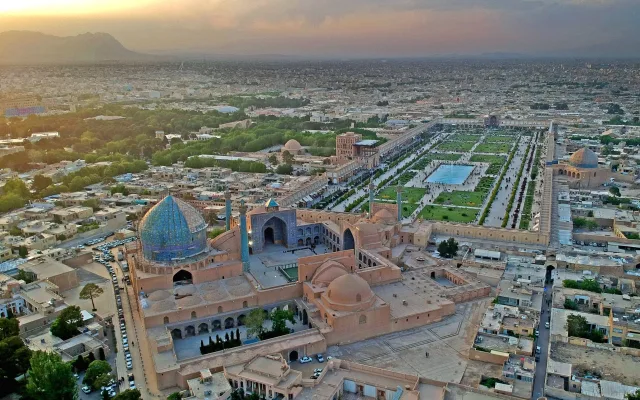
The Safavid capital in central Iran: the UNESCO-listed Naqsh-e Jahan Square, turquoise-domed mosques, the bridges over the Zayandeh Rud and the Armenian quarter of Julfa.
Wiki
Isfahan has a fair claim to being one of the most beautiful cities of the Islamic world. Set in the centre of Iran on the banks of the Zayandeh Rud, it spent centuries as a crossroads of trade routes before becoming, at the start of the 17th century, the dazzling capital of the Safavid empire. Today it is the country's third-largest city, where monuments of world significance sit alongside busy bazaars, tea houses and shaded gardens.
History and general character
There was a settlement here before Islam, and under the Sasanians it was a substantial administrative centre. The great flowering came in 1598, when Shah Abbas I moved his capital here and launched an enormous building programme. That is when the saying "Isfahan is half the world" was coined: the city astonished ambassadors and travellers with the scale of its squares and the sheer number of its mosques, palaces, bridges and caravanserais. The layout of the Safavid centre — straight avenues, canals and gardens — is considered an early example of deliberate town planning.
Isfahan's architectural language is instantly recognisable: pointed iwan portals, bulbous domes clad in turquoise and cobalt tiles worked into plant motifs and calligraphy. Importantly, this is not a museum under glass — the mosques are still prayed in, the bazaar still trades, and the bridges are where the city takes its evening walk.
Naqsh-e Jahan Square
The heart of the city is the rectangular Naqsh-e Jahan ("image of the world"), also known as Imam Square. It is one of the largest urban ensembles on the planet and is inscribed on the UNESCO World Heritage list. Four key buildings of the Abbas era frame its sides:
- The Imam (Shah) Mosque — a monumental building with a double dome and a portal faced in polychrome mosaic. Under the dome there is a remarkable acoustic effect: one clap comes back many times over.
- The Sheikh Lotfollah Mosque — an intimate court mosque with no minarets and no courtyard, famous for its cream-and-peach dome, in whose pattern the silhouette of a peacock appears at sunset.
- The Ali Qapu Palace — a tall ceremonial pavilion with a raised terrace balcony from which the shah watched horse games and processions; the upper "music room" is decorated with fretted niches.
- The Qeysarieh Portal — the ceremonial entrance to the Grand Bazaar.
The square itself is enclosed by two tiers of arcades housing craftsmen's shops — coppersmiths, miniature painters, carpet weavers.
Mosques, palaces and the bazaar
Beyond the main square, the Jameh (Friday) Mosque is essential — a UNESCO site in its own right and something of a textbook of Iranian architecture: built and rebuilt over more than a thousand years, from the Seljuks to the Safavids, so that you can trace the succession of styles and brickwork techniques in a single building.
The Grand Bazaar runs for kilometres of covered galleries, linking the square to the historic quarters. The Chehel Sotoun palace ("forty columns"), with its mirrored gallery and ceremonial frescoes, and the Hasht Behesht pavilion in its garden fill in the picture of Safavid court life.
The bridges over the Zayandeh Rud
The river divides the city and gave it its famous bridge-weirs. Si-o-se-pol ("the bridge of thirty-three arches", early 17th century) is a long brick promenade and the favourite place for a walk at sunset. Khaju Bridge combines a crossing with a water-regulating structure: there are sluices under its arches and a pavilion in the middle. The water level varies with the season, and in dry periods the bed can run empty.
Julfa and the Armenian heritage
On the south bank lies the Armenian district of New Julfa, settled by decree of Shah Abbas in 1606 with people moved here from Julfa in the Caucasus. Its centre is the Holy Saviour Cathedral (Vank), where a European church form is combined with Persian decoration: the vaults are covered in biblical scenes and gilding. There is a museum and an old printing house attached.
Food
Local cooking follows the general Iranian tradition with Isfahani specialities. The signature dish is beryani Isfahani style, made of minced mutton and served with flatbread. Try the thick khoresh stews, including fesenjan with ground walnuts and pomegranate paste, saffron-scented rice, and the sweet-and-sour main dishes. For dessert people buy gaz, the pistachio and almond nougat invented here, and poolaki, thin boiled-sugar discs. The meal ends with tea from the samovar.
A three-day route
- Day 1. Naqsh-e Jahan Square and all four of its monuments, plus the arcades with the craft workshops.
- Day 2. The Jameh Mosque, the Grand Bazaar, the Chehel Sotoun palace and the Hasht Behesht garden.
- Day 3. The Julfa quarter with the Vank Cathedral, then Si-o-se-pol and Khaju bridges towards evening.
Practical notes
Spring and autumn are the best times, without the summer heat or the winter chill. Modest clothing is required in the mosques and women need a headscarf; many religious sites hand out a cover at the entrance. It is easier to start early, before the crowds, and the tiled domes look their best in soft evening light. Check current visa rules and money arrangements before you plan: foreign bank cards do not work in Iran, and prices are written in rials but quoted in tomans, which are rials divided by ten.