Description
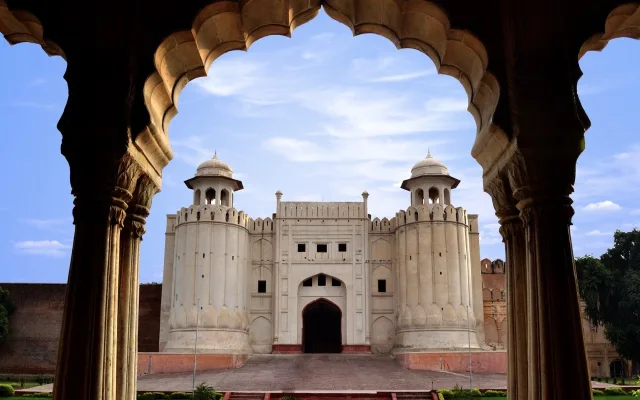
The cultural heart of Pakistan — Lahore Fort and the Shalimar Gardens, both on the UNESCO list.
Wiki
Lahore is an ancient city in eastern Pakistan, spread along the left bank of the Ravi close to the Indian border. It is called the soul of the subcontinent: the eras of the Mughals, of Sikh rule, of British dominion and of the birth of independent Pakistan all crossed here, and the layers of that history show through in every quarter.
The basics
Lahore is the administrative centre of Punjab province and the country's second city, with around 13 million people in the metropolitan area. For centuries it served as a Mughal capital. It was the home of the poet and thinker Allama Iqbal, whose tomb lies by the walls of the Badshahi Mosque, and of Faiz Ahmed Faiz, the greatest Urdu lyric poet of the 20th century. An old Punjabi saying holds that whoever has not seen Lahore has not yet been born. The city remains Pakistan's cultural, publishing and educational centre, and the acknowledged culinary capital of the region. Check the current security situation and entry rules before travelling.
Main sights
- Lahore Fort (Shahi Qila) — the UNESCO-listed palace complex of the 16th and 17th centuries. Inside are the famous Sheesh Mahal, the mirror palace inlaid with thousands of pieces of glass, the elegant Naulakha pavilion and the monumental Elephant Path.
- The Badshahi Mosque — the great mosque of 1673, one of the largest in South Asia, able to hold tens of thousands at prayer. Red sandstone and white marble, four minarets and a vast courtyard make it the symbol of the city.
- The Shalimar Gardens — another World Heritage site, a Mughal "paradise garden" of 1641-1642 with three terraces, canals and hundreds of fountains, embodying the Persian idea of an earthly paradise.
- Minar-e-Pakistan — the memorial tower of around 70 metres, raised where the historic Lahore Resolution calling for a separate Muslim state was adopted in 1940.
- The Walled City — the historic centre enclosed by a wall with thirteen gates. Delhi Gate, Bhati Gate and Roshnai Gate survive; behind them hide tight lanes, craft workshops and old havelis.
- Anarkali Bazaar — one of the oldest markets on the subcontinent, selling textiles, spices, jewellery and traditional sweets.
- Lahore Museum — the country's largest collection, with its Gandharan holdings including the celebrated Fasting Buddha from Sikri.
- The Allama Iqbal Museum and the tomb of the emperor Jahangir at Shahdara Bagh complete the picture of Mughal and national heritage.
- The Wagah border, 25 km from the city, where the flag-lowering ceremony between Pakistan and India is performed every evening.
Food
Lahori and Punjabi cooking are known for deep flavour and generous portions. Do try nihari, meat stewed overnight, paya and rich haleem, the spicy fried chicken chargha, and a range of kebabs and tandoor naan. The morning traditionally begins with a sweet or salted lassi of thick yoghurt. Street food in the Gawalmandi quarter and around the Walled City is inexpensive, while the restaurants overlooking the Badshahi offer the same range in calmer surroundings. Vegetarians will find dal, saag and vegetable curries.
Getting there and getting around
Allama Iqbal International Airport links Lahore with Pakistani cities, the Gulf and a number of European destinations. The railways are well developed, and Lahore station is itself a monument of British architecture. Around the city, ride-hailing apps are convenient, along with the modern Metrobus line and the Orange Line light metro. In the historic centre many distances are walkable, and auto-rickshaws work the narrow lanes.
Three days in Lahore
Three days covers the essentials. The first sensibly goes to the Mughal core: the fort, the Badshahi Mosque, the Hazuri Bagh gardens and a walk through the Walled City with a stop at Anarkali Bazaar. The second takes in the Shalimar Gardens, Jahangir's tomb and the Lahore Museum, with an evening trip out to the Wagah ceremony. Leave the third for modern Lahore: the colonial architecture along the Mall, Jilani Park, the Iqbal museum and a tasting of local sweets.
When to go
Lahore is most comfortable from November to March, when the weather is mild and dry. Summer, and May and June especially, brings exhausting heat, and the monsoon arrives in July. In spring the city comes alive for the kite-flying festival, and the historic quarters are at their finest in the soft light of winter days.