Description
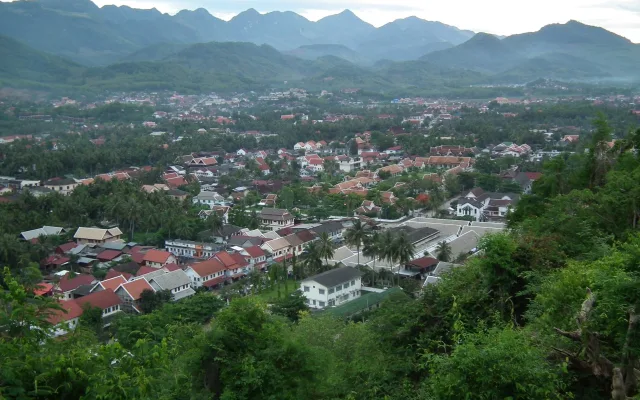
The former royal capital of Laos and a UNESCO site: thirty working monasteries, monks at dawn, the Kuang Si waterfalls and the meeting of the Mekong and the Khan.
Wiki
Luang Prabang is the former royal capital and the spiritual heart of Laos, spread across a narrow peninsula between the Mekong and the Khan. It is small — around 50,000 people — and counts as one of the most completely preserved Buddhist towns in Southeast Asia; its historic centre has been on the UNESCO World Heritage list since 1995.
History and the look of the town
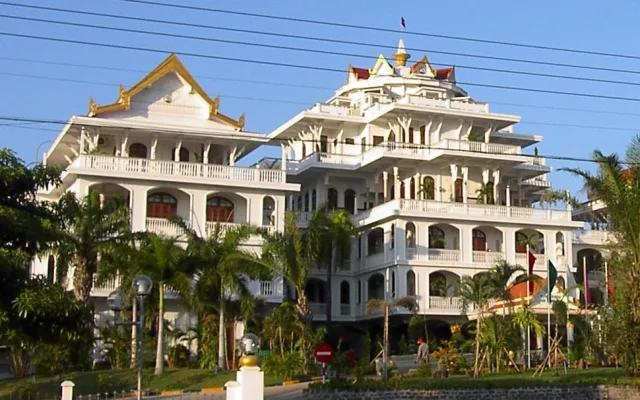
The town grew up around the old kingdom of Lan Xang ("the land of a million elephants") and takes its present name from the golden Phra Bang Buddha brought here in the 14th century. For centuries it remained the religious and royal centre, until the monarchy was abolished in 1975. What gives Luang Prabang its particular character is the meeting of two architectural traditions: austere Lao temples with their tiered roofs, and French colonial building — two-storey houses with shutters, arcades and balconies left over from the protectorate. The lanes of the old town are narrow and green, with almost nothing tall, which is what preserved the historic scale.
Since 2021 getting here has become far easier: the high-speed railway linking Vientiane with the Chinese border runs through the town. The journey from the capital takes under two hours instead of a full day on the bus over mountain switchbacks. The station is outside the centre, a short tuk-tuk ride from the old town.
Temples and the main sights
There are around thirty working monasteries (wats) in the compact centre, and monastic life is visible at every turn.
- Wat Xieng Thong — the jewel of the town, built in 1559 under King Setthathirath. It is famous for the "tree of life" mosaic on its rear wall and its gilded carved façades.
- Wat Mai — a temple with gilded bas-reliefs at the entrance; for a long time the Phra Bang statue was displayed here during the new year festivities.
- The Royal Palace (Haw Kham) — the early 20th-century residence, now the National Museum. The relic itself, the golden Phra Bang Buddha and symbol of the state, is kept in a separate pavilion beside it.
- Phousi Hill — a hundred-metre rise in the middle of town; 328 steps lead up to the That Chomsi stupa and a panorama of the rivers and tiled roofs. The classic place to watch the sunset.
The Tak Bat ceremony
Every morning at dawn (roughly 5.30 to 6.30) hundreds of monks in saffron robes file through the streets in single line, receiving sticky rice and other offerings from residents. This alms round is called Tak Bat. It is performed in silence and asks for respect: watch from a distance, do not block the procession and do not use a flash.
Nature around the town
- The Kuang Si waterfalls — about 30 km south, a cascade some 60 metres high dropping into a chain of turquoise limestone pools you can swim in. There is an Asiatic bear rescue centre at the entrance.
- The Pak Ou caves — 25 km upstream on the Mekong, two grottoes in the cliff above the river holding thousands of Buddha figures left by pilgrims. You get there by slow boat, two to three hours each way.
- The craft villages — in the surrounding countryside, places such as Ban Phanom, where weavers make silk and cotton cloth by hand.
Food
Local cooking combines Lao traditions with French influence. The foundation is sticky rice, eaten with the fingers. Try laap (a sharp salad of chopped meat and herbs), Lao-style khao soi, dried Mekong river weed (kaipen) with jaew sauce, and the baguettes and coffee inherited from the colonial period. In the evenings the night market unrolls along the main street: food stalls and handicrafts from the Lao, Hmong and Khmu — textiles, silver and saa paper.
Practicalities
Four days is a comfortable allowance for the town and its surroundings: a day for the temples and the museum in the centre, a day for the waterfalls, a day for the boat trip to the caves, and time for unhurried wandering and the market. The best season is the cool, dry months from November to February. The centre is easy on foot or by bicycle; for trips out of town people take a tuk-tuk or join a tour. Respect for monastic custom, modest dress in the temples and shoes off at the door are not optional.