Description
Milan is the world capital of fashion, home to the famous Duomo cathedral, the Galleria Vittorio Emanuele and a great many first-class restaurants.
Wiki
Milan is the largest city in northern Italy and the capital of Lombardy, an acknowledged world centre of fashion, design and finance. Behind the gleam of the fashion windows and the business districts lies one of the oldest and culturally richest cities in the country, with two thousand years of history.
A little history
Founded by Celts and later conquered by the Romans, the city, under the name Mediolanum, became one of the capitals of the Western Roman Empire at the end of the 3rd century. It was here in 313 that the emperor Constantine issued the Edict of Milan, putting Christianity on an equal footing with other religions. In the Middle Ages and the Renaissance the city was ruled by the powerful Visconti and Sforza dynasties, under whom architecture and art flourished. Later Milan lived through Spanish and Austrian rule, and in the 19th century it became one of the focal points of Italian unification. Today it is a dynamic metropolis where business energy sits alongside a rich inheritance.
Main sights
- The Duomo — a majestic Gothic cathedral built between the 14th and the 19th centuries. Thousands of statues adorn its facade, and a forest of spires — 135 in all — crowns the roof. The climb up to the terraces opens a panorama of the city, and in clear weather the snowy peaks of the Alps are visible. Inside, the stained glass and the treasury are worth attention.
- The Galleria Vittorio Emanuele II — an elegant covered arcade of 1877 with a glass dome, one of the oldest shopping centres in the world. Tradition has you make a wish by spinning three times on your heel on the mosaic bull.
- Leonardo da Vinci's "Last Supper" — the famous wall painting in the refectory of the monastery of Santa Maria delle Grazie, on the UNESCO list. Viewing is in small groups at timed slots, so tickets go months in advance.
- The Sforza Castle — an imposing Renaissance fortress, now a complex of museums. Among its treasures is Michelangelo's unfinished "Rondanini Pieta". Beyond the castle walls stretches the large Sempione park.
- The Pinacoteca di Brera — a picture gallery with masterpieces by Raphael, Mantegna, Caravaggio and Bellini, set in the bohemian quarter of the same name.
Districts and atmosphere
Every corner of Milan has its own character. Brera, with its narrow streets, artists' studios and antique shops, keeps its artistic spirit. Navigli is the district of old canals, laid out partly with Leonardo's involvement; in the evening the quaysides come alive with bars and the ritual of the aperitivo. Futuristic Porta Nuova, with its skyscrapers and the famous "Vertical Forest", shows the modern face of the city. The main squares and busy pedestrian streets are concentrated around the Duomo.
Fashion and shopping
Milan wears the title of a fashion capital by right. The heart of luxury shopping is the "Golden Quadrilateral" (Quadrilatero d'Oro): Via Montenapoleone, Via della Spiga and Via Sant'Andrea, where the leading houses of the world are represented. Fashion Weeks take place twice a year and set the trends. Anyone hunting a bargain should make the trip to the Serravalle outlet village, about an hour and a half away, where branded goods are sold at considerable discounts.
Gastronomy
The local cooking is filling and distinctive. Its emblem is risotto alla milanese, coloured a golden yellow by saffron. Equally well known are ossobuco (braised veal shank) and the crisp cotoletta alla milanese. For the holidays bakers make the airy panettone, which has become a symbol of the Italian Christmas. The ritual of the aperitivo deserves a mention of its own — a drink with snacks before dinner.
A three-day route
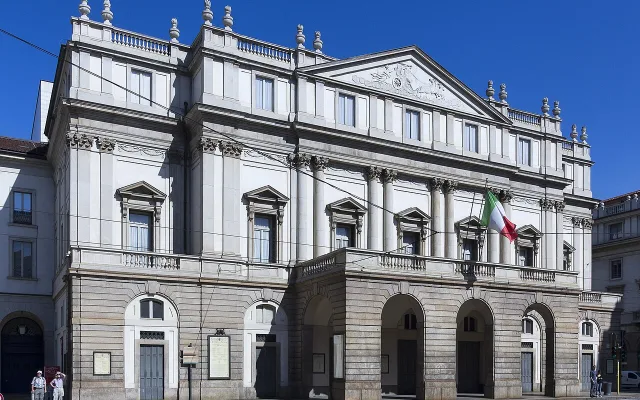
Three days are enough to cover the essentials. Devote the first day to the centre: the cathedral with the climb to the roof, the galleria, Piazza della Scala and the famous opera house. The second to art: the "Last Supper", the Sforza Castle and its park, the Brera gallery. Leave the third day for unhurried walks along the Navigli, for shopping and, if you like, a trip to the outlet.
Practicalities
Milan is well connected to other cities: Frecciarossa high-speed trains reach Rome in about three hours, and Florence and Venice more quickly still. The airports of Malpensa, Linate and Bergamo take flights from all over the world. Getting around the city is easy on a metro of several lines, and on trams and buses; the historic centre is compact and simple to cover on foot. The best time to visit is spring and autumn, when the weather is mild and the flow of tourists is gentler than in summer.