Description
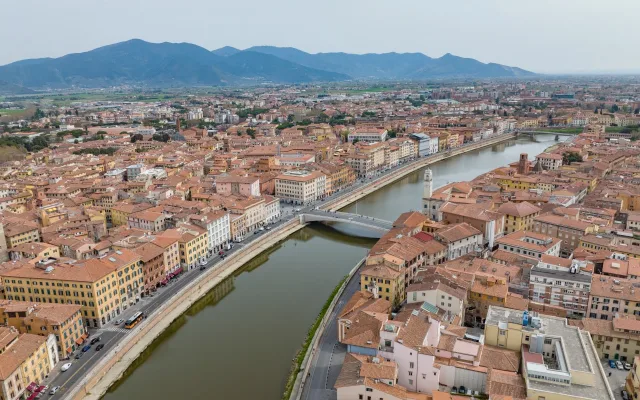
Pisa is a city famous for its Leaning Tower, which stands on the Piazza dei Miracoli — a masterpiece of Romanesque architecture in white marble set on a green lawn.
Wiki
One of Italy's most recognisable landmarks draws visitors to this city of around 90,000 people in Tuscany, 80 km west of Florence. The UNESCO-listed Piazza dei Miracoli (Square of Miracles), home to the Leaning Tower, is the main draw. In the Middle Ages Pisa was one of Italy's four Maritime Republics (10th–13th centuries), a rival to Genoa and Venice. Most tourists visit as a day trip from Florence, but the city rewards one or two nights — it is also home to one of Italy's oldest universities (founded 1343).
Main sights
- Piazza dei Miracoli (Piazza del Duomo) — the UNESCO-listed main complex containing all the principal monuments.
- Leaning Tower (Torre Pendente) — the cathedral's bell tower, built 1173–1372, with a tilt of 4 degrees (3.9 m off vertical). The climb involves 296 steps; tickets cost 20€ and must be booked in advance.
- Pisa Cathedral (Duomo) — an 11th–12th-century Romanesque cathedral and the prototype of the Pisan-Romanesque style found across the Mediterranean. Free entry with any other site ticket.
- Baptistery of San Giovanni (Battistero) — the largest baptistery in Italy (54 m), famous for its extraordinary acoustics; guides often sing in the circular hall.
- Camposanto Monumentale — the monumental cemetery, built on soil said to have been brought from Golgotha by Crusaders in the 12th century.
- Museo dell'Opera del Duomo — original sculptures and frescoes from the cathedral complex.
- Museo delle Sinopie — sinopie (preparatory sketches) for the Camposanto frescoes.
- Piazza dei Cavalieri — the city's second main square, lined with Vasari-designed palaces including the Palazzo della Carovana, the main building of the Scuola Normale Superiore.
- Borgo Stretto — the main pedestrian street, lined with arcades and shops.
- Chiesa di San Nicola — another leaning tower; a third, San Michele degli Scalzi, also leans.
- Museo Nazionale di San Matteo — Pisa's main art museum, covering Tuscan art from the 12th to 15th centuries.
Food and prices
The cooking is Tuscan and Pisan: cecina (a chickpea flatbread and Pisa's signature street food), pappa al pomodoro, ribollita, pici, and bistecca alla fiorentina. A glass of Chianti runs 4–6€ (about $5–7). Lunch at a trattoria costs 12–22€ ($15–27), dinner at a restaurant 25–50€ ($31–62). A Leaning Tower ticket is 20€ ($25); a combined ticket for the cathedral, baptistery, Camposanto and museum is 11€ ($14). A litre of fuel is around 1.7€ ($2.10), public transport 1.5€ ($1.85), and a taxi 8–15€ ($10–19). Prices are as of 2026.
Getting there and around
Pisa Galileo Galilei International Airport (PSA) is 1 km from the city centre and is served by Ryanair, Vueling, and Lufthansa, among others. The PisaMover shuttle connects the airport to the central station in 8 minutes for 5€ ($6). From Florence, trains take about 1 hour and cost 10–15€ ($12–19). The city centre is compact and walkable — all the main sights are within a 1 km radius. Lucca is 30 minutes away; the Cinque Terre around 2 hours.
When to go
April to October brings temperatures of 12–28°C. May–June and September are the sweet spot. Summer (July–August) is hot (28–35°C) and crowded. Winter (December–March) is cool and rainy (5–12°C) but largely tourist-free. The Regatta of the Maritime Republics (Regatta delle Repubbliche Marinare) rotates between Pisa, Venice, Genoa, and Amalfi — Pisa hosts once every four years.