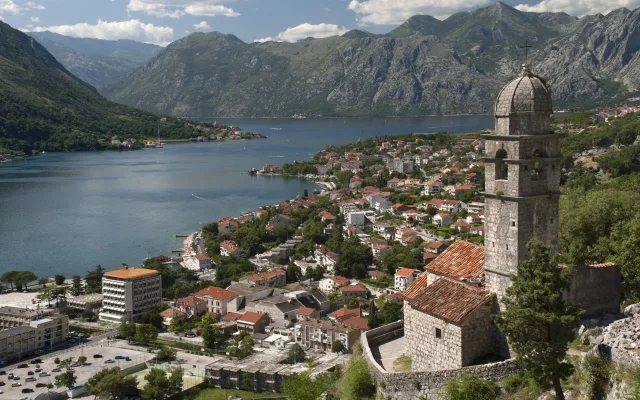
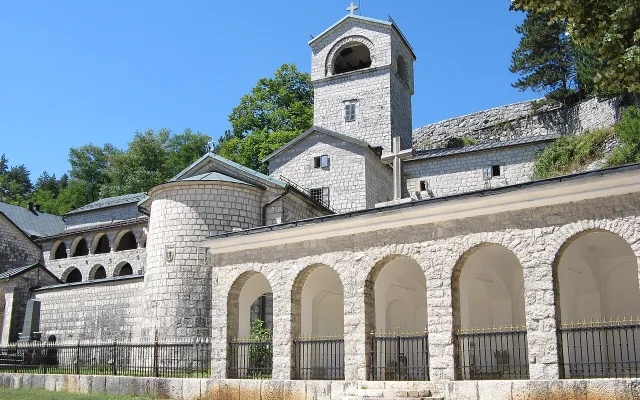
Description
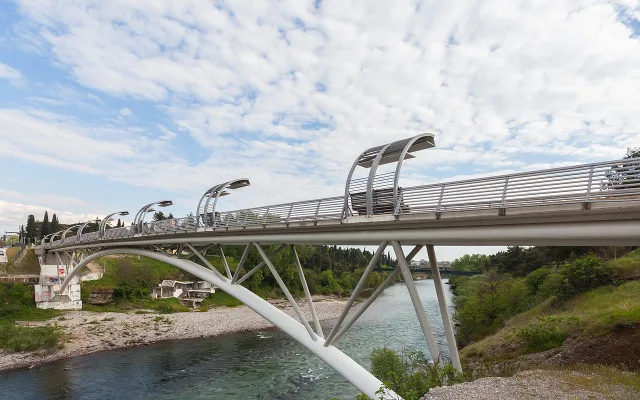
The modest capital of Montenegro — ancient Doclea, the Millennium Bridge and the Cathedral of the Resurrection of Christ.
Wiki
Podgorica rarely appears on must-see lists, and most people come through in transit — from the airport, from the bus station, on the way to the sea or the mountains. But you can spend a day here, and as a base for radial excursions around the country the capital works very well.
Is it worth staying
Honestly: Podgorica is not about architecture and postcards. The city suffered badly in the Second World War and was rebuilt with socialist-era blocks, so there is almost no "old centre" in the usual sense. There is little point coming here for 2–3 days for the city itself — one day is enough. But as a transport hub and starting point Podgorica is convenient: Lake Skadar, Ostrog, the canyons and the coast are all close.
What is genuinely worth seeing in a day:
- The Millennium Bridge — the city's calling card, a cable-stayed bridge over the Morača. Handsome in the evening when it is lit.
- The Cathedral of the Resurrection of Christ — a large modern church with unusual mosaics inside. Worth going in.
- Stara Varoš — the Ottoman quarter with its clock tower (Sahat Kula) and remnants of Turkish building, the one fragment of an "old town".
- Ancient Doclea — the ruins of a Roman city on the outskirts, at the confluence of the rivers. Free and almost without visitors; interesting for anyone who likes archaeology, but awkward to reach.
- The Morača and Ribnica embankments and the park with the Ribnica fortress — pleasant for a walk.
Getting there
Podgorica Airport is about 11 km from the centre. There has traditionally been no convenient regular bus, so people usually take a taxi; agree the fare in advance or insist on the meter so as not to overpay. Sometimes it works out better to book a transfer through your accommodation.
The bus station and railway station stand next to each other, not far from the centre. Buses are the main way of getting around the country: there are frequent connections with Kotor, Budva, Cetinje and Nikšić. Trains run towards Bar (for the sea) and Kolašin/Bijelo Polje — a scenic mountain route, and cheap.
Getting around the city
The centre is compact and the key points can be walked. There are city buses, but a visitor barely needs them — the exception is a trip to Doclea or to the outskirts, for which a taxi is simpler and relatively inexpensive. Hiring a car makes sense if Podgorica is your base for trips around the country: the roads are decent, but there are hairpins in the mountains, and parking in the centre is charged in places.
Where to stay
Best is the Nova Varoš area and the centre, nearer the pedestrian zone (Slobode, Hercegovačka) and the embankment. Everything is within walking distance from here, and there are cafés and life in the evening. If you are tied to an early bus or train, take accommodation by the stations. Overnight prices are noticeably lower than on the coast — Podgorica is good value in that respect.
When to go
Podgorica lies in a basin and bakes in summer — in July and August the heat often passes 35 °C and walking during the day is hard going. The best time is April–June and September–October: warm, green and comfortable. Winter is mild but rainy. If your aim is to set out for the mountains or the lake, spring and early autumn are also ideal.
Food and prices
The cooking is Balkan, the portions are large and the prices are below coastal levels:
- Ćevapi, pljeskavica, ražnjići — grilled meat, filling and cheap.
- Njeguši pršut (dry-cured ham) and cheese, and burek pastry for breakfast.
- Fish and eel — if you are going to Lake Skadar.
Look for places where locals eat, in courtyards and on side streets — the food there is better and cheaper than at the tourist spots by the bridge. Coffee is a cult here: sitting for hours in a kafana (a traditional tavern-café) is the local norm, and it is cheap.
Safety and practicalities
The city is calm, with little serious street crime, and walking through the centre in the evening is fine. Standard care with valuables is enough. The currency is the euro (Montenegro is not in the eurozone but uses the euro). Cards are accepted in the city, but keep cash for markets, small cafés and buses.
Common mistakes
- Expecting a "postcard European capital" from Podgorica — you will be disappointed. Prepare for a working, living, unpolished city.
- Allowing several days for it — better to make it a hub and go out on day trips.
- Heading to Doclea without a transport plan — the ruins are off to one side and too far to walk, so arrange a taxi in advance.
- Walking in the midday heat in summer — shift activity to morning and evening.
- Counting on a convenient bus from the airport — budget for a taxi or transfer.
In sum: allow a day (or even half a day) for Podgorica itself, and use the rest of the time with the city as a convenient and inexpensive base for getting to know the real Montenegro — the lake, the monasteries and the mountains.