Description
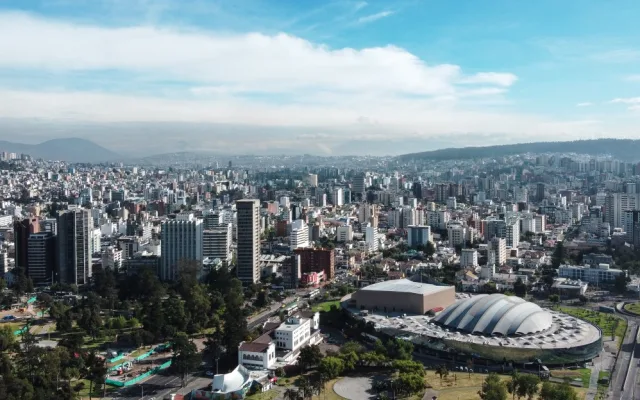
The equatorial capital with Latin America's best-preserved colonial centre, a cable car up Pichincha, and views of snow-capped volcanoes.
Wiki
Quito is the capital of Ecuador and the administrative centre of Pichincha Province, the country's second-largest city after Guayaquil. Sitting almost exactly on the equator, it stretches in a narrow strip along the eastern slope of the Pichincha volcano, giving the city skyline a distinctively mountainous character.
Overview and Geography
Quito lies at roughly 2,850 metres above sea level in an Andean valley, making it the highest official capital city in the world (La Paz in Bolivia is formally the seat of government but not the de jure capital). The greater metropolitan area has a population of around 2.8 million. The city extends nearly 50 kilometres from north to south while only a few kilometres wide — hemmed in by the surrounding terrain. Within a radius of about 50 km, nine volcanoes rise around the city, some of them active. Despite its proximity to the equator, the altitude produces a mild, spring-like climate year-round: daytime temperatures of 18–22 °C, with cool nights. Seasons differ not in temperature but in rainfall — the drier period runs from June to September.
Historic Centre
The Old Town (Centro Histórico), covering around 320 hectares, is one of the largest and most completely preserved colonial ensembles in Latin America. In 1978 it became one of the first sites inscribed on the UNESCO World Heritage List. Baroque, Moorish and local Andean traditions intertwine here — the so-called Quito School of religious art.
- Plaza de la Independencia (Plaza Grande) — the heart of Old Quito. Around its perimeter stand the Presidential Palace (Palacio de Carondelet), the cathedral, the municipal building, and the Archbishop's Palace.
- Iglesia de la Compañía de Jesús — a Jesuit church whose interior is considered the most lavishly decorated on the continent: vaults and altars are covered in gold leaf.
- Iglesia y Convento de San Francisco — a large monastic complex, one of the oldest in South America, founded shortly after the city was established in 1534.
- Basílica del Voto Nacional — the largest neo-Gothic church in the region, adorned not with conventional gargoyles but with figures of Ecuadorian animals: tortoises, condors, iguanas, and armadillos. The towers can be climbed for sweeping views.
- La Ronda — a picturesque pedestrian lane lined with balconied houses, craft shops, and traditional cafés.
Viewpoints and Nature
- El Panecillo — a rounded hill above the Old Town, crowned by a 41-metre aluminium statue of the Winged Virgin of Quito. It offers a wide panorama over the historic centre.
- TelefériQo — a cable car that climbs the flank of Pichincha volcano to around 4,050 metres. On clear days the snowy cones of neighbouring volcanoes are visible; from the upper station, trails lead towards the summit of Rucu Pichincha (acclimatisation is essential before attempting the hike).
Surroundings
- Mitad del Mundo — the "Middle of the World" monument, 25 km to the north, marking the zero-latitude line. According to modern measurements, the actual equator runs a couple of hundred metres further north, on the grounds of the Intiñan Museum.
- Otavalo — a famous indigenous market roughly two hours away, the largest craft market in South America; the main trading day is Saturday.
- Cotopaxi — one of the highest active volcanoes on the planet (around 5,897 m), in a national park to the south of the city; a popular destination for trekking and mountaineering.
Food and Drink
Local cuisine blends Andean and coastal traditions. Worth trying: locro de papa (a thick potato soup with cheese and avocado), ceviche, empanadas, and hornado — slow-roasted pork. On the more adventurous side: fried guinea pig (cuy) and street-side tropical fruits. A common accompaniment is canelazo — a warm drink made with sugarcane spirit, cinnamon, and fruit, a welcome warmer on cool evenings.
Practical Information
Allow around three days to see Quito comfortably: one day for the historic centre, one for the viewpoints and Mitad del Mundo, and a third for a day trip to Otavalo or Cotopaxi. Because of the altitude, it's wise to take the first day easy to let your body acclimatise to the thinner air. Mariscal Sucre International Airport lies outside the city; the journey to the centre takes about an hour. The official currency is the US dollar. As in any large city, keep a close eye on personal belongings in tourist areas and on public transport.