Description
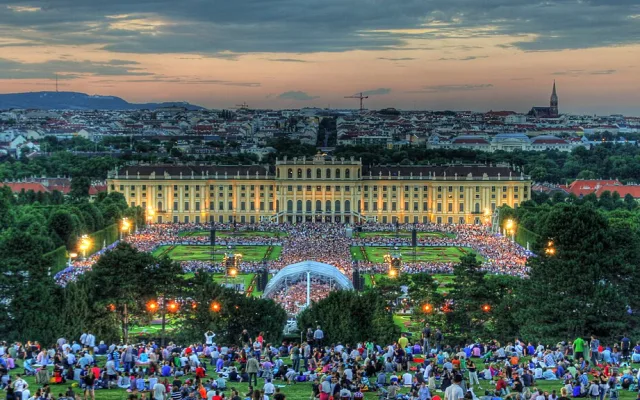
Vienna is the imperial capital, known for the Schonbrunn and Hofburg palaces, for its musical culture and for Wiener schnitzel.
Wiki
Vienna is the capital of Austria and one of the cultural jewels of Central Europe, set on the banks of the Danube at the eastern spurs of the Alps. For centuries the city served as the centre of the vast Habsburg realm, and that imperial past can be felt in every quarter: from opulent palaces to concert halls where classical music still sounds today.
A little history
The first settlement on this site was founded by the Romans — the military camp of Vindobona on the frontier of the empire. In the Middle Ages the city became the seat of the Babenberg dukes and then of the Habsburgs, under whom Vienna turned into the capital of the Holy Roman Empire and later of Austria-Hungary. Twice Ottoman armies halted beneath its walls (1529 and 1683). Its flowering came in the 19th century: under the emperor Franz Joseph the fortifications were pulled down and a ceremonial ring of boulevards, the Ringstrasse, was laid out, along which the Opera, the City Hall, the Parliament and the museums went up. The beginning of the 20th century made the city a focus of art nouveau, psychoanalysis and the musical avant-garde.
Main sights
Along with Schonbrunn, the Hofburg, the Belvedere and the Kunsthistorisches Museum, it is worth seeing:
- St Stephen's Cathedral — the symbol of the city and a masterpiece of Gothic, with its patterned tiled roof. The viewing platform of the south tower opens a panorama of the centre.
- The Ringstrasse — the ring boulevard with its ensemble of historicist buildings; it is best seen on foot or from the window of tram routes 1 and 2.
- The Hundertwasser House — a residential block with undulating lines, bright facades and trees on the balconies, designed by the artist Friedensreich Hundertwasser.
- The Prater — the historic amusement park with the famous Riesenrad ferris wheel, one of the emblems of Vienna.
- The MuseumsQuartier — one of the largest cultural complexes in Europe, with the Leopold Museum (the Egon Schiele collection) and the MUMOK contemporary art centre.
Coffee houses and food
The Viennese coffee house is not simply a place to eat but an institution, where the custom is to read the newspapers for hours over a single cup. The classic addresses are Central, Sacher, Landtmann and Sperl. Alongside the melange and the einspanner, people try the kapuziner and the famous Sachertorte with its apricot jam. For Wiener schnitzel of veal, boiled beef tafelspitz and apple strudel, the traditional taverns known as Beisl are the place to go. In autumn, in outlying districts such as Grinzing, the heurigen open — wine taverns serving young wine from vineyards inside the city limits.
Districts
The centre (the 1st district, Innere Stadt) holds most of the monuments and is on the UNESCO World Heritage list. Beyond the Ringstrasse lie the residential districts: bohemian the 7th (Neubau) with its design shops, lively the 2nd (Leopoldstadt) by the Prater, and green the 13th around Schonbrunn. The Danube Island and the embankments are a popular place for residents to relax in summer.
Practical advice
In four days you can realistically see the historic centre, give a day to Schonbrunn and the Hofburg, another to the museums and the Belvedere, and keep the remaining time for walks, coffee houses and, if possible, an evening at the opera. The Vienna City Card or day tickets are good value if you move around a lot. Public transport runs precisely and covers the whole city; at weekends the metro runs through the night.
The best seasons are late spring and early autumn, when it is warm and not crowded. December deserves particular attention: Christmas markets open across the city — at the City Hall, at Schonbrunn and on Am Hof — with mulled wine, gingerbread and craft souvenirs. Vienna consistently tops the rankings of the most liveable cities in the world, and that shows in the cleanliness of the streets, the safety and the well-considered fabric of the city.
Photos