Description
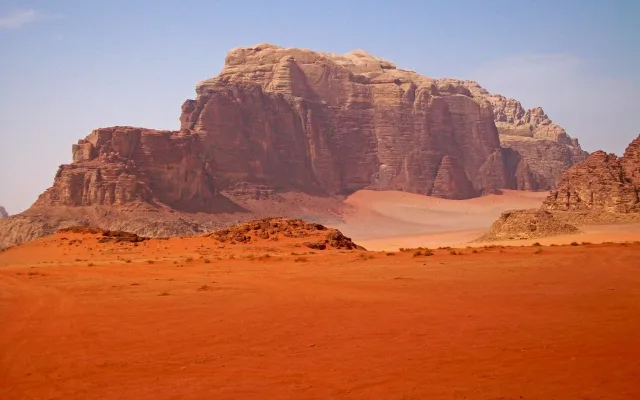
The Valley of the Moon — red sand, Bedouin camps, jeep tours, Khazali Canyon and the Burdah rock bridge.
Wiki
The Valley of the Moon is what they call Wadi Rum, and it is probably the least conventionally touristy place in Jordan: you do not come to "see the sights" but to sleep under an open sky, be shaken about in the back of a jeep across red sand, and fall silent looking at the rocks. Planning works differently from a normal town — almost everything here hangs on which Bedouin camp you choose.
How much time to allow
Two days is the optimum, and here is why. The classic pattern: arrive during the day, check into a camp around lunchtime, head out on a jeep tour in the afternoon (sunset in the desert is compulsory), sleep over and return in the morning. Limit yourself to a single day with no overnight and you lose the whole point — the silence, the stars and the dawn. Three days or more only makes sense for serious trekking (Umm ad-Dami, multi-day routes) or if you want to be in absolutely no hurry.
Getting there
Wadi Rum is not a place for getting about under your own steam. You drive to the visitor centre, pay the entry fee for the protected area, and from there a camp jeep collects you.
- From Aqaba — the closest, about an hour. A taxi will take you straight to the visitor centre; minibuses run but irregularly and with a change at the highway junction, so check times in advance, as there are none in the evening.
- From Petra (Wadi Musa) — a popular pairing: most people take a direct transfer, and it takes a couple of hours. The logical route is Amman → Petra → Wadi Rum → Aqaba, or the reverse.
- From Amman — a long way, half a day on the road. There are JETT coaches and scheduled minibuses to Aqaba, and you continue with local transport from there.
One important point: arrange your pick-up with the camp IN ADVANCE. Private cars are not allowed into the reserve beyond the village — you leave the car in the car park and go on by jeep.
Choosing a camp
The overnight stay is your "hotel", and the range is enormous. Judge by location rather than price:
- Camps deep in the desert — further from Rum village, quieter, darker at night (better for stars), but a longer drive to reach. This is what you want for atmosphere.
- Camps near the village — cheaper and closer to civilisation, but you hear generators and neighbours at night, and the light spoils the sky.
- Bubble domes with a transparent roof let you watch the stars from bed. Expensive and, frankly, often too hot by day and too cold by night — take one for the experience, not the comfort.
Check that dinner, breakfast and at least part of a jeep tour are included in the price; many camps sell it as a package, and buying "night plus tour separately" works out dearer.
The jeep tour: what you see
You move between points in the desert only by jeep with a Bedouin driver — the distances are far too great on foot. A standard half-day or full-day circuit covers the essentials: Khazali Canyon with its petroglyphs, Lawrence's Spring, the sand dunes, the natural arches (Burdah rock bridge can be climbed without equipment, though you need shoes with grip) and the Seven Pillars of Wisdom rock by the entrance.
In practice:
- Agree the route and the length BEFORE you set off — "the tour" means a different number of stops at different camps.
- Watch the sunset from high ground or the dunes; it is the climax of the day, so do not lose it to rushing.
- Umm ad-Dami (the highest point in Jordan, about 1,854 m) is a separate four- to five-hour outing with an early start. Plan it as its own item.
- A camel ride is really a twenty- to thirty-minute photo opportunity rather than a way of travelling.
Food, money, daily life
You are fed Bedouin cooking, and it is good: zarb — meat and vegetables slow-cooked in a pit under hot coals, theatrically dug up for dinner — plus mansaf, flatbreads and sage tea. Meals are almost always included in the camp price, and there is nothing else to spend money on: there are no shops in the desert.
- Cash is essential. Camps and drivers often do not take cards and there are no ATMs inside the reserve — withdraw dinars in Aqaba or Petra.
- The reserve entry fee is also part of the Jordan Pass — if you have that pass (it pays for itself with a Petra visit), check whether it covers your entry.
- Signal comes in patches and camp internet is weak. Treat it as part of the digital detox.
When to go, and safety
The best months are spring (March–May) and autumn (September–November). In summer the daytime heat pushes 40°C; in winter nights can fall to around freezing — and in any season the swing between day and night is sharp. Warm clothes for the evening are needed even in summer.
- Dress in layers, bring a hat and plenty of water; there is no shade to be found in the desert.
- Closed shoes: sand, stones and thorns.
- The place itself is safe and the Bedouin are hospitable. The real risk is dehydration and sun, not crime.
- Respect local custom: modest clothing, and ask before photographing people.
Common mistakes
- Coming for a single day — you miss the stars and the dawn, which were the whole point.
- Not bringing cash and warm clothing.
- Failing to agree the visitor-centre pick-up and the contents of the jeep tour in advance.
- Chasing a luxury dome at the expense of the camp's location — silence and a dark sky matter more than a transparent roof.