Hong Kong SAR China
Where to go
#
What to see
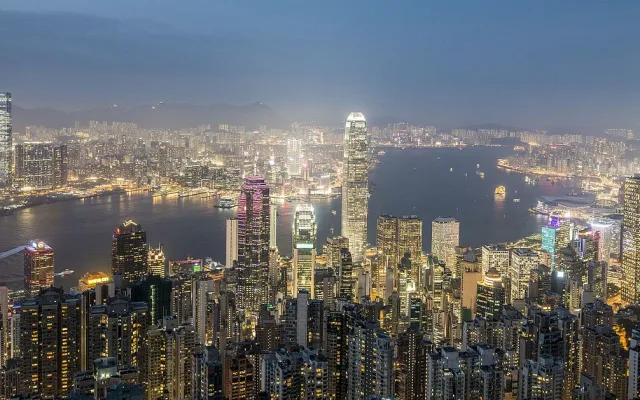
#Victoria Peak: The city's main viewpoint, reached by the historic Peak Tram climbing at 45 degrees. From the top you get the best panorama of the harbour and hundreds of towers.
Star Ferry: The cheap way to cross Victoria Harbour, on a historic double-decked ferry. It is an essential ride that delivers postcard views for the price of a few coins.
Big Buddha: The enormous statue on Lantau, up 268 steps. The Po Lin monastery next door serves traditional vegetarian food to visitors.
Symphony of Lights: The large-scale laser show, best watched at 20:00 from the Tsim Sha Tsui promenade. Towers on both shores light up in time with the music under computer control.
Mong Kok markets: Ladies' Market and Temple Street are where to wander for food and souvenirs. Haggling is not merely acceptable here, it is required if you want a decent final price.
SoHo: Walk the bar and restaurant district using the covered escalator system that runs up the hillside. It is the natural place for an evening out and for meeting the city's international crowd.
Prices
#Currency: The Hong Kong dollar is pegged firmly to the US dollar at roughly 7.8 to 1, which makes converting prices in your head easy.
Cards: Visa and Mastercard work almost everywhere, contactless included, but many small noodle shops and market stalls remain cash-only, so never rely on plastic alone. Amex is accepted far less widely, and a Wise or Revolut card keeps the conversion cost down.
Changing money: The best rates are in the exchange shops of Tsim Sha Tsui and Mong Kok, Chungking Mansions among them. The airport rate is traditionally poor, so change only what you need for transport there.
Tipping: Most restaurants already fold a ten per cent service charge into the bill. In taxis and small eateries nothing extra is expected, and you get your change down to the last cent.
Octopus: This card is your main wallet for the metro, buses and small purchases in shops like 7-Eleven. Top it up with cash at any counter, in 50 and 100 dollar notes.
| Item | Price (USD) |
|---|---|
| Dim sum for two | 19.50 |
| Char siu pork with rice | 7.80 |
| MTR metro ride | 1.80 |
| Star Ferry ticket | 0.50 |
| Ding ding tram fare | 0.40 |
| Peak Tram return | 8.50 |
| Ngong Ping cable car | 26.00 |
| Sky Terrace 428 viewpoint | 2.50 |
| Hostel bed | 38.00 |
| Guesthouse room, 10 sq m | 65.00 |
| Three-star hotel in Kowloon | 95.00 |
| 15-minute taxi ride | 13.00 |
| Bottle of water 0.5l | 1.50 |
| Litre of milk | 3.10 |
| Fast food meal | 12.00 |
| Dinner at a restaurant with a view | 58.00 |
| Airport Express to the centre | 15.00 |
Getting around
#MTR: The fastest way to move, covering nearly every district. Stations are clean and air-conditioned with excellent English signage, and trains run until midnight.
Octopus card: Buy one the moment you land for 200 HKD, of which 50 is a refundable deposit. It works on every form of transport and even pays for your coffee or groceries.
Ding ding trams: The double-decker trams run only on Hong Kong Island. It is an absurdly cheap and romantic way to see the city, at about 3 HKD paid as you get off.
Buses: The double-decker network is extensive and fares depend on how far you go. Board at the front, tap immediately, and note that drivers give no change in cash.
Taxis: Red cabs cover the whole city apart from parts of Lantau. A 15-minute ride costs roughly 100 HKD, and you should always ask for the meter.
From the airport: The Airport Express reaches the centre in 24 minutes. The cheaper option is the A21 or A11 bus, at about a third of the price.
Star Ferry: Boats cross between Kowloon and Hong Kong Island every ten minutes. It is transport and sightseeing at once, and the best place to photograph Victoria Harbour.
Where to stay
#Room size: Accommodation here is catastrophically small because there is simply no land. A ten square metre room with the bed touching both walls is normal at the budget end.
Districts: Tsim Sha Tsui or Mong Kok in Kowloon suit visitors best, largely for the food. Hong Kong Island costs more and is where you stay for the business district and SoHo nightlife.
Guesthouses: The cheapest rooms cluster inside the vast Chungking Mansions and Mirador Mansions buildings. There are hundreds of tiny rooms and comfort depends entirely on which operator you land with.
Booking: Demand is enormous and the good options go weeks ahead. Do not wait for a last-minute discount; book and pay in full early.
Deposit: Almost every hotel asks for a deposit at check-in, usually one night's rate. You can leave cash or have the amount held on a card, and it comes back when you leave.
What to check: Cheap rooms often have no window, or one facing a narrow ventilation shaft. Read the description carefully and confirm there is air conditioning, without which the climate is brutal.
What to eat
#Dim sum: Small dishes in bamboo steamers, traditionally eaten in the first half of the day. Expect steamed dumplings, rice rolls and rice wrapped in fragrant lotus leaves.
Cha chaan teng: The local tea diners, where Chinese cooking met British habits. Order the egg toast, the sweet buttered buns and the famous milk tea with coffee.
Char siu: The legendary roast pork in thick, sweet red sauce, sold at hundreds of counters. Choose the places with a queue and high turnover, which is also where several Michelin stars hide.
Street food: At the Mong Kok markets, buy the hot bubble waffles, gai daan jai. Curry fish balls and fried squid, cooked in front of you, are the other staples.
Mall restaurants: If the street chaos is not for you, head into the big shopping centres. There are always food courts with good quality and chains like Tim Ho Wan at reasonable prices.
Water: The tap water is technically safe, but Hong Kongers themselves prefer to boil it. Visitors do better buying bottled water, which is sold on every corner.
Safety
#The general picture: This is one of the safest large cities in Asia. You can walk alone late at night without concern, and police patrols are everywhere.
Pickpockets: In the Mong Kok market crowds and on packed metro trains, pickpockets are active. Watch your bag and never keep anything valuable in a back pocket.
Typhoons: The storm season runs from May to November. When a T8 signal is raised the city stops: shops, transport and the airport close, and you stay indoors.
Rules: Eating and drinking on the MTR is strictly forbidden and carries a substantial fine. Littering and smoking in the wrong places are punished just as firmly.
Scams: In the tourist blocks of Tsim Sha Tsui you may be pushed counterfeit electronics or fake watches. Inspect goods before paying and stay out of dubious basement shops.
Climate: Summer humidity and heat here are extreme and can bring on heatstroke quickly. Carry water and duck into air-conditioned spaces regularly.
Etiquette and culture
#Queueing: People here are devoted to order. Forming a straight line at bus stops and lifts is the norm, and pushing in will earn you real anger.
Escalators: Observe the unwritten rule and stand on the right so people in a hurry can pass on the left. This applies in the metro, the malls and the long street escalators.
Table manners: In tea houses, tap two fingers on the table to thank whoever pours your tea. Never stand chopsticks upright in a bowl of white rice.
Face: Avoid public scenes and do not raise your voice at staff. Staying calm resolves a problem faster and avoids humiliating the person you are dealing with.
Two hands: Anything you pass or receive, business cards and banknotes especially, should be handled with both hands. It is a gesture of respect that is genuinely noticed.
Dress: The city is fashion-conscious, but temples require covered shoulders and knees. Otherwise shorts and a T-shirt are fine everywhere except upmarket restaurants and private clubs.
Connectivity
#Languages: Cantonese is the everyday language and differs sharply from mainland Mandarin. English is spoken by nearly all hotel, transport and large-shop staff, and signage is bilingual throughout.
Internet: 5G coverage is flawless, even deep in the metro tunnels. The easiest option is an eSIM from a reputable provider bought before departure, so you are connected the moment you land.
Local SIMs: Tourist bundles for a week cost around 100 HKD and are sold in 7-Eleven kiosks. Activation often needs a simple passport registration through a website.
Navigation: Google Maps works without restriction and plots public transport routes well. Download Citymapper too; it is more accurate on bus arrival times.
Translation: For menus in non-tourist canteens, use the camera in Google Translate. An offline Cantonese pack helps with some taxi drivers.
Wi-Fi: The free Wi-Fi.HK network covers parks and many metro stations. In cafes and restaurants the password is often printed at the very bottom of your paper receipt.
Phrasebook
#| English | Cantonese | Pronunciation |
|---|---|---|
| Hello | 你好 | nay-HO |
| Thank you (for a service) | 唔該 | m-GOY |
| Thank you (for a gift) | 多謝 | daw-JEH |
| How much is it? | 幾多錢 | gay-daw-CHIN |
| That's too expensive! | 太貴了 | tai-GWAI-la |
| The bill, please | 埋單 | mai-DAAN |
| Where is the toilet? | 廁所在邊度 | chi-saw-hai-bin-DO |
| Help! | 救命 | gau-MENG |
| Sorry | 對唔住 | deui-m-JYU |
| Yes | 係 | hai |
| No | 唔係 | m-HAI |
| Delicious | 好食 | ho-SIK |
| Beautiful | 靚 | leng |
| Rice | 飯 | faan |
| Noodles | 麵 | min |
| Tea | 茶 | chah |
| Beer | 啤酒 | be-JAU |
| Water | 水 | seui |
| One | 一 | yat |
| Two | 二 | yi |
| Goodbye | 再見 | joi-GIN |
Good to know
#Emergencies: One number covers police, fire and ambulance: 999. Operators speak English and the call works even from a phone with no local SIM active.
Apps: Install MTR Mobile for metro maps and OpenRice for restaurant ratings that locals actually use. MyObservatory is indispensable for weather and typhoon warnings.
Sockets: The city uses the British three flat-pin standard, type G. Almost every hotel has adapters, and hardware shops sell them for very little.
Consular help: Most countries maintain a consulate general in Hong Kong, many of them in Admiralty or Wan Chai. Note the address and the out-of-hours number for your own nationality in case you lose your documents.
Air conditioning: Indoor spaces and transport are kept arctic. Even at 30 degrees outside, carry a light layer so the blast does not floor you.
Websites: The official Discover Hong Kong portal has current maps and an events calendar. For entry rules, use only the Immigration Department site at immd.gov.hk.
Frequently asked questions
#Hong Kong is a separate immigration zone from mainland China with its own rules, and many nationalities receive generous visa-free entry, so check what your own passport allows. Instead of a stamp you are given a small paper landing slip, which you must keep until you leave.
The fastest option is the Airport Express train, which reaches Central in 24 minutes. The cheaper alternative is the A21 or A11 double-decker bus, running to the main visitor districts.
Buy one at the MTR desks in the airport or in any 7-Eleven. Tap it on the readers on transport and at shop tills, and top it up with cash at any counter.
Day one, Victoria Peak and SoHo. Day two, the Mong Kok markets and the Tsim Sha Tsui waterfront. Give the third day entirely to Lantau, the Big Buddha and the village of Tai O.
Budget from 1000–1200 USD per person excluding flights for a comfortable trip without extravagance. Most of that goes on accommodation, since hotels in the city are genuinely expensive.
Ferries cross between Kowloon and Hong Kong Island every ten minutes, so there is no timetable to learn. The trip costs under a dollar and is easiest paid with an Octopus card at the turnstile.
Book Peak Tram tickets online in advance for a specific time slot and use the fast lane. If you would rather not wait at all, bus 15 winds up to the top by road.
You can, but it is a separate immigration jurisdiction, so check the current entry requirements for the mainland before you go to Guangzhou or Shenzhen; they change often. Note that hopping across the border and straight back to reset your stay in Hong Kong is not permitted and can lead to fines or a ban.
Yes, but with restrictions. Registration is mandatory for drones from 250 g — lighter models can fly without it. Drones from 250 g are registered with the CAD, and models over 250 g require online training. There are few places where you may fly. Rules for other countries are in the drone ranking by country.
Yes — renting a car requires an international driving permit alongside your national licence. Traffic drives on the left. Car rental starts at 18. Traffic drives on the left and intercity roads are often unpaved. Rules for other countries are in the driving and rental table.
You can rent a bike, but you need an international driving permit. Crucially, your licence must include category A. Category B is not enough — this is what catches most riders out. A helmet is compulsory. Bike rental usually starts at 18. Rules for other countries are in the driving and rental table.
Updated
The data on this page goes out of date. Visa rules and permitted stays, border requirements, prices and budgets, transport and local conditions all change fast, and we do not re-check every page every day. We show the date of our last check where we have one, but before you travel, verify with official sources: the country’s consulate, its immigration service, its e-visa portal and your carrier.