

Tonga
The last Polynesian kingdom — the only Pacific nation never formally colonised. Its 170 islands are scattered across the ocean, from flat coral atolls to volcanic peaks under rainforest. Tonga is famous for swimming with humpback whales between July and October, for undeveloped beaches and for a deep respect for tradition. This is Polynesia without mass tourism, where Sunday is genuinely a day of silence.
Where to go
#Nuku'alofa
The capital sits on Tongatapu, and the Talamahu market is where to go for craftwork. It is a modest place with a Royal Palace and a waterfront, closer in feel to a very large village than a city. Every route out to the outer islands and every reef trip starts from here.
Neiafu
The main town of the Vava'u group and a genuine yachting mecca thanks to its sheltered harbours. Worth a trip for the diving, kayaking and the best humpback whale tours in the country. It also has the most developed infrastructure for independent travellers anywhere in Tonga.
Pangai
The administrative centre of the Ha'apai group, on the island of Lifuka. Life moves slowly, the beaches are untouched and the Sunday church services are something to witness. Come here if you want solitude and whales in the calmest possible setting.
'Ohonua
The only settlement on the rocky island of 'Eua, reached by ferry from the capital. Wild hiking trails run from here through thick tropical forest and into deep limestone caves. There are a handful of comfortable guesthouses run by local families.
Popua
A small village next to Nuku'alofa, known for its landscaped park and family picnic spots. It makes a calm place to spend a day before setting off on the long voyage north, and locals come here for weekend barbecues by the water.
What to see
#Whales: Swimming with humpbacks is the single reason most people come to Tonga, and the season runs July to October. That is when the giants arrive in the warm waters of Vava'u and Ha'apai to breed and raise their calves.
Ha'amonga 'a Maui: This massive thirteenth-century trilithon is worth seeing for the sheer age of it and for the puzzle of Polynesian navigation. The structure worked as a solar calendar, which becomes obvious at the solstice.
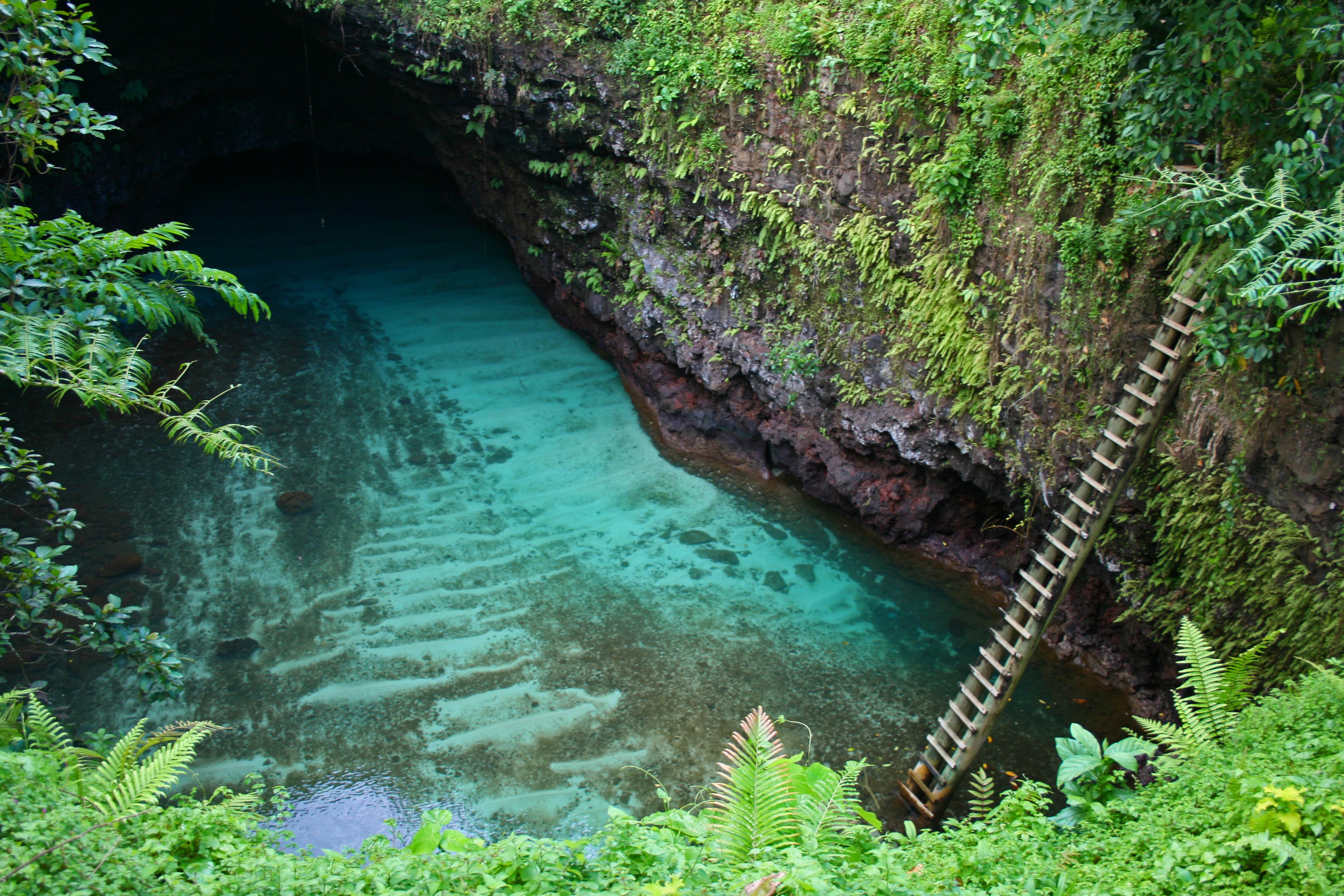
Anahulu Cave: On Tongatapu's eastern coast, this cave hides an underground freshwater lake. Swimming among the stalactites is permitted and it is a superb way to cool down after a long walk in the sun.
Mapu'a 'a Vaea: These coral blowholes fire seawater up to thirty metres out of the cliffs. The show is most impressive at high tide, when the swell smashes into the rock along a kilometre of coast.
Pangaimotu: You can do this island in a day, taking a motorboat straight from the capital's wharf. It is the popular spot for snorkelling around a wrecked ship and doing very little on a strip of white sand.
Ene'io Botanical Garden: In Vava'u this garden introduces visitors to endemic plants and traditional cooking methods. It is where to go if you want the culture and the natural history together rather than separately.
Prices
#Currency: The local money is the pa'anga, abbreviated TOP. Notes and coins are both in circulation, and the rate is pegged to a basket of neighbouring Pacific currencies rather than floating freely.
Exchange: Change cash at the banks in Nuku'alofa or at the airport on arrival. Street exchange counters barely exist, and the banks shut completely at weekends and on public holidays.
ATMs: You can withdraw in the capital and in Neiafu from ANZ and BSP machines. On outlying islands such as 'Eua or in Ha'apai there may be no machine at all, or it may simply be empty.
Cards: Card payment is thin on the ground and limited to larger hotels and pricier restaurants. Fees on foreign cards for payment or withdrawal frequently reach five percent, so bring US or New Zealand dollars in cash.
Tipping: Not part of the culture and never expected. Rounding up for a boat crew after a good whale trip is welcome but entirely optional.
| Item | Price (USD) |
|---|---|
| Lunch in a simple cafe | 10 |
| Restaurant dinner | 35 |
| Street snack | 4 |
| Dorm bed | 13 |
| Guesthouse per night | 45 |
| Beachfront bungalow | 95 |
| Taxi ride | 6 |
| Ferry to 'Eua | 12 |
| Flight to Vava'u | 190 |
| Whale swim tour | 250 |
| One dive | 100 |
| Bottle of beer | 4 |
| Cup of coffee | 3 |
| Local SIM card | 12 |
Getting around
#Getting there: Nuku'alofa is reached through Auckland, Nadi in Fiji, or Sydney. From Europe you fly via a Gulf or Asian hub into Auckland; from North America the usual path is Los Angeles to Auckland or Nadi, then the short hop across.
Domestic flights: Lulutai Airlines connects the main island groups, but delays and cancellations are routine. Always leave a couple of days' buffer before your international departure so a scrubbed flight does not cost you the whole trip.
Ferries: Large cargo and passenger vessels run between the islands for very little money. The capital to Vava'u can take a full day, but it is a genuine chance to spot whales straight off the deck.
Local buses: Small buses run around Nuku'alofa without any fixed timetable or marked stops. Wave one down from the roadside and call out when you want to get off.
Taxis: Fares within town are effectively fixed and pretty reasonable. Agree the price with the driver before you get in, since meters are almost never used.
Car hire: Renting on Tongatapu gives you freedom to reach the remote natural sites. To drive legally you need an International Driving Permit and a local permit issued by the police.
Bicycles: The flat coral atolls of Ha'apai are ideal for cycling and it costs almost nothing. Most guesthouses will rent you an old but perfectly serviceable town bike.
Where to stay
#Guesthouses: The most popular option for independent travel, where you effectively live on the same compound as the family. It saves money and it is how you learn everything worth knowing about island life.
Apartments: In the capital and Neiafu you can find places with a kitchen and a separate entrance. That suits anyone who wants to cook with produce bought fresh at the morning market.
Fale bungalows: Along the coast you find traditional thatched fale. At the budget end they offer basic facilities, a shared bathroom and a mosquito net that you will definitely use.
Booking: The big international platforms carry very little here, and many properties are found through social media instead. A direct message to the owner is usually the most reliable way to secure a room.
What to expect: Hot water and air conditioning are far from universal. Be ready for simple island living, no television, and wifi in the lobby that you may have to pay for.
Location: Choose the outer islands for quiet and the capital for anything resembling activity. In Nuku'alofa, stay within walking distance of the wharf where the ferries and tour boats leave.
What to eat
#The basics: The cuisine is built on root vegetables, coconut milk and whatever came off the boat that morning. Portions are generally enormous, since Tongans value food that genuinely fills you up.
'Umu: On Sundays food is cooked in an earth oven over hot volcanic stones. Meat, fish and vegetables are wrapped tightly in banana leaves and left for hours until everything falls apart.
Ota ika: The national dish is raw tuna marinated in lime juice and coconut cream. It is worth trying for the combination of soft texture and sharp tropical flavour alone.
Markets: Produce stalls sell bunches of bananas, huge papaya and pineapple for next to nothing. This is the cheapest way to eat well and avoid the marked-up restaurant menus in tourist areas.
Lu pulu: Tender beef with onion baked in taro leaves with coconut milk. It is heavy going but deeply aromatic, and it appears at every celebration meal.
Kava: Try the ceremonial infusion made from the root of a pepper plant, which has a mild relaxing effect. It tastes distinctly earthy and is drunk in dedicated men's clubs in the evenings.
Safety
#Overall: Crime in the kingdom is extremely low and you can walk around at any hour. Islanders are genuinely friendly, but keep the usual basic care over valuables in shared accommodation.
Natural hazards: Tonga sits in a seismically active zone, so pay attention to official tsunami alerts. Between November and April severe storms and tropical cyclones are possible.
The ocean: Currents around the reefs are treacherous for anyone not confident in open water. Wear proper reef shoes to avoid cuts from sharp coral and sea urchins.
Sun: The UV index here is extreme even under cloud. Use high-factor sunscreen without exception, cover up and wear a wide-brimmed hat.
Dogs: There are a lot of stray dogs and they sometimes gather in noisy packs. They rarely bother people, but on an empty street it is simplest to ignore them and walk around.
Health: Tap water quality is questionable, so drink bottled or boiled water only. Make sure your travel insurance covers emergencies properly, and check your own government's travel advisory before you go.
Etiquette and culture
#Sunday: This is an absolutely sacred day of rest, and commercial activity and noise are prohibited by law. Shops close, transport stops, and playing loud games in the street can genuinely earn you a fine.
Dress: Away from hotel beaches, cover shoulders and knees, and this applies to women in particular. Looking modest and tidy avoids misunderstandings in villages and earns real goodwill.
Church: Attending a Sunday service is the best way to hear Tongan choral singing, which is extraordinary. Dress formally, remove any hat before entering and stay quiet through the sermon.
Etiquette: Never step over someone sitting on the floor or ground, which is taken as a mark of disrespect. Do not touch anyone's head either, as it is considered the sacred part of the body.
Gifts: If you are invited to a home, bring some food or a kava root as thanks. Tongans are enormously hospitable and value the gesture far above whatever the item cost.
Manner: Shouting and open aggression read as poor upbringing and weakness here. Stay polite and calm, smile often, and almost any problem resolves itself faster.
Connectivity
#Operators: Digicel dominates the market and the easiest place to buy a SIM is the arrivals hall. Registration needs nothing more than your passport and a small amount of cash.
Coverage: 4G is stable only within Nuku'alofa and Neiafu. On the outer islands or at sea the signal disappears entirely for long stretches, which matters if you rely on your phone for navigation.
Wifi: Networks in cheaper hotels are often paid and painfully slow. Tonga is genuinely one of the better places on earth for a full digital detox, so plan for that rather than fighting it.
eSIM: If your phone supports it, an eSIM data package saves you hunting for a shop, which is impossible at weekends anyway. It costs more than a local SIM but works from arrival.
Language: Tongan and English are both official and almost everyone speaks English fluently. Signs and menus are in English, and the education system means you can hold a conversation with anyone in the street.
Social media: Facebook is the main platform for information and for reaching small businesses. Boat tours, ferry schedules and guesthouse bookings all happen through it.
Phrasebook
#| English | Tongan | Pronunciation |
|---|---|---|
| Hello | Mālō e lelei | MAH-loh eh leh-LAY |
| Thanks | Mālō | MAH-loh |
| Delicious! | 'Ifo! | EE-fo |
| Thank you very much | Mālō 'aupito | MAH-loh ow-PEE-to |
| Yes | 'Io | EE-o |
| No | 'Ikai | ee-KAI |
| Please | Kātaki | kah-TAH-kee |
| Sorry, excuse me | Fakamolemole | fa-ka-mo-le-MO-le |
| How much is it? | 'Oku fiha? | OH-koo FEE-ha |
| Where is...? | Ko fē...? | ko FEH |
| Mate, friend (slang) | Tokoua | to-ko-OO-a |
| All good | Sai pē | sigh PEH |
| Beautiful | Faka'ofo'ofa | fa-ka-o-fo-O-fa |
| Goodbye | Nofo ā | NO-fo AH |
| Water | Vai | vye |
| Food | Kai | kye |
| Help | Tokoni | to-KO-nee |
| Whale | Tofua'a | to-foo-AH-a |
| Ocean | Moana | mo-AH-na |
| Family | Fāmili | FAH-mee-lee |
| Foreigner, westerner | Pālangi | pah-LANG-ee |
Good to know
#Consular help: Very few countries keep a mission in Tonga, and most cover the kingdom from Wellington, Canberra or Suva. Find out which applies to your passport and save the contact details offline before you fly.
Electricity: Tonga uses Australian-style sockets with three angled flat pins. Buy a universal adapter before you travel, since local shops rarely stock them.
Water: Do not drink straight from the tap, to avoid stomach infections. Keep a supply of bottled water with you and use boiled water in rural guesthouses.
Time zone: Tonga sits at GMT+13 and is among the first places on earth to see each new day. Work out the offset from home before you start scheduling calls, because it is easy to get a day out.
Souvenirs: Carved bone, woven mats and local vanilla all travel well. Buying at the market from the maker is both cheaper and more interesting than the shops.
Packing: Natural cotton clothing works best, but bring a windproof layer for boat trips, which get cold. Insect repellent is not optional, as the mosquitoes here are relentless.
Frequently asked questions
#Most nationalities receive a free entry stamp on arrival for up to 31 days. You need a passport valid for six months, an onward ticket and often proof of accommodation, so check your own passport's rules before flying.
Cards work only in the larger hotels and better restaurants, with fees around five percent. ATMs exist in Nuku'alofa and Neiafu but not on the smaller islands, so carry cash.
The humpback season runs strictly from July to October. August and September are the sweet spot, when the sheltered bays of Vava'u and Ha'apai hold the most mothers and calves.
No. The country stops completely: shops, markets and cafes close by law and public transport does not run. Buy food in advance and schedule any travel for Saturday or Monday.
It is one of the calmest and safest places in the Pacific, with very little crime. Solo visitors are comfortable here thanks to genuine friendliness and a traditional respect for guests.
Taxis wait outside the terminal and are the simplest option. The run into town takes about thirty minutes, and you should agree the fare before getting in.
That is the dry winter season, with comfortable temperatures around 25C. It is the ideal window to visit, with none of the draining heat or long tropical downpours of the wet months.
There are no mandatory vaccination requirements for entry. Doctors still recommend keeping hepatitis and typhoid cover up to date and carrying a basic medical kit with your usual medicines.
Yes, but with restrictions. Registration is mandatory for a drone of any weight. The drone and operator must be registered before arrival, and customs inspects the gear. Rules for other countries are in the drone ranking by country.
Updated
The data on this page goes out of date. Visa rules and permitted stays, border requirements, prices and budgets, transport and local conditions all change fast, and we do not re-check every page every day. We show the date of our last check where we have one, but before you travel, verify with official sources: the country’s consulate, its immigration service, its e-visa portal and your carrier.