Description
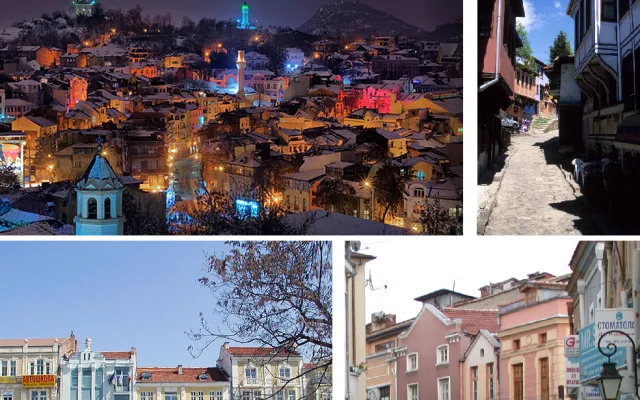
Bulgaria's second-largest city and one of the oldest in the world, with a Roman theatre, the bohemian Kapana quarter, and a colourful Old Town.
Wiki
Bulgaria's second-largest city and one of the oldest continuously inhabited cities in Europe — over 8,000 years old, predating Rome, Athens and Constantinople — with a population of around 350,000. Former European Capital of Culture 2019. Built across seven hills (like Rome), the city layers Thracian, Roman, Byzantine, Ottoman and Bulgarian history. It surpasses Sofia in architectural heritage and punches above its weight on gastronomy and wine.
Main sights
- Old Town (Stariyat Plovdiv) — the main architectural quarter on Nebet Tepe hill, lined with Bulgarian National Revival houses from the 19th century, art galleries and cafés.
- Roman Theatre (Theatre of Philippopolis) — 2nd century AD, one of the best-preserved in the world, still used for concerts and performances. A 30-minute walk up from the centre.
- Roman Stadium — the largest in Bulgaria (240 × 50 m), partially uncovered beneath the main pedestrian street.
- Kapana ("The Trap") — a restored craftsmen's quarter filled with bars, galleries and coffee shops. The city's main nightlife hub.
- Glavnata — the 1.5 km pedestrian main street, the spine of the city.
- Dzhumaya Mosque — 15th century, one of the oldest Ottoman mosques in the Balkans.
- Ethnographic Museum — housed in the Kuyumdzhioglu mansion (1847), a classic of the Bulgarian National Revival style.
- Balabanov House — another period mansion, now an exhibition centre.
- Stone Bridge (Maritsa River) — the main bridge and riverside promenade.
- Bachkovo Monastery — Bulgaria's second most important monastery (after Rila), 30 km away. Founded in 1083, with frescoes from the 14th–17th centuries.
- Asenovgrad and Asen's Fortress — one of Bulgaria's oldest fortresses, 25 km away, with Thracian, Byzantine and Bulgarian layers.
- Rose Valley (Rozova Dolina) and Kazanlak — Bulgaria's main rose-growing and rose-oil region, about an hour away (Rose Festival in June).
Food and prices
The cuisine is Bulgarian: shopska salad, banitsa, kavarma, moussaka, roast lamb, rakia, mastika. Plovdiv's wine lists rank among the best in the Balkans. Lunch at a mehana (tavern) costs 7–12 BGN (about $4–7); dinner at a restaurant 18–35 BGN ($10–20). A glass of Mavrud — the principal local grape variety — runs 3–5 BGN ($2–3). A litre of petrol is around 1.4 BGN ($0.83), a city taxi ride 3–7 BGN ($2–4), and a single public-transport fare 0.5 BGN ($0.30). Prices are as of 2026.
Getting there and around
Plovdiv Airport (PDV) is small with limited scheduled services. Sofia Airport (SOF), 150 km away, is often the more practical gateway — trains to Plovdiv take 2–3 hours (10–18 BGN / $6–10) and buses around 3 hours (12–20 BGN / $7–12). The city centre is compact and very walkable; taxis cover everything else.
When to go
April to October brings temperatures of 12–28 °C. May–June and September–October are the sweet spot. The Wine and Spirits Festival takes place in Plovdiv in November; the Festival of the Roses in Kazanlak is in June. Winters are cold (−5 to +5 °C), with occasional snow, though Kapana stays open year-round.