Города и дороги
Description
The capital of North Ossetia on the Terek, where the Georgian Military Road begins: a merchant centre with a 1904 tramway, the mosque above the river, and the crypts of Dargavs in the gorges nearby.
Wiki
Vladikavkaz stands on the Terek at the point where the mountains give way to the plain, and about three hundred thousand people live here. The fortress was founded in 1784 to hold the entrance to the Darial Gorge, and the Georgian Military Road was later run south from it — the only all-season route across the Greater Caucasus range. Hence the name: the city commands the Caucasus in the sense of controlling the pass. It became the capital of North Ossetia in the twentieth century, but its merchant character had taken shape earlier, and the centre still consists of two-storey houses from the end of the nineteenth century. In clear weather Table Mountain is visible from the main avenue — a flat three-thousand-metre summit that already stands on the Ingush side and serves the city as a natural backdrop.
Why come and what to actually see
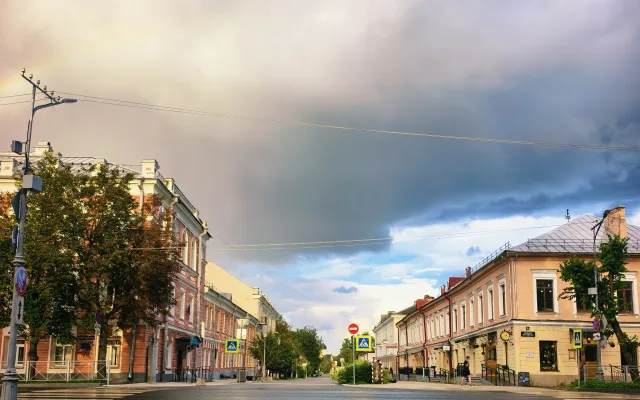
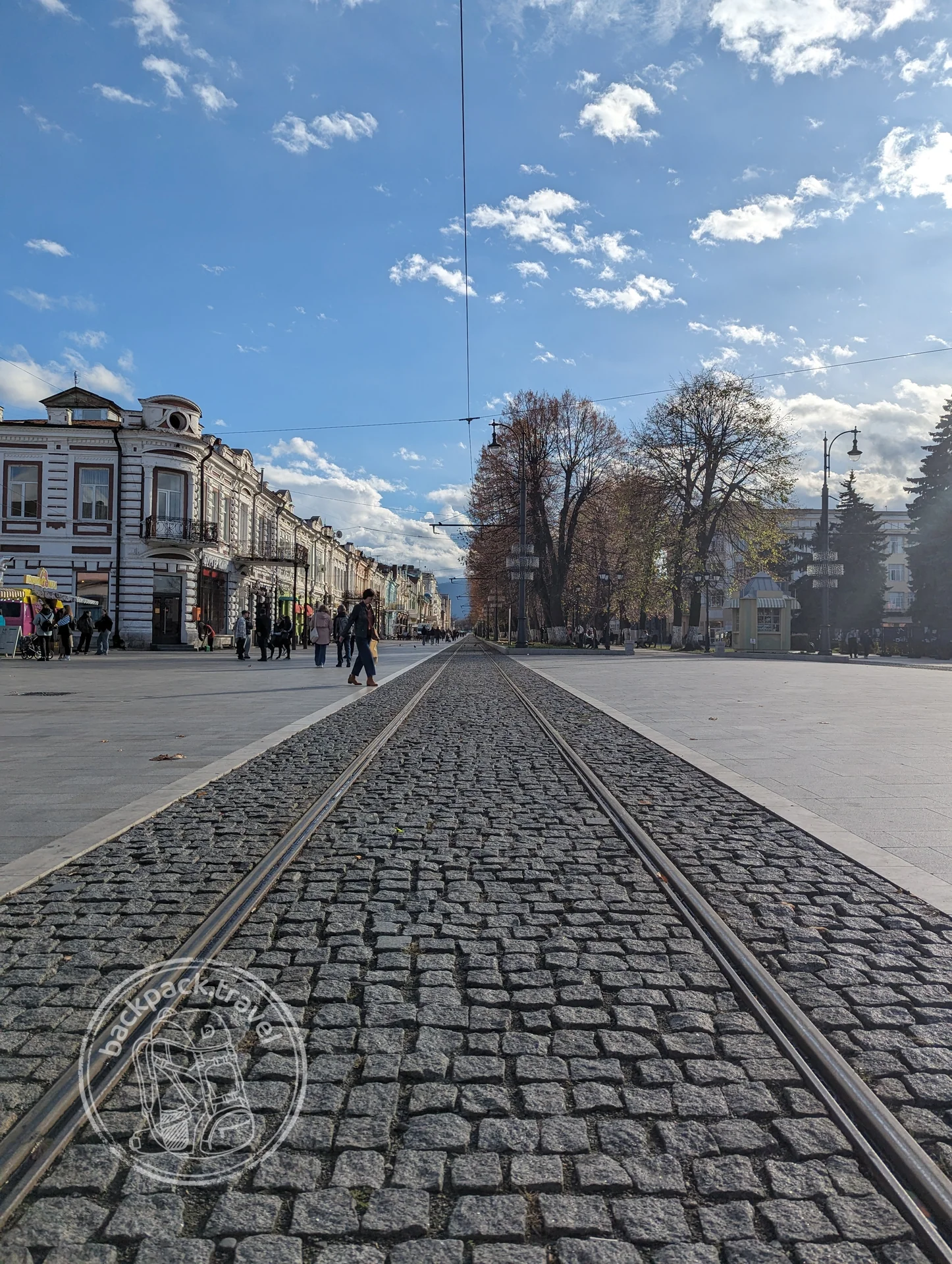
Prospekt Mira is a pedestrian street about a kilometre long, along which a tram nonetheless runs. The Vladikavkaz tramway opened in 1904 and remains one of the oldest systems in the country; a tramcar moving down the boulevard between the lime trees and the merchant houses is the city's most recognisable image.
The Sunni mosque on the left bank of the Terek was built between 1900 and 1908 with money from the oil magnate Murtuza Mukhtarov and follows Egyptian models: two minarets, striped masonry, blue-and-white decoration. It stands directly above the water, and the walk to it along the embankment is the best in town.
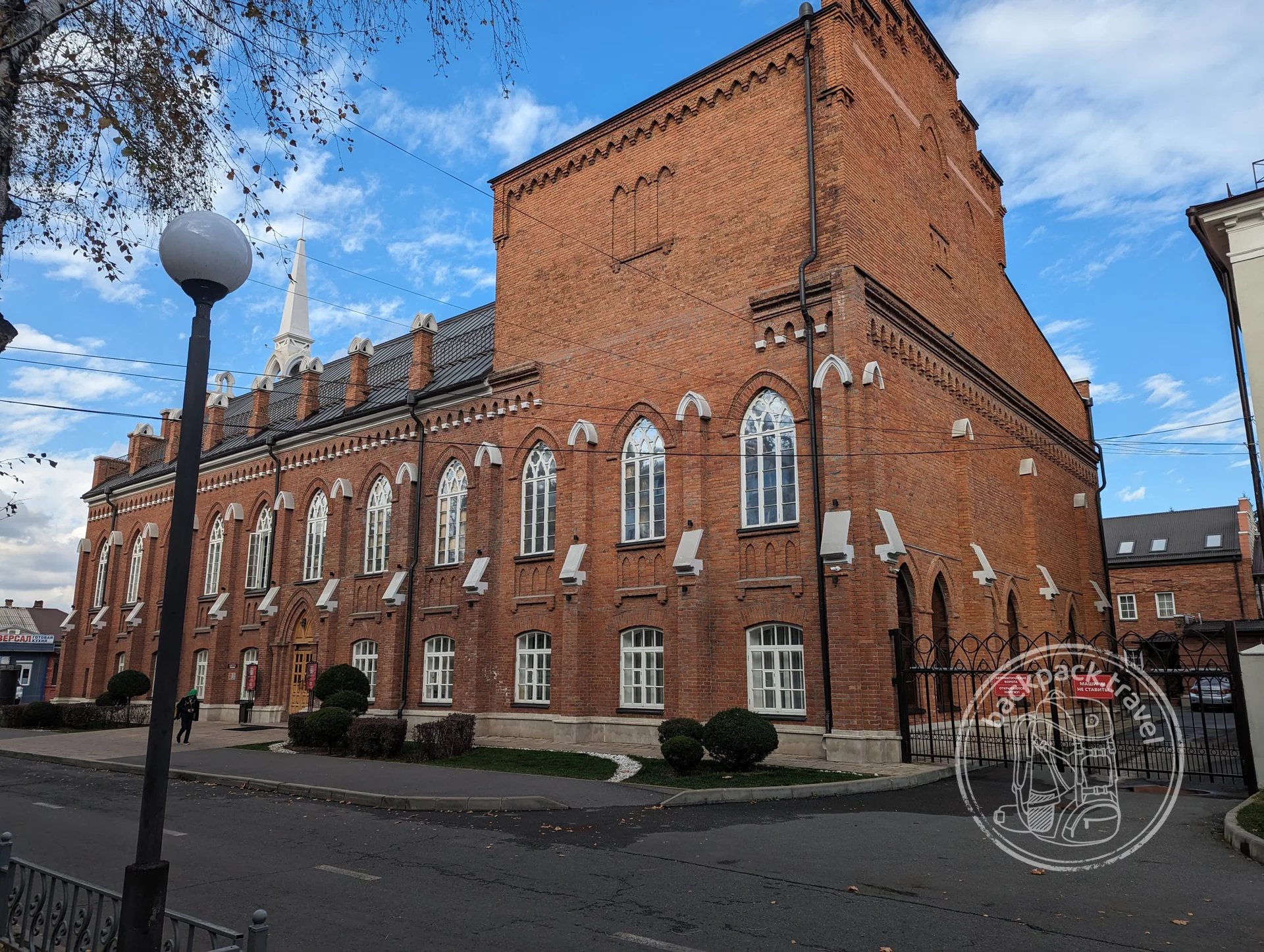
The Ossetian Church of the Nativity of the Virgin, from 1815, is the oldest building in Vladikavkaz. On the terrace beside it lies the old cemetery, where Kosta Khetagurov, the founder of Ossetian literature, is buried. Nearby stand the Armenian church of Gregory the Illuminator, built in 1868, and the Lutheran church, with the new St George's Cathedral rising above them all.
The republic's national museum gives a coherent account of the Alans, Scythian gold and highland traditions; it is worth going through before heading out to the gorges, since it makes sense of them. The Terek embankment is a destination in itself — the city is stretched out along it.
Getting there and getting around
Beslan airport lies 25 kilometres to the north and has regular flights to Moscow and St Petersburg. Marshrutkas and taxis run from the airport into the city, half an hour on the road.
Trains from Moscow take about a day and a half, and there are services to Rostov and Mineralnye Vody. Buses connect Vladikavkaz with the whole of the North Caucasus, and the Georgian border at Verkhny Lars is around 25 kilometres away along the Georgian Military Road.
Trams, trolleybuses and marshrutkas cover the city, and the centre is walkable. The gorges are another matter: scheduled transport into the mountains is sparse, and putting a route together without your own or a rented car is close to impossible.
Where to stay
The hotels are concentrated in the centre, around Prospekt Mira and the embankment, and that is the right choice: restaurants, museums and the tram are all at hand. Standards are mostly mid-range, and prices are well below the spa towns of the Caucasian Mineral Waters.
The alternative is a guesthouse in the mountains, at Fiagdon or Verkhny Zgid, an hour to an hour and a half away. It is colder and quieter up there, and worth it if you came for the gorges and want to start at first light.
Day trips
Dargavs, 40 kilometres out, is the "city of the dead" — a hillside with nearly a hundred stone crypts of the fourteenth to eighteenth centuries. Whole families were buried in them, and it is the largest necropolis of its kind in the Caucasus. The road there climbs over a pass in switchbacks.
The Kurtatinsky Gorge offers several stops at once: the rock fortress of Dzivgis, built straight into the cliff, the Alanian monastery on a terrace above the river, and the village of Fiagdon. It adds up to a full day.
The Tsey Gorge, 70 kilometres away, is known for its glacier, a cable car and the Rekom sanctuary. The Karmadon Gorge is closer; in 2002 the collapsing Kolka glacier destroyed a settlement here and killed more than a hundred people, including Sergei Bodrov's film crew, and a memorial by the road recalls it.
When to come
May to October is the main season. May and June bring green mountains and full rivers; September and October are dry and clear, with the best visibility of the year, which matters for views of the range.
Summer in the city is warm, around twenty-eight degrees, but close and heavy before the thunderstorms that come regularly; the gorges are a few degrees cooler. Winter in Vladikavkaz is mild, around freezing, and snow does not lie long, but mountain roads can close, and the Georgian Military Road is shut when there is avalanche danger.
One thing to factor in separately: fog is common in the mountains in May and early summer, and half the viewpoints simply disappear.
Food and money
Ossetian pies here are not tourist food but part of daily life: three are set on the table in a stack and cut crosswise. The fillings vary — cheese, potato with cheese, beet greens, meat — and fydjyn, the meat one, counts as festive.
The pies come with brined Ossetian cheese and dzykka, a thick mixture of sour cream and flour. The local drink is araka, a strong spirit distilled from maize or barley, along with beer, which Ossetia has been brewing for a long time.
Payment is in roubles, Russian bank cards are accepted everywhere and foreign ones do not work. In the mountains you need cash.
What to know
Vladikavkaz is valuable above all as a base: the city itself takes a day, and everything else lies in the gorges, which have to be driven to. Budget for a car and for the switchbacks when planning — the 40 kilometres to Dargavs take an hour and a half.
Some areas near the border fall inside the frontier zone, and visiting them requires a permit arranged in advance. Check any route along the border before setting out.
The region is mountainous and seismically active, and mudflows and rockfalls after heavy rain are routine; check local forecasts and road conditions before you leave. The Georgian Military Road functions as an international crossing, and queues at Verkhny Lars can run to several hours.
Updated